

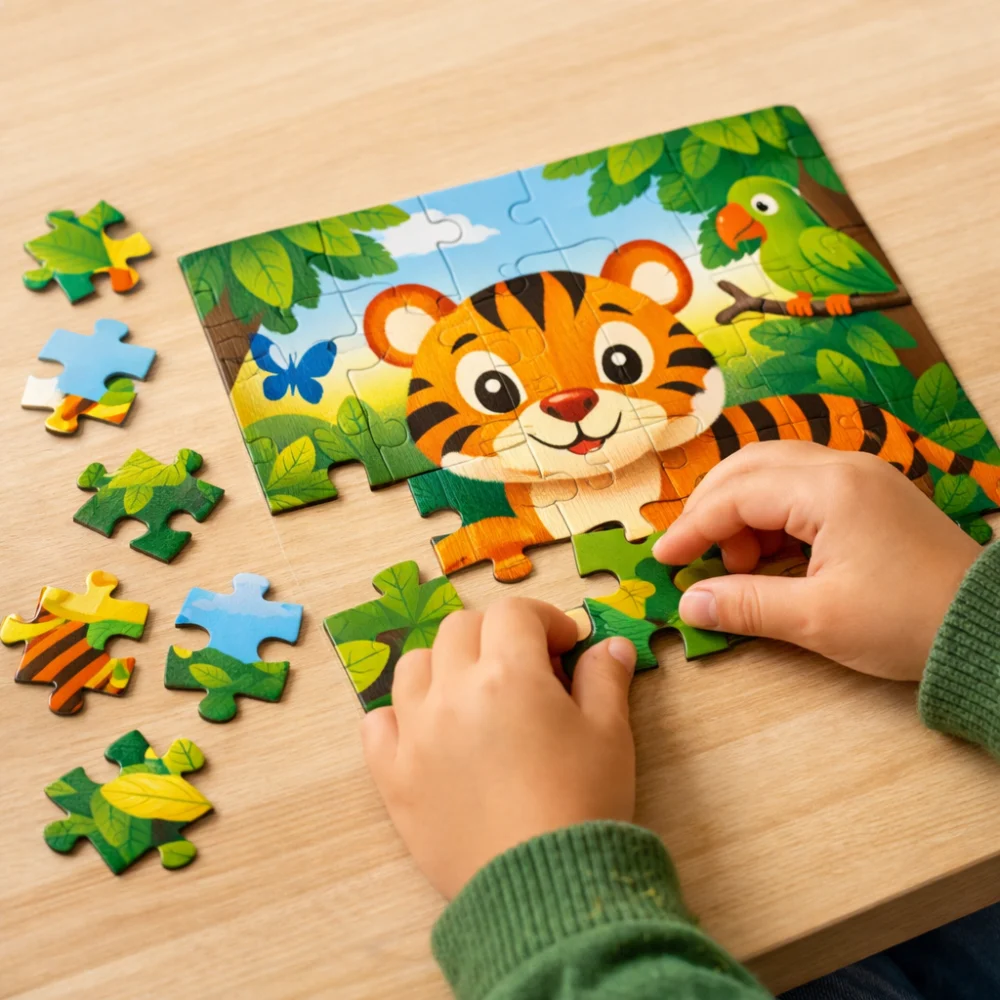
Jigsaws for children range from simple puzzles with a small number of pieces to more involved pictures that may take longer to complete. The right choice depends on the child’s experience, the setting and whether the puzzle is intended for a short activity or a longer challenge.
Piece count is a useful starting point, but it does not tell the whole story. Picture detail, piece size and the puzzle’s overall format can all affect how approachable it feels.
What should you look for in a jigsaw for a child?
Start with the child’s age guidance and experience, then consider the piece count, size and picture. A familiar, clearly defined image may be easier to approach than one with large areas of similar colour. Check whether the puzzle is a single activity or part of a set, and whether its format suits the space where it will be used.
Compare the main buying factors
| Feature | What it means | Why it matters | What to check |
|---|---|---|---|
| Piece count | The number of pieces in the puzzle. | It can help indicate the scale of the task, but is not a complete measure of difficulty. | Compare the count with the child’s experience and consider the image and piece size too. |
| Piece size | How large or small the individual pieces are. | Pieces that are comfortable for the intended child to handle may make sorting and placement easier. | Look for stated piece dimensions or clear product images if handling size is important. |
| Picture and detail | The subject, colours and amount of visual detail in the finished image. | Distinct shapes and colours can give useful visual clues; repetitive areas may be more challenging. | Check the complete picture and consider whether its subject will hold the child’s interest. |
| Format | The puzzle’s overall presentation, such as a standard board, a larger floor format or a set of puzzles. | Format affects where the activity can be completed and how much space it may need. | Check the finished size, what is included and whether the available surface suits it. |
| Age guidance | The suitability information provided for the particular puzzle. | It helps buyers assess whether the product is intended for the recipient. | Read the product’s age guidance and any relevant small-piece warnings. |
Specifications vary by model, so always check the individual product page before buying.
How to choose the right level of challenge
Use piece count as a starting point
A lower piece count may be a sensible place to start for a child who is new to jigsaws or prefers shorter activities. A higher count can offer a more involved task for a child who already enjoys fitting pieces together. These are broad comparisons: picture complexity and the size and shape of pieces can change how challenging a puzzle feels.
Consider the picture
Look beyond the subject name to the full image. Clearly different colours, objects and outlines can provide more visual clues, while broad areas that look alike may require closer inspection. If a child has a strong interest in a particular theme, that may help make the activity appealing, but the image still needs to suit their preferred level of challenge.
Check piece size and finished size
Piece size affects how easy the pieces may be to pick up and handle, while the finished puzzle size affects where it can be assembled. If either is important, check the stated measurements rather than relying on a product photo, which may not show scale clearly.
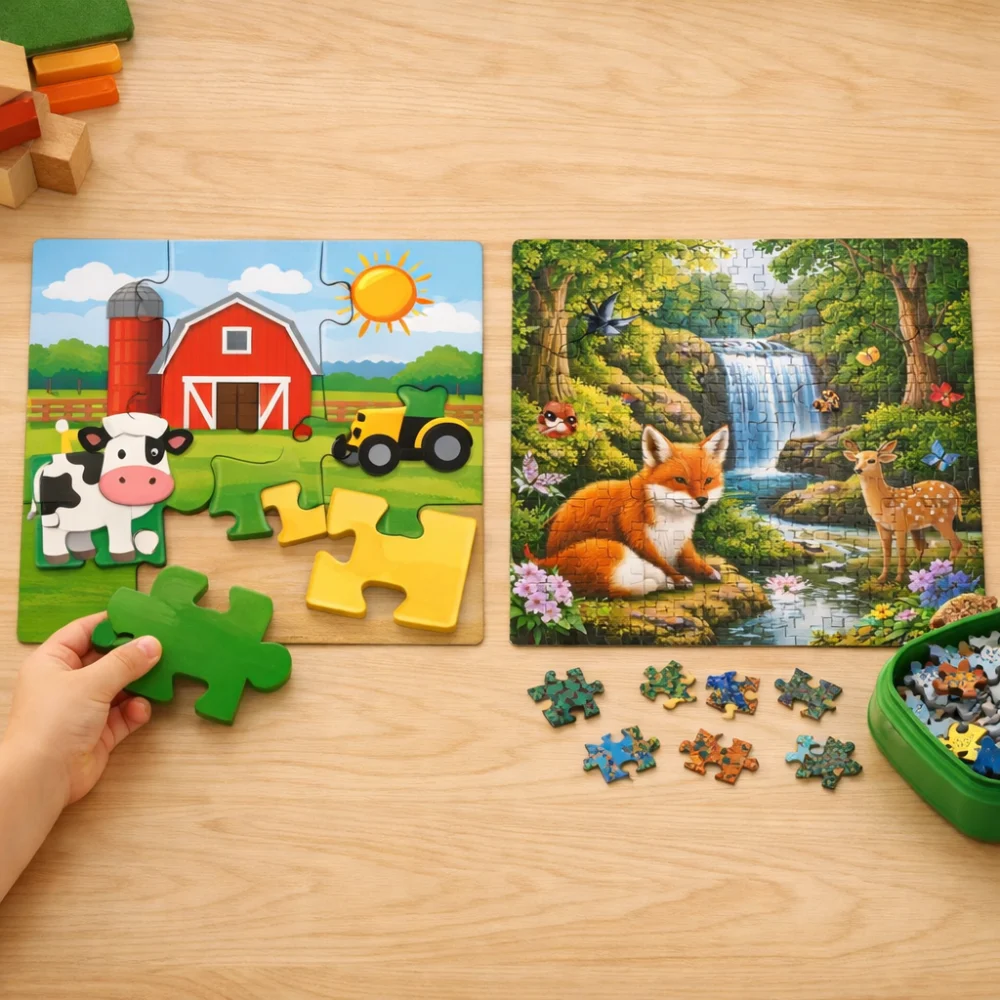
Types and formats
- Single jigsaws: A straightforward choice when the aim is one picture and one defined activity. Check the piece count and finished size for that individual puzzle.
- Multi-puzzle sets: These can offer different pictures or challenges in one set. Check how many puzzles are included and whether each has its own piece count and age guidance.
- Wooden puzzles: Some children’s jigsaws use wooden pieces. Check the product details for construction information, piece size and care guidance rather than assuming all wooden puzzles are alike.
- Large-format or floor puzzles: A larger finished format may suit a spacious play area, but it can need more room to assemble and leave in place. Check its completed dimensions.
Match the puzzle to the child and setting
| Need | What to prioritise | Trade-off to consider |
|---|---|---|
| A first jigsaw | Manageable piece count, easy-to-read picture and pieces that suit the child’s handling ability. | A very simple puzzle may be completed quickly if the child already has experience. |
| A child who enjoys a longer challenge | More pieces or a picture with greater visual variety, in line with their existing experience. | A larger challenge can take more time and may be less suited to a short activity. |
| Several activities in one gift | A set with clearly described puzzle contents and individual piece counts. | Check whether the puzzles offer a useful range of challenges rather than assuming every one is equally suitable. |
| Limited assembly space | A smaller stated finished size and a format that can be completed on the available surface. | A compact puzzle may have smaller pieces, so check both dimensions and handling suitability. |
Common buying mistakes
- Choosing by piece count alone: Treat it as one clue. Also assess the picture, piece size and finished dimensions.
- Assuming an age label guarantees a good fit: Use the product’s guidance, then consider the particular child’s experience and ability to handle the pieces.
- Overlooking the completed size: A puzzle may need more table or floor space than expected. Check its stated dimensions before choosing.
- Assuming a set has one shared challenge level: Multi-puzzle sets may contain puzzles with different counts or content. Review the details for each one.
- Relying on the product image for scale: Images can make pieces look larger or smaller than they are. Look for stated measurements if size matters.
Safety and suitability
Check the manufacturer’s age guidance and any warnings, particularly if the intended child may put small objects in their mouth or will be sharing the puzzle with younger children. Consider whether the pieces are suitable for the child to handle and whether the activity is appropriate for their current abilities. Do not assume that all products in the category have the same piece size or suitability guidance.
Care and storage
Keeping a puzzle together between sessions can make it easier to return to, especially if it contains many small pieces. Check whether the product comes with a box or other storage provision, and follow any care guidance supplied for its materials. For a set, make sure the separate puzzles can be kept organised so pieces are not mixed.
A simple buying process
- Decide who the puzzle is for and whether they are new to jigsaws or already enjoy them.
- Choose a suitable starting challenge by considering piece count alongside picture detail and piece size.
- Pick a format that fits the available space and the intended activity.
- For a set, check what each puzzle includes and whether the challenges suit the recipient.
- Review the individual product information, dimensions, age guidance and warnings before deciding.
Buyer checklist
- Does the age guidance suit the intended child?
- Is the piece count appropriate when considered alongside the picture and the child’s experience?
- Are the piece size and finished dimensions suitable for the child and available space?
- If it is a set, have you checked the details for each puzzle?
- Have you read the product’s warnings and care information?
Frequently asked questions
Does a higher piece count always mean a harder puzzle?
No. Piece count is only one factor. Picture detail, colour variation, piece size and the child’s familiarity with jigsaws can also affect the challenge.
What should I check when buying a jigsaw as a gift?
Check the age guidance, piece count, image and finished dimensions. If you do not know the child’s experience, a clear picture and a manageable challenge may be a more flexible starting point than choosing by a large piece count alone.
Are multi-puzzle sets suitable for beginners?
They can be, but the contents vary. Review the piece count and image for each puzzle in the set, and check that the guidance suits the intended child.
How can I tell whether a puzzle will fit on a table?
Look for the stated finished dimensions and compare them with the usable surface. Allow for some extra room around the completed image if pieces will be sorted nearby.
What does age guidance tell me?
It is product-specific suitability information to consider alongside the child’s experience and ability to handle the pieces. Read any accompanying warnings rather than relying on the age guidance alone.
What should I check for a wooden jigsaw?
Check the individual product details for piece size, dimensions and any care guidance. The material alone does not tell you how large or easy to handle the pieces will be.


