

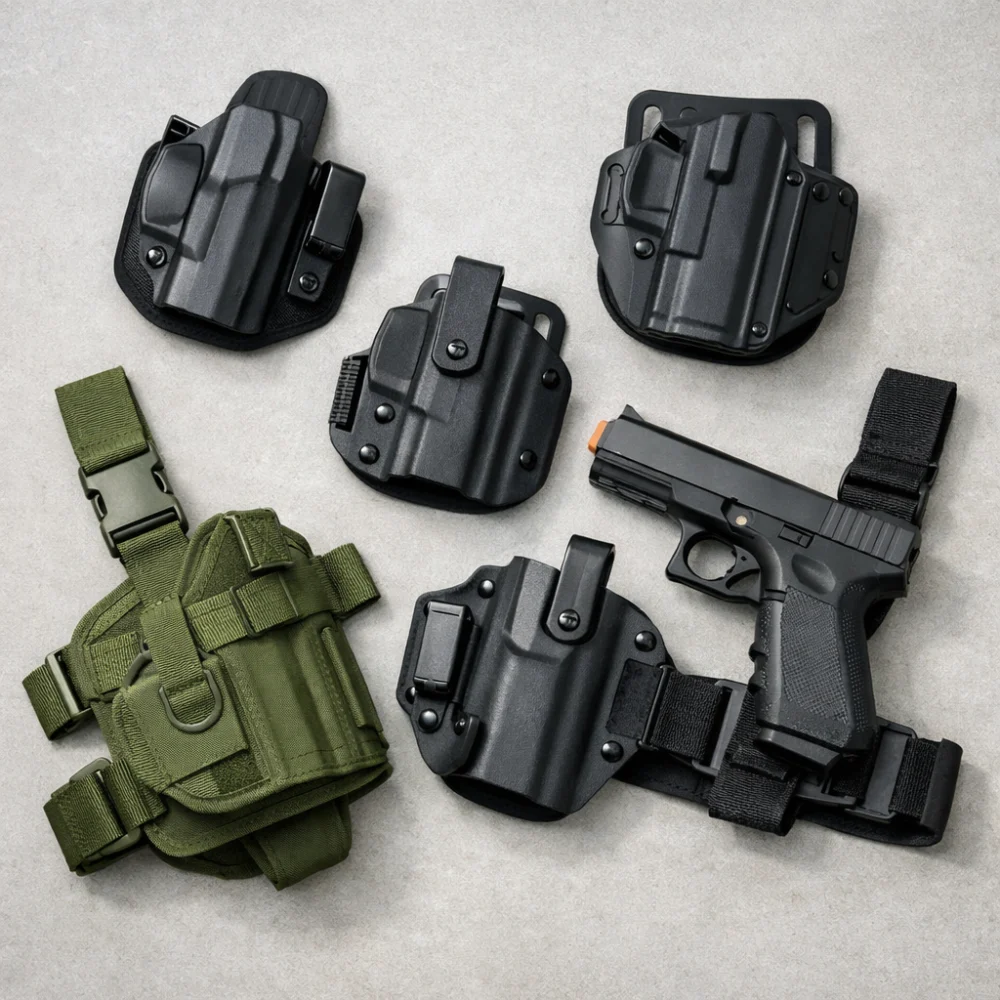

Choosing an airsoft holster is mostly about fit, carry position and how quickly you want to draw and re-holster your pistol. The right choice depends on your sidearm, your clothing or rig setup, and whether you want everyday field use, a more secure carry position or a more accessible draw.
Because holster design varies widely, it helps to compare the practical details rather than relying on the name alone. A holster that looks suitable in a title may still differ in hand orientation, mounting method, coverage and adjustability.
This guide focuses on the buying choices that matter before you place an order, so you can narrow the options with less guesswork.
Compare Airsoft Holsters



As an Amazon Associate we earn from qualifying purchases.
What should you look for in an airsoft holster?
Start with compatibility, then think about how you want to carry the pistol during play. The most useful holster is the one that fits your airsoft sidearm securely, suits your dominant hand and can be mounted where you can reach it comfortably. Retention, comfort and access usually move in opposite directions, so the main job is finding the balance that matches your use.
Specifications vary by model, so always check the individual product page before buying.
| Feature | What It Means | Why It Matters | What To Check |
|---|---|---|---|
| Fit and compatibility | Whether the holster is shaped for your pistol or intended as a universal design | A poor fit can make the holster awkward to use or unsuitable for your sidearm | Pistol model compatibility, adjustable retention and any stated size range |
| Carry position | Where the holster sits on the body or kit | Affects comfort, draw speed and how well it works with other equipment | Waist, thigh, shoulder or platform mounting |
| Hand orientation | Whether it is designed for right- or left-handed use | Wrong-hand holsters are inconvenient and may not work naturally in use | Dominant hand and whether the holster can be swapped or adjusted |
| Retention | How firmly the pistol is held in place | More retention can improve security, but may slow the draw | Retention strap, locking method or tension adjustment |
| Mounting system | The way the holster attaches to a belt, rig or leg platform | It affects stability, comfort and how easily you can move between setups | Belt loop, paddle, platform, MOLLE or drop-leg style |
| Coverage and access | How much of the pistol is enclosed and how quickly you can get a grip | More coverage can feel secure, while faster access may be more exposed | Trigger guard coverage, thumb release and re-holstering ease |
Key decision criteria
Compatibility with your pistol
The first question is whether the holster is made for your specific pistol or designed to fit a range of similar models. Model-specific holsters often give a neater fit, while universal options may offer more flexibility. The trade-off is that a more flexible design can be less precise, so the product page should be checked carefully for the exact pistol or platform it supports.
Carry position and comfort
Holsters are commonly chosen for where they sit on the body or kit, because that affects movement and comfort across a whole session. A waist-mounted option can keep the pistol close to the body, while a thigh or drop-leg style may feel easier to reach for some users. The better choice depends on your loadout, how much you move and whether you already carry other gear around the waist.
Retention and draw feel
Retention is the balance between keeping the pistol secure and being able to draw it smoothly. Some buyers want a simple, open holster for faster access, while others prefer more holding power for confidence during movement. If you are comparing options, look for the retention method rather than assuming all holsters secure the pistol in the same way.
Mounting and kit compatibility
The attachment system matters because it determines how the holster sits with your belt, vest or other clothing. A belt holster may suit simple carry, while a platform or MOLLE-compatible design can work better with tactical kit. Think about what you already wear most often, because changing the holster mount may change the rest of your setup too.
Common holster types and variants
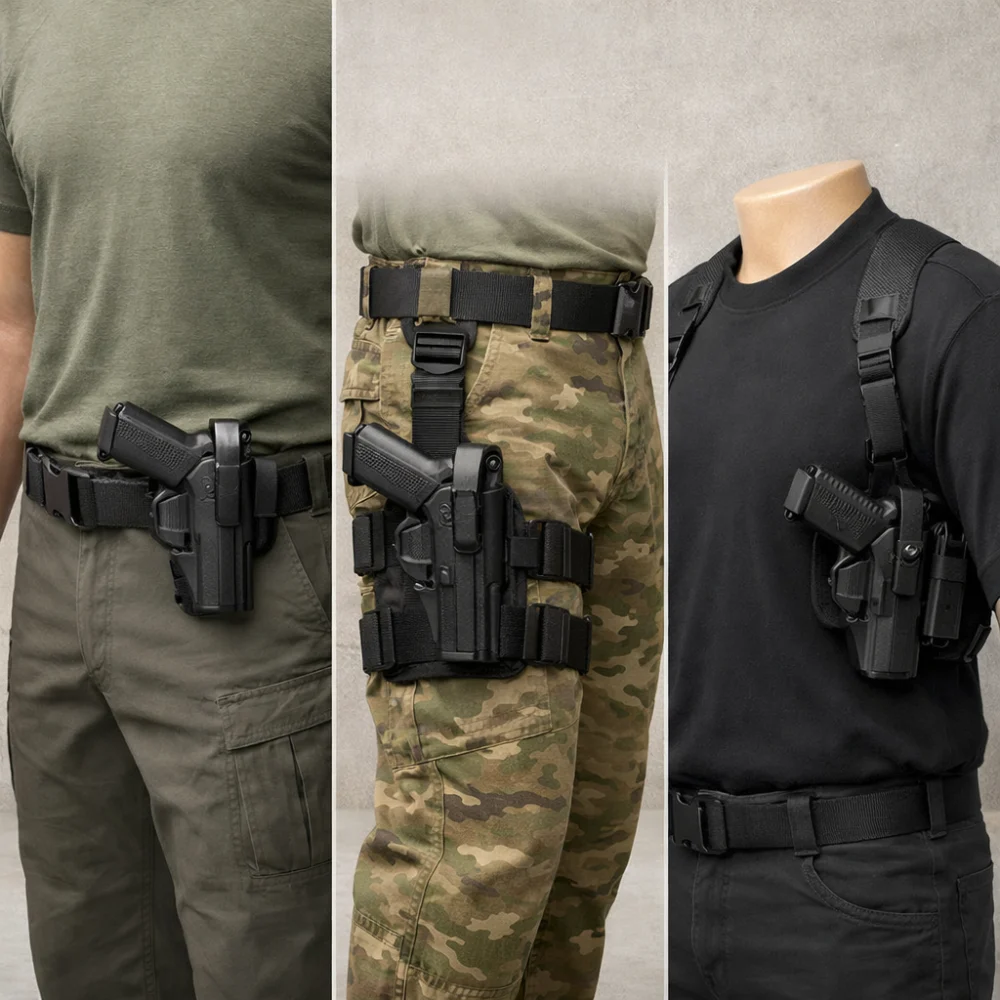
Airsoft holsters are usually best understood by carry style rather than by one single standard design.
- Waist holsters sit on the belt area and are often chosen for a straightforward, compact carry.
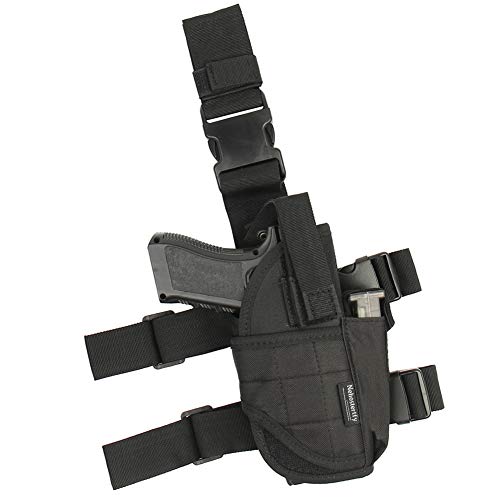
- Thigh or drop-leg holsters place the pistol lower down and may suit users who want an easier side draw with other kit around the waist.
- Shoulder holsters spread the carry across the upper body and can suit some loadouts, though they are less common for all-day use.
- Universal holsters aim to fit more than one pistol style, which can be helpful if you change sidearm, but fit may be less exact.
The main limitation with any variant is that it is a compromise between access, comfort and fit. What feels ideal in one loadout may be awkward in another, so it helps to match the carry style to how you actually play.
Which holster suits which buyer?
| Buyer need | What to prioritise | What to avoid |
|---|---|---|
| Beginners | Straightforward fit, simple mounting and clear compatibility information | Overly complex adjustment or unclear model matching |
| Players who change loadouts often | Adjustability and mounting systems that work with more than one setup | Overly specific designs that only suit one arrangement |
| Users who want quicker access | Easy draw, sensible hand orientation and a position that does not clash with other kit | Bulky placement or retention that feels unnecessarily restrictive |
| Users who value security and stability | Firm retention, stable mounting and a design that stays put during movement | Loose carry or mounting that may shift on the body |
| Gift buyers | Clear compatibility notes and a holster style that is likely to suit the recipient’s kit | Assuming a universal fit without checking the pistol and carry preference |
Common mistakes to avoid
- Buying by appearance alone: a tactical look does not tell you whether the holster fits your pistol or suits your carry style.
- Ignoring hand orientation: a right-handed and left-handed holster are not interchangeable in practice.
- Overlooking the rest of your kit: a holster can be technically suitable but still clash with a vest, pouch layout or belt setup.
- Assuming universal means exact: universal designs can be useful, but they may not feel as precise as a model-specific option.
- Focusing only on retention: more hold is not automatically better if the draw becomes awkward for your use.
Safety and suitability caveats
An airsoft holster should be treated as a fit-and-use decision rather than a guarantee of convenience in every situation. Check that it suits your specific sidearm, dominant hand and intended carry position before buying. If you use the holster with other equipment, make sure the mounting method works with that kit rather than assuming it will sit well by default.
Maintenance, storage and long-term use
Holsters usually need little maintenance, but they do benefit from basic care and sensible storage. Keep them clean, dry and free from debris that could affect fit or movement, and store them so straps, mounts or retention parts are not bent out of shape. If the holster uses adjustable parts, it is worth checking them occasionally so the carry feel stays consistent.
How to compare options efficiently
- Confirm the pistol model or holster type you actually need.
- Decide where you want to carry it and how it must work with your other kit.
- Compare retention, mount style and hand orientation before looking at appearance.
- Check the product page for the exact compatibility notes and any adjustment details.
- Choose the option that gives the best balance of access, stability and fit for your setup.
Summary buyer decision checklist
- Does the holster suit your airsoft pistol or intended pistol style?
- Is it for your left or right hand?
- Does the carry position match your loadout and movement style?
- Is the retention level appropriate for your preferences?
- Will the mount work with your belt, rig or clothing?
- Have you checked the individual product page for the exact compatibility details?
Frequently asked questions
Are airsoft holsters universal?
Some are designed to fit a wider range of pistols, but that does not mean every pistol will sit equally well. Universal holsters can be useful when flexibility matters, yet a model-specific holster may give a cleaner fit.
What is the difference between a waist holster and a thigh holster?
A waist holster sits higher and usually keeps the pistol close to the body, while a thigh holster hangs lower and is often chosen for a different reach and setup. The better option depends on your kit, comfort and how much movement you expect.
How important is hand orientation?
It is very important because it affects how naturally the holster works in use. A holster made for the wrong hand can be inconvenient or unusable in practice.
Should I choose a holster with more retention?
Not necessarily. More retention can help keep the pistol secure, but it may also slow the draw or make re-holstering less smooth. The right level depends on how you plan to use it.
Can I use an airsoft holster with other tactical kit?
Often yes, but only if the mounting system suits the rest of your setup. Check whether it is meant for a belt, platform, MOLLE attachment or another carry arrangement.
What should a beginner prioritise?
Beginner buyers usually benefit from clear compatibility, simple mounting and a carry position that feels comfortable and easy to understand. A straightforward holster is often easier to live with than a highly adjustable one.
Do I need a model-specific holster?
Not always, but it can be a good choice if you want a more exact fit. If you may change pistols later, a universal design could be more flexible, provided the fit is still suitable.
Check the replica and its accessories
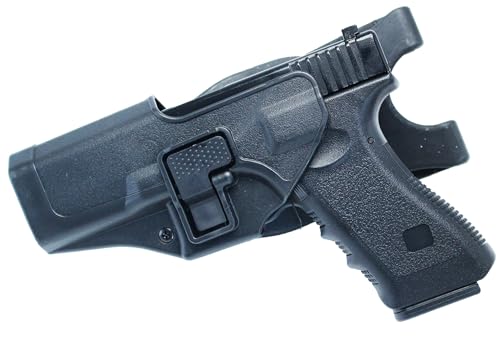
A holster listing that names a pistol model does not necessarily confirm a fit for every airsoft version of that model. Replicas can differ in their shape or fitted parts, so compare the product page’s compatibility details with your specific sidearm rather than relying on the model name alone.
Also account for anything attached to the pistol, such as a sight or light: an accessory may affect whether the replica fits or whether a retention feature can be used as intended. If the listing does not clarify fit for your configuration, avoid assuming that an otherwise compatible holster will accommodate it.
More Airsoft Holsters
See all 301 Airsoft Holsters →


As an Amazon Associate we earn from qualifying purchases.


