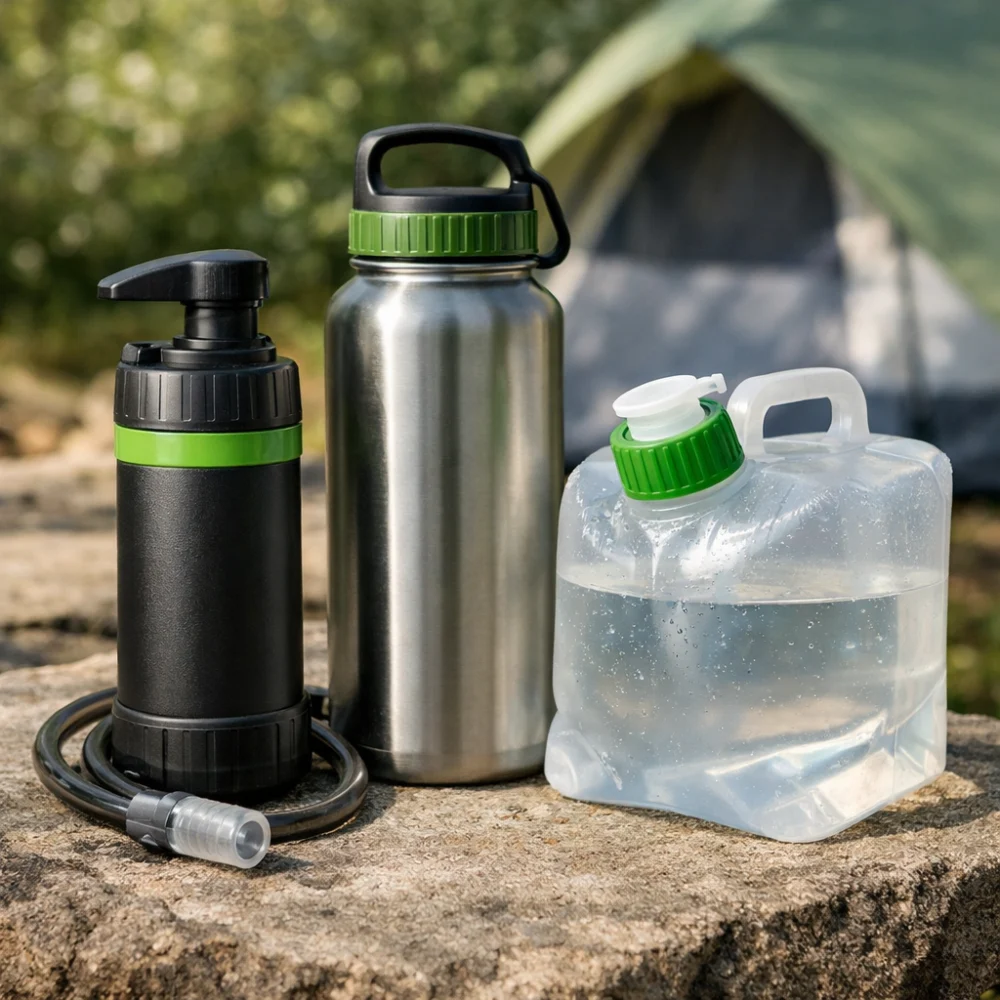
Water filters and purifiers are bought for one main reason: to help make untreated water more suitable for drinking when you are away from reliable taps. That might mean topping up from a stream, using campsite facilities more confidently or carrying a backup for longer trips.
The right choice depends on where you will use it, how much water you need and how much effort you are happy to put into filling, filtering and carrying the system. Some options are built for solo use and speed, while others suit groups, base camps or emergency kits.
Because the category covers several formats, it is worth comparing how each product fits your trip rather than assuming one style suits every situation.
What should you look for in a water filter or purifier?
Start with the water source, the number of people relying on it and the type of use you expect. A compact personal filter can suit a lightweight solo trip, while a larger gravity or bottle system may be more practical for shared use or repeated refills. The main trade-off is usually between portability, speed, ease of use and the level of treatment the product is designed to provide.
Specifications vary by model, so always check the individual product page before buying.
| Feature | What it means | Why it matters | What to check |
|---|---|---|---|
| Format | Straw, bottle, pump, squeeze or gravity style | Changes how you collect and drink the water | Whether it matches solo use, group use or camp setup |
| Portability | How easy it is to carry in a pack or pocket | Affects comfort on long walks and minimalist trips | Packed size, weight and how much room it takes when wet |
| Flow and effort | How much work is needed to get usable water | Some systems are quicker or easier than others | Whether it relies on suction, squeezing, hanging or pumping |
| Treatment level | The amount and type of filtration or purification the model is designed for | Important for matching the product to your intended water source | What the product page says it is designed to remove or reduce |
| Capacity and output | How much water can be treated at a time | Matters if more than one person will use it or you need water for cooking | Batch size, bottle volume or reservoir size |
| Maintenance | Cleaning, drying and replacement parts | Affects convenience and long-term use | Filter life, cleaning instructions and whether spares are available |
Key decision criteria explained
Format and drinking style
The format shapes the whole experience. A straw-style product is simple and lightweight, but it is usually best for drinking directly from the source. A bottle or squeeze system can be more convenient if you want water to carry with you. Gravity systems are often easier for camp use because they can work while you do other tasks, but they need somewhere to hang or place them.
Portability versus convenience
Lightweight options are often attractive to hikers and backpackers, yet they may take more effort at use time. More convenient systems can be bulkier to pack. Think about whether you want the smallest possible item in your bag or a setup that makes regular water collection easier.
How the product is intended to be used
Some products are aimed at quick personal hydration, while others are better for larger volumes or repeated use. If you mainly need a backup for short trips, simplicity may matter most. If you are filtering water often, comfort and ease of refilling can matter more than the smallest packed size.
Maintenance and replacement needs
Many buyers focus on the initial purchase and forget the upkeep. Check whether the filter can be cleaned, whether any parts need replacing and how storage is handled between trips. A product that is easy to dry and maintain may be more practical if you travel often.
Common types and variants
Within this category, the main differences are usually in how water is collected and how much effort the user puts in.
- Straw-style filters: Simple and compact for drinking directly from a source, usually suited to solo use.
- Bottle systems: Useful when you want filtered water in a container you can carry and sip from later.
- Squeeze systems: Often a flexible option for transferring water into another bottle or container.
- Gravity systems: Convenient for camps or groups because they can process water with less active effort.
The best variant depends on whether you value speed, packability or convenience once you are at camp.
Which type suits different buyers?
| Buyer need | Usually worth prioritising | Why |
|---|---|---|
| Solo hiking | Low weight, small packed size, straightforward use | It keeps the load down and is easy to carry every day |
| Family or group camping | Higher output, easier refilling, less effort per use | Shared water needs make convenience more important |
| Emergency backup | Simple storage, clear replacement guidance, reliable upkeep | You want something easy to keep ready when needed |
| Travel and mixed use | Balanced size, easy cleaning, flexible format | It needs to work in more than one setting |
Common mistakes and misunderstandings
- Choosing only by size: A tiny product is not always the most practical if it is awkward to use repeatedly.
- Ignoring the water source: A product suited to one kind of water collection may be less convenient for another.
- Overlooking maintenance: If cleaning and drying are awkward, the product may be less pleasant to keep using.
- Forgetting the group size: A personal filter can be fine for one person but slow for several users.
Safety and suitability checks
A water filter or purifier should be chosen with care, especially if you may rely on it away from established facilities. Check what the product is designed for and do not assume all models handle the same conditions in the same way. If the product page does not clearly explain its intended use, treat that as a sign to look more closely before buying.
For outdoor use, it is sensible to think about backup options as well as the main product. No single item suits every source, every trip or every user.
Maintenance, storage and lifespan considerations
Water treatment products often need more attention than a simple bottle or mug. After use, they may need rinsing, drying or careful storage so they stay ready for the next trip. Some products may also involve cartridges or other replaceable parts, so check how long they are intended to last and what ongoing upkeep is involved.
If you travel occasionally, ease of storage may matter more than maximum output. If you travel often, a product that is simple to clean and pack away may be the better long-term choice.
How to compare options efficiently
- Start with your main use: solo hiking, camping, group travel or emergency backup.
- Choose the format that suits that use, such as straw, bottle, squeeze or gravity.
- Compare portability, ease of use and how much water you need at once.
- Check what the product page says about maintenance and any replaceable parts.
- Confirm that the individual model matches your intended water source and trip style.
Summary buyer decision checklist
- Do I need a personal, camp or shared-use solution?
- Is the format easy for me to carry and use?
- Will the output be enough for my group or trip length?
- Do I understand the upkeep and storage needs?
- Have I checked the product page for model-specific details?
Frequently asked questions
What is the difference between a water filter and a purifier?
In buying terms, the distinction usually comes down to the level and type of treatment the product is designed to provide. The terms are sometimes used differently by different brands, so it is better to read the individual product details than rely on the label alone.
Which type is easiest to carry on a hike?
Straw-style and other compact personal systems are often chosen for lightweight carry. They are usually the simplest to pack, but they may be less convenient if you need to collect or store larger amounts of water.
Are bottle systems better than straws?
Not always. Bottle systems can be more convenient if you want filtered water to carry with you, while straws are often lighter and simpler. The better choice depends on whether you want immediate drinking or a more portable container.
What should I check before relying on one for camping?
Check the intended use, the format, the upkeep needs and whether the output suits the number of people using it. It is also worth looking at how easy it is to store and whether any replaceable parts are involved.
Do larger systems always work better?
Larger systems can be more convenient for groups or base camps, but they are usually less portable. A bigger setup is only better if you will benefit from the extra capacity and do not mind carrying or setting it up.
How important is cleaning and drying?
Very important for practical ownership. A product that is awkward to clean or store may be less pleasant to use over time, even if it seems appealing at first glance.