

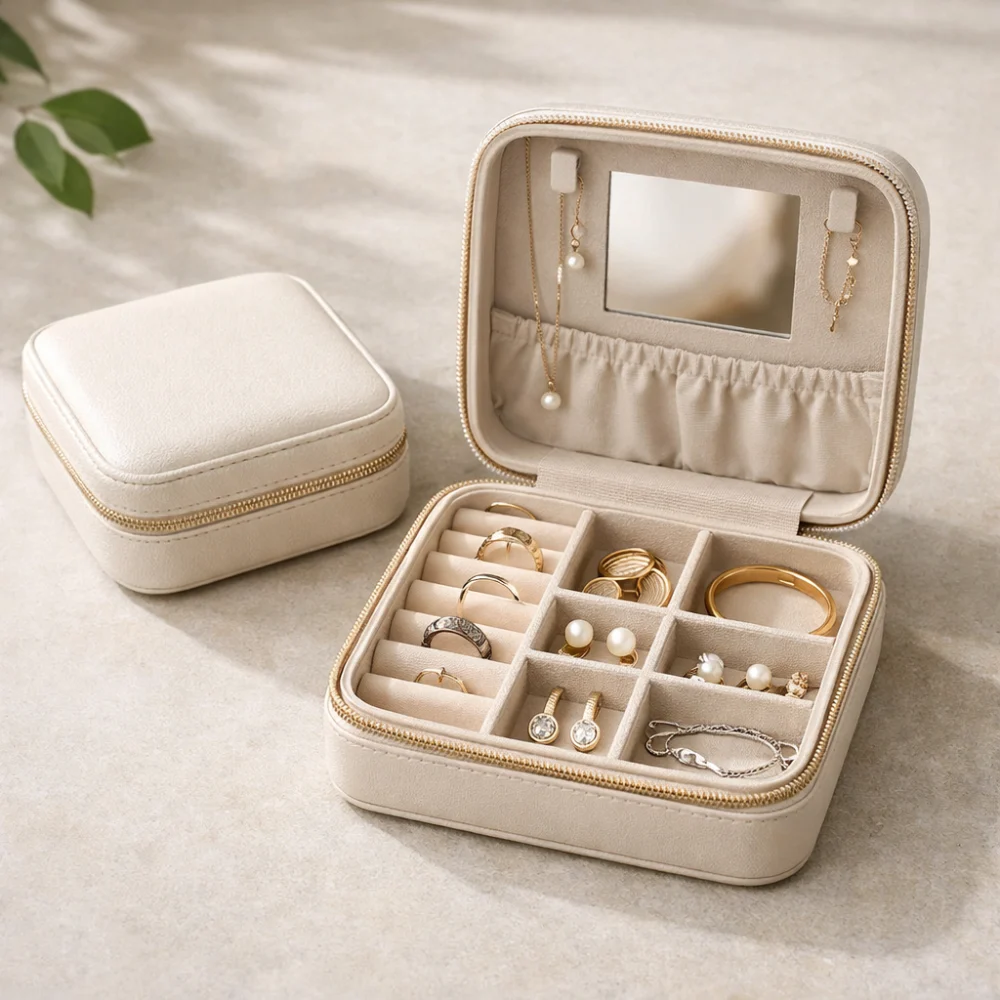
A jewellery box can keep pieces together at home, organise a collection for travel or present a single item as a gift. The right choice depends less on the number of drawers or compartments than on whether the layout suits the jewellery it needs to hold.
This guide covers storage organisers, travel cases and small presentation boxes. Consider what you own, where the box will be kept and whether it is for ongoing storage or gift-giving; then check the individual product details for fit and construction.
What should you look for in a jewellery box?
Start with the pieces you want to store and how often you will access them. Choose a layout with suitable places for your jewellery, and check its internal dimensions rather than relying on the overall size alone. A larger organiser can offer more separation but take up more space; a compact case is easier to carry but may have less room.
Compare the main buying factors
| Feature | What it means | Why it matters | What to check |
|---|---|---|---|
| Layout and compartments | The arrangement of spaces, trays or sections inside. | Different shapes suit different pieces; separation can help keep items organised. | Whether compartments suit your rings, earrings, bracelets or necklaces, and whether their dimensions are stated. |
| Capacity and size | How much the box can hold and how much room it takes up. | A box may look spacious externally yet have a layout that does not suit your collection. | Interior and exterior measurements, usable space and room for any larger pieces. |
| Portability | Whether the design is intended for carrying or mainly for a fixed storage place. | A travel case may be convenient to pack; a larger organiser may be better suited to a dressing table. | Overall size, how it closes and whether the product is described as suitable for travel. |
| Materials and finish | The listed materials, lining and external finish. | These affect appearance, feel and the care the box may need. | Material details and any cleaning or care guidance provided for that specific item. |
| Closure and access | How the box opens and stays closed. | Convenient access matters for daily use; a secure-feeling closure should not be mistaken for valuables protection. | The closure type, how it is described and whether the design suits your intended setting. |
| Presentation | Whether the box is designed to present an individual item or organise a collection. | Gift packaging and long-term storage serve different purposes. | Intended use, internal space and whether the box is a presentation box or an organiser. |
Plan the layout around your jewellery
A quick inventory can make comparisons more useful than choosing by appearance alone. Group the pieces you plan to store and note which need their own space: for example, rings, pairs of earrings, bracelets and longer chains may call for different compartment shapes. Check the product’s internal layout against those groups, and leave some allowance if you expect the collection to grow.
Specifications vary by model, so always check the individual product page before buying.
Choose the right type for your use
Home storage organisers
These are intended to keep a collection together in a regular storage spot. Trays, drawers or several levels may make it easier to sort pieces, but take up more room than a small case. Check the box’s footprint, access and compartment arrangement against both your space and your collection.
Travel cases
A compact case may suit someone who wants to take a small selection of jewellery away from home. Its smaller size can limit capacity, so check how many pieces it is designed to hold and whether the internal spaces suit the items you would pack. Do not assume that a travel label means every piece will fit or remain separated.
Stackable trays or modular layouts
Separate trays or a stackable design can suit someone who wants to organise jewellery by type or make storage easier to adapt. They may need more vertical space and are not automatically portable. Check how the components are arranged and whether the dimensions work for the intended storage place.
Individual presentation boxes
A small presentation box may be appropriate for giving or displaying one item, rather than storing a varied collection. Its compact format is a limitation if you need space for several pieces. Check the internal dimensions against the item and confirm the intended purpose.
Match the box to the need
- For everyday access: prioritise a layout that makes frequently worn pieces easy to find, and check that the box fits its intended place.
- For a larger or mixed collection: compare the compartment shapes and interior measurements with the pieces you own; extra drawers are useful only if their layout suits your needs.
- For travel: focus on a manageable size, a closure described for the case and compartments suited to the smaller selection you plan to take.
- For a gift: decide whether you need presentation for one piece or storage for a collection. If buying for someone else, consider whether the box’s style and format fit their likely use.
Common buying mistakes
- Choosing by exterior size alone: outer measurements do not show how much usable space is inside. Compare internal dimensions and compartment layout.
- Assuming every compartment is versatile: spaces may be shaped for particular kinds of jewellery. Check the layout against the pieces you plan to store.
- Confusing a presentation box with an organiser: a box for one gift may not suit ongoing storage. Confirm the intended use before choosing.
- Expecting a small travel case to hold a whole collection: portability and capacity can pull in different directions. Decide which pieces you actually need to carry.
- Treating a decorative lock as security: a lock or key detail does not by itself establish protection for valuables. Check the product description and choose storage appropriate to the value of the contents.
Suitability and sensible checks
Choose a box for the jewellery and setting it is intended to suit. If children may handle it, consider whether small pieces could be accessible and store the contents appropriately. A lock, lining or closure should not be taken as a guarantee of security or protection; rely on the product information for the box’s stated purpose.
Care and storage considerations
Care requirements depend on the materials and finish. Read the product’s care guidance before cleaning, and consider whether its stated care needs suit the place where you plan to keep it. Keep the box in a location that works for its size and access, and avoid assuming that a jewellery box will protect every type of jewellery from all storage conditions.
A simple buying process
- List the jewellery you want to store or take with you.
- Decide whether you need home organisation, a travel case or gift presentation.
- Compare internal layout and dimensions with the pieces and storage space.
- Weigh capacity against portability, access and the space available.
- Check the individual product information for materials, closure, intended use and care guidance.
Buyer checklist
- Is the box for home storage, travel or presenting a gift?
- Do the compartments suit the types and sizes of jewellery you plan to keep in it?
- Have you checked internal as well as external dimensions?
- Will the box fit the intended storage place or travel use?
- Are the materials, closure and care information clear for the specific product?
- Are you treating any lock or protective feature only as described, not as a guarantee?
Frequently asked questions
How do I choose the right size jewellery box?
Start with the pieces you want to store and the space available for the box. Compare the internal measurements and compartment layout with your jewellery, as exterior size alone may not show whether items will fit.
Are jewellery boxes suitable for travel?
Some are designed as travel cases, while larger organisers are intended more for a regular storage place. Check the product’s stated use, size, closure and layout rather than assuming any compact-looking box is travel-suitable.
Can a jewellery box store necklaces without tangling?
That depends on the space and layout provided. Look for compartments suited to the chains you want to store and check their dimensions; a box cannot guarantee that jewellery will never tangle.
Is a jewellery box with a lock secure?
A lock or key may be part of the design, but it does not by itself establish security for valuables. Check what the product information says and consider whether the box is appropriate for the value of its contents.
What is the difference between a jewellery organiser and a gift box?
An organiser is intended to arrange and store a collection, while a small presentation box may be intended to hold or display one gift. Check the stated purpose and internal dimensions to make sure the format matches your need.


