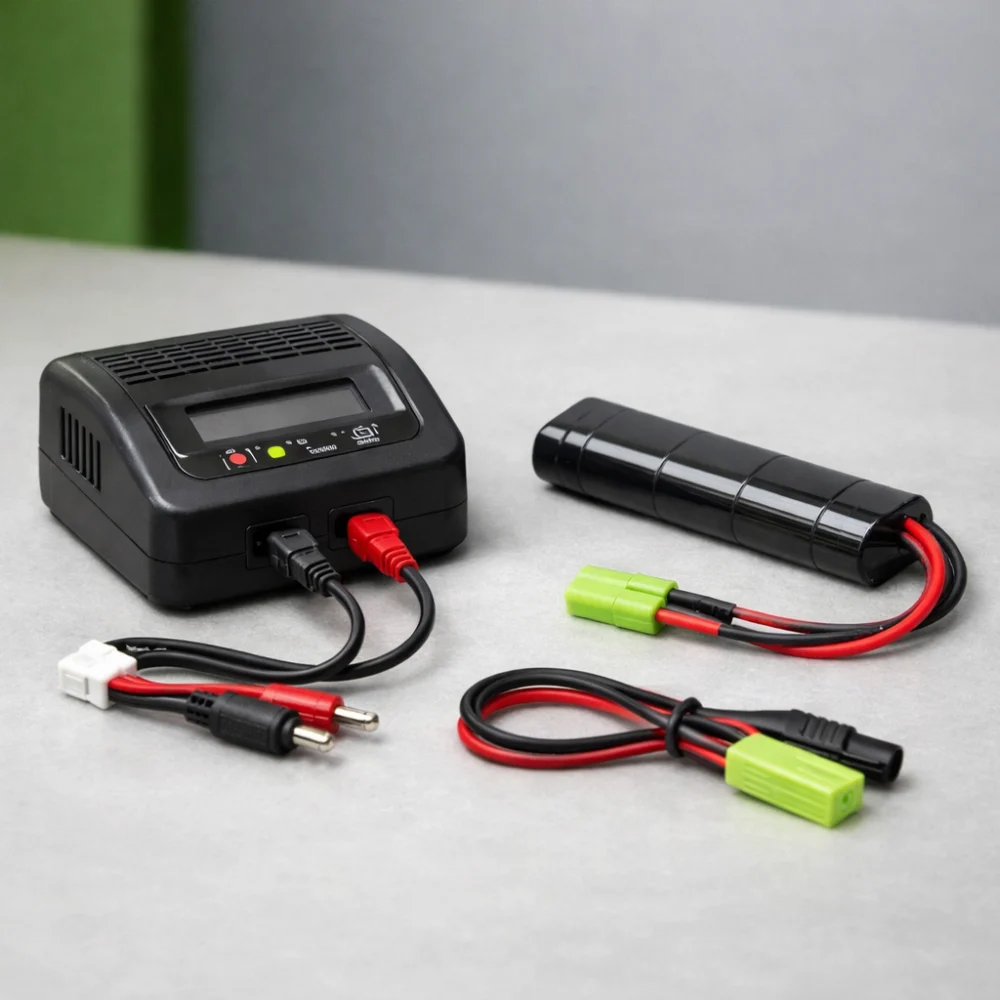
If you play airsoft regularly, the charger you use matters almost as much as the battery itself. The right choice helps you charge confidently, match the battery chemistry you own and avoid buying something that is awkward to use or unsuitable for your setup.
Airsoft battery chargers cover a wide range of styles, from simple plug-in options to smarter chargers that give you more control. The main job is the same, but the details are not: battery type, connector compatibility and charging convenience all affect which charger makes sense for you.
This guide focuses on the buying decision, not on how to use the charger. It is for players replacing a basic charger, upgrading to a more capable one or choosing a first charger for a specific battery setup.
What should you look for in an airsoft battery charger?
The best starting point is to match the charger to the battery chemistry and connector you already have. After that, decide whether you want a simple charger or a smarter one with more charging control. The most useful trade-off is usually convenience versus flexibility: simpler chargers are easier to live with, while more advanced chargers can suit a wider range of batteries and charging needs. Specifications vary by model, so always check the individual product page before buying.
| Feature | What it means | Why it matters | What to check |
|---|---|---|---|
| Battery chemistry support | Which battery types the charger is designed to work with | Not every charger suits every battery type | Confirm the charger and your battery use the same chemistry |
| Connector type | The plug connection between charger and battery | A mismatch can make the charger unusable without the right lead or adapter | Check the connector on the charger, battery and any required lead |
| Charging style | Simple charging or more advanced smart charging | Changes how much control and feedback you get | Decide whether ease of use or more detailed control matters more |
| Power input | How the charger is powered | Affects where and how easily you can charge | Look at whether it suits your available mains, USB or other power source |
| Battery balance support | Whether the charger can manage battery cells more precisely | More relevant for some battery types than others | Check whether your battery needs balance charging and whether the charger provides it |
| Display and indicators | Lights, screen or status information | Helps you understand charging progress at a glance | Choose how much feedback you want from the charger |
The main decision factors
Battery type compatibility
This is the first check because it tells you whether a charger is suitable in the first place. Airsoft batteries are not all the same, and a charger intended for one type may not suit another. Do not assume that a connector alone is enough to make a charger compatible.
Connector matching
Even when the charger suits the battery type, the plug still has to match. Some buyers discover too late that they have the right charger category but the wrong lead or connector. Check the exact connector shown on the product page and compare it with your battery before you buy.
Smart features versus simplicity
Basic chargers can be a good fit if you want straightforward charging with minimal setup. Smart chargers are more flexible and may give you more information about the charge process, but they can also feel more involved if you only need a simple replacement. The right choice depends on whether you value speed of use or wider control.
Power source and portability
Think about where you will usually charge batteries. A charger that suits your available power source is far easier to live with than one that needs extra adapters or a setup you will rarely have to hand. If you travel to games, portability may matter as much as charging features.
Feedback, monitoring and confidence
Some buyers want a charger that gives clear status information, while others are content with a simple indicator. More feedback can make it easier to understand what is happening during charging, especially if you manage more than one battery. If you prefer a less technical experience, a simpler charger may be enough.
Common charger types and what they suit
Within this category, the broad differences are usually about control and connection rather than dramatic product types. That makes the decision more about how you charge than about how the charger looks.
- Simple chargers: suited to buyers who want an easy replacement or a low-effort option.
- Smart chargers: better for users who want more control, more information or wider battery handling.
- USB-powered options: useful where portability or convenient charging from common power sources matters.
- Mains-powered options: can suit buyers who mostly charge at home and want a more conventional setup.
Which type makes sense depends on the battery you own and how you plan to charge it day to day.

Which charger suits different buyers?
| Buyer need | What to prioritise | Why |
|---|---|---|
| First-time buyer | Clear compatibility and simple operation | Helps avoid a charger that is confusing or unsuitable |
| Replacing a lost charger | Exact connector match and the right battery support | Reduces the chance of buying something that does not fit |
| Regular player | Convenience, reliable feedback and practical power options | Useful if you charge batteries often |
| Buyer with more than one battery type | Broader compatibility and smarter charging features | Can make a multi-battery setup easier to manage |
| Portable or game-day use | Compact size and a suitable power source | More practical when charging away from home |
Common mistakes to avoid
- Buying by connector alone: the plug matters, but the charger still has to suit the battery type.
- Assuming all chargers are interchangeable: different battery chemistries need different charger support.
- Overlooking the power source: a charger is only useful if it works with where you plan to use it.
- Choosing more complexity than you need: advanced features are helpful only if you will actually use them.
- Not checking the product page carefully: small differences in support or connectors can make a big difference.
Safety and suitability caveats
Choose a charger only if it is intended for your battery type and configuration. If you are unsure about a battery or connector, treat the product page as the source of truth rather than relying on appearance alone. A charger that seems similar can still be wrong for your setup, so check carefully before you buy.
Maintenance and storage considerations
Chargers generally need little maintenance, but they do benefit from sensible storage and careful handling. Keep leads tidy, avoid strain on connectors and store the charger where it will not be knocked or exposed to moisture. If you are buying a charger for regular use, think about how easy it will be to keep alongside your batteries and accessories.
How to compare options efficiently
- Confirm the battery type you need to charge.
- Check the connector and any lead or adapter requirement.
- Decide whether a simple or smarter charger suits your routine.
- Think about your usual power source and where you will charge.
- Read the individual product page for the exact supported setup.
Summary buyer decision checklist
- Does the charger suit your battery type?
- Does the connector match your battery or lead?
- Is the power source practical for how you will use it?
- Do you want a simple charger or a smarter one?
- Are the charging feedback and controls suitable for your experience level?
- Have you checked the individual product page for the exact supported details?
Frequently asked questions
Do I need a charger made for airsoft batteries?
Usually, yes. The main issue is not just fitting the plug but making sure the charger is appropriate for the battery type you use. A charger designed for the wrong battery chemistry may be unsuitable even if the connector looks close.
What is the difference between a basic charger and a smart charger?
A basic charger focuses on simplicity, while a smart charger usually offers more information and more control. The right choice depends on whether you want an easy replacement or a charger that can handle a wider range of charging needs. For many buyers, the question is convenience versus flexibility.
How important is the connector?
Very important, because a mismatch can stop the charger from being usable without additional parts. Even then, the connector is only one part of compatibility. Always check the battery type as well as the plug.
Can I choose a charger just because it has the same voltage as my battery?
Not safely on that basis alone. Voltage is only one part of the picture, and charger suitability also depends on battery chemistry and connector details. Check the individual product page for the full compatibility information.
Are USB chargers always the easiest option?
They can be convenient, especially for portable use, but ease depends on your setup. Some buyers prefer mains-powered chargers at home, while others value the flexibility of USB power. The best option is the one that fits your routine.
Do I need a charger with display information?
Not necessarily, but a display or clear indicators can make charging feel more reassuring. If you want a simple, low-fuss setup, you may not need extra feedback. If you manage multiple batteries, more information can be useful.