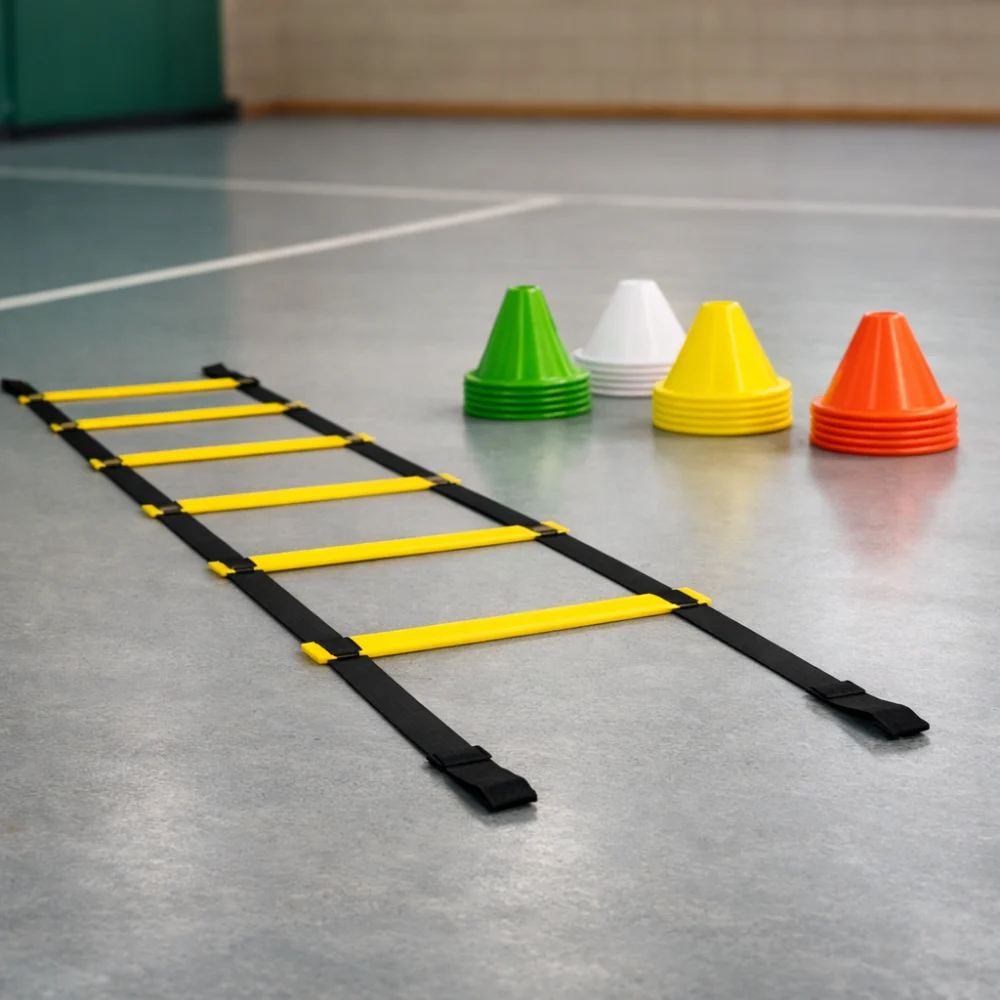
Agility ladders and cones are simple training tools, but the right choice depends on how you plan to use them. They are commonly bought for warm-ups, footwork drills, coaching sessions, home training and organised sport practice.
If you are comparing options, the main question is not which item looks most complete, but which setup suits your space, user level and routine. A small, easy-to-carry set can be ideal for quick sessions, while a larger training layout may suit coaching groups or repeated drills.
This guide helps you decide between ladder-led drills, cone-led marking and mixed training setups, so you can choose equipment that matches your space and training style.
What should you look for in agility ladders and cones?
Start with the drills you want to do most often. An agility ladder is useful for repeated foot placement patterns, while cones are better for marking routes, turning points, zones and improvised drill layouts. Many buyers find that the best starting point is the format that matches the sessions they already plan to run.
The biggest trade-off is between structure and flexibility. Ladders give a clear stepping pattern, which helps with rhythm and coordination, while cones are more adaptable and can be rearranged quickly for different activities. Specifications vary by model, so always check the individual product page before buying.
| Feature | What it means | Why it matters | What to check |
|---|---|---|---|
| Training focus | Whether the item is mainly for footwork, marking space or mixed drills | Helps you choose equipment that fits the session rather than adding clutter | Think about drills, warm-ups, team coaching or solo practice |
| Size and layout | How much space the setup needs in use | Affects whether it suits a hall, garden, pitch or home training area | Check the stated dimensions and how much clear space you have |
| Portability | How easy it is to carry, pack away and move between locations | Important for coaches, clubs and families training in different places | Look for carry bags, compact storage and simple pack-down |
| Durability and material feel | How the ladder or cones are built for repeated handling | Matters if the kit will be used often or by groups | Review product details for construction and intended use |
| Indoor or outdoor suitability | Whether the kit is intended for smooth floors, grass, artificial turf or mixed use | Helps avoid buying gear that is awkward for the surfaces you have | Check any surface guidance on the product page |
Key decision criteria
Ladders versus cones
A ladder is usually the better choice when you want a repeatable stepping pattern and a clear rhythm for footwork practice. Cones are more flexible when you want to build courses, define boundaries or add variety to drills. If you expect to run both types of session, a mixed setup can be more practical than choosing only one style.
Space and session length
Think about where the equipment will be used most often. A compact kit is easier for short sessions in a smaller area, while a broader cone layout may be more useful where there is enough room to vary routes and distances. The right choice is often the one that fits the space without constant rearranging.
Group use or individual practice
For group coaching, visibility and quick reset matter because drills may change frequently. For solo practice, ease of setup and storing the kit away may matter more. A buyer who trains alone may prefer a straightforward, compact option, while a coach may value a set that can be adapted across multiple exercises.
Portability and storage
These products are often chosen because they are light and easy to move, but not every set is equally convenient to carry. If you plan to take the kit to clubs, parks or away matches, check how it packs away and whether the storage method suits your routine. Small practical differences can matter more than appearance.
Types and variants you are likely to compare
Within this category, the main difference is usually between agility ladders, cones and mixed training sets. Ladders support pattern-based footwork, cones support layout-based drills, and mixed sets give you more ways to vary practice. The trade-off is simple: more flexibility can mean more pieces to store and keep track of.
Some cone sets are designed for marking lanes or turning points, while others are sold in larger quantities for broader drill use. If you only need a few markers, a smaller set may be enough. If you want to build repeated team sessions, a larger set can reduce the need to constantly reset the same markers.
Which option suits different buyers?
| Buyer need | Often suits | Why |
|---|---|---|
| Home fitness and general conditioning | Compact ladder, small cone set or mixed starter kit | Easy to store and simple to use in short sessions |
| Coaches and clubs | More adaptable cone layouts or a ladder plus cones | Useful for repeated drills and changing session plans |
| Solo footwork practice | Agility ladder | Supports clear stepping patterns and repeatable drills |
| Open-ended movement drills | Cones | Better for routes, zones, turns and space marking |
| Mixed sport training | Combination of both | Gives more variety without needing separate purchases |
Common mistakes and misunderstandings
Buying for the wrong kind of drill. A ladder is not automatically better just because it looks more technical. If your sessions rely on changing routes and turning points, cones may be more useful.
Ignoring the space you actually have. A setup that works well on paper can be awkward in a tight room or small garden. Measure the area you plan to use and leave enough room for movement around it.

Choosing quantity over practicality. More cones or a larger layout are not always better. Consider whether the kit will be used often enough to justify the extra pieces to manage.
Overlooking storage and transport. Some buyers focus on training use and then find the kit inconvenient to carry or pack away. If portability matters, this should be part of the comparison from the start.
Safety and suitability to check before buying
These are straightforward training aids, but they still need to suit the people and surfaces using them. Check that the layout works for the intended age, ability and training environment, and make sure the product page matches the surface you expect to use.
Keep in mind that these items are for drill practice and marking space, not for providing protection or preventing injury. Avoid buying a format that encourages use in a space that is too crowded or unsuitable for movement.
Maintenance, storage and lifespan considerations
Agility ladders and cones are usually chosen because they are easy to store and reuse, but long-term convenience still matters. Consider whether the kit can be wiped clean, whether it packs away neatly and whether the storage approach suits your training habits.
If the items will be used outdoors, exposure to weather, rough ground and repeated folding can affect how practical they feel over time. A simple product that stores well is often easier to keep in regular use than a more elaborate set that is awkward to organise.
How to compare options efficiently
- Decide whether your main need is footwork, marking space or a mix of both.
- Check the space where you will train most often.
- Compare how portable and easy to store each option is.
- Look at the product page for any surface or usage guidance.
- Choose the simplest setup that matches your drills without adding unnecessary complexity.
Summary buyer decision checklist
- Do I need a ladder, cones or both?
- Will the kit fit the space I have available?
- Is it easy to carry, store and reset between sessions?
- Does it suit solo training, coaching or group drills?
- Have I checked the individual product page for the details that vary by model?
Frequently asked questions
Are agility ladders or cones better for beginners?
Beginners often find both useful, but in different ways. A ladder gives a clear pattern to follow, while cones are easier to understand when you want to mark a route or area. The better choice depends on whether the person is learning foot placement or general movement drills.
Can I use these indoors?
Often yes, but the space and surface matter. Indoor use is usually more practical when there is enough room for movement and when the product page supports that type of use. Always check the individual listing for any surface guidance.
Do I need both ladders and cones?
Not always. If your training is mostly repeated footwork patterns, a ladder may be enough. If you want to vary drills or set up more open-ended movement tasks, cones may be the more flexible starting point.
What should coaches look for first?
Coaches usually benefit from kit that is quick to reset, easy to transport and simple for different drills. Flexibility matters because session plans can change quickly. It is also worth checking whether the kit suits the space where it will be used most often.
Are larger cone sets always better?
Not necessarily. A larger set can be useful for group sessions, but it is only worth it if you will use that many markers regularly. Smaller sets can be easier to store and may be more convenient for home practice or occasional drills.
How do I choose between a starter set and a larger setup?
Start with how often you train and how varied your drills are. A simpler setup is often enough for occasional use, while frequent training or coaching may justify something more adaptable. The main question is whether extra pieces will genuinely improve your sessions.