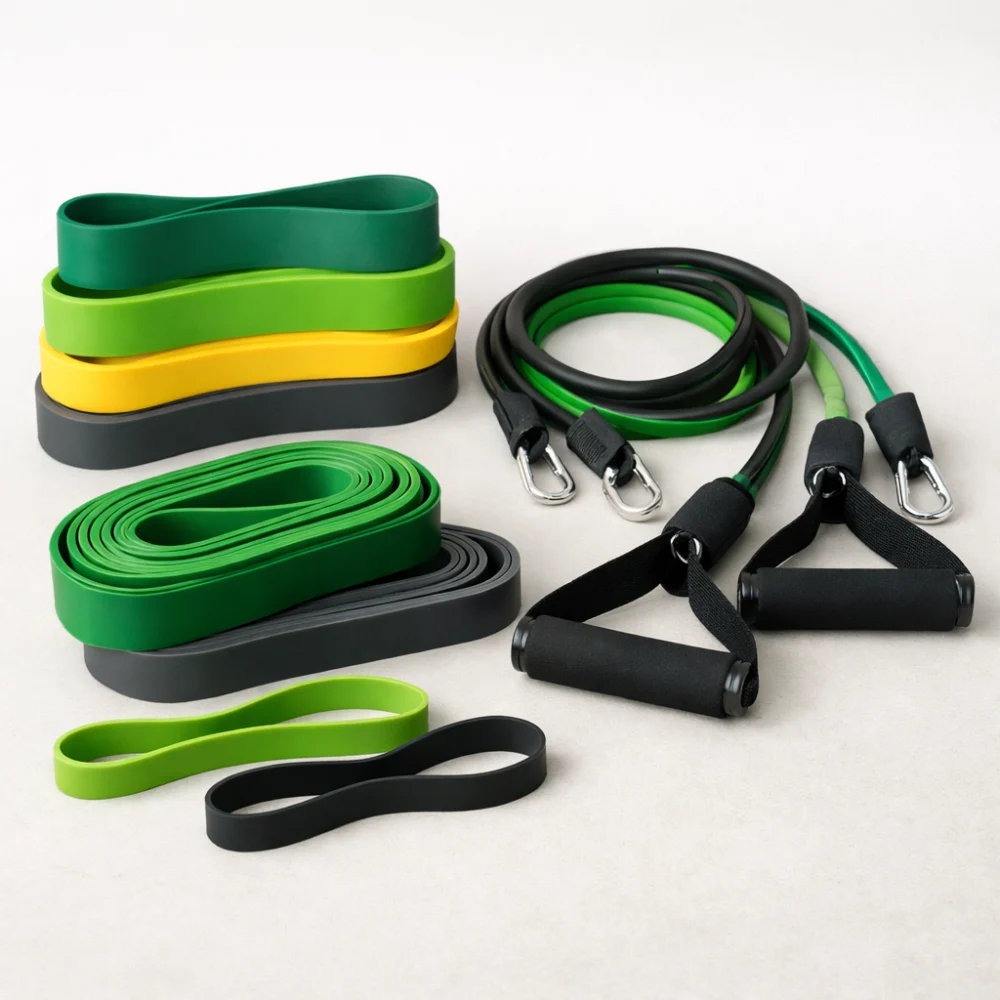
Resistance bands are a simple, adaptable way to add resistance to exercise without a lot of space or heavy equipment. They are used for warm-ups, mobility work, strength training and some assisted movements, but the right choice depends on the style of training you want to do.
If you are comparing bands for the first time, the main challenge is not choosing the highest resistance level. It is deciding which format suits your exercises, how you want to anchor or hold the band, and whether you need a set of different tensions or just one band for a specific purpose.
That makes resistance bands a category where shape, feel and setup matter as much as the headline resistance claim.
What should I look for in resistance bands?
The best starting point is the exercise you want to do most often. Loop bands, long flat bands and tube-style bands all behave differently in the hand and under tension, so the right option depends on whether you are training lower body, upper body, assisted bodyweight movements or general conditioning. Specifications vary by model, so always check the individual product page before buying.
| Feature | What It Means | Why It Matters | What To Check |
|---|---|---|---|
| Band type | Loop, flat, tube or fabric style | Changes how the band feels and how it is used | Whether it suits your exercise plan and grip preference |
| Resistance level | How much tension the band provides | Affects exercise difficulty and progression | Whether you need one level or a set of different tensions |
| Length | The overall size of the band | Influences range of motion and exercise options | Whether it is intended for pull-up assistance, looping, or general training |
| Grip and comfort | How the band feels in the hands or around the body | Important for longer sessions and repeated movements | Handles, fabric construction, width and edge feel |
| Accessories | Extra items such as anchors, cuffs or handles | Can increase exercise variety and setup options | Whether the extras are actually useful for your workouts |
Key decision criteria
Band type
Different band shapes suit different exercises. Flat or loop bands are often chosen for stretching, glute work and assisted movements, while tube-style bands are commonly used when a handle or anchor-based setup is preferred. Fabric loop bands can feel more stable for some lower-body exercises, but they are not the same as every other loop band.
Resistance feel
Resistance is not only about the number on the pack. Some bands feel smoother through the movement, while others increase tension more sharply as they stretch. If you want gradual progression, a set of different resistance levels can be useful. If you only need one band for a specific drill, a single band may be simpler.
Length and stretch
Length affects how far you can move before the band becomes tight. A longer band may suit assisted bodyweight exercises or taller users, while shorter options can work well for smaller movements and lower-body activation. The important point is to match the band’s intended use to the exercise rather than assuming a longer or stronger band is automatically better.
Attachment and setup
Some bands are used directly around the body or limbs, while others rely on a door anchor, handles or ankle cuffs. That changes convenience, safety and exercise variety. If you plan to train at home, think about where you will anchor the band and whether the included accessories make sense for your space.
Comfort and grip
Comfort matters more than many buyers expect, especially for repeated sessions. Wider bands may spread pressure more evenly, while handles can make pulling exercises feel easier to manage. For lower-body work, check whether the band is likely to roll, twist or pinch during movement.
Types and variants within this category
- Loop bands: Useful for glutes, legs and assisted movements. They are simple to store, but the open size and tension range may not suit every exercise.
- Flat bands: Often chosen for stretching, mobility and general training. They are versatile, though grip and anchoring can matter more.
- Tube bands with handles: Better when you want a more cable-like pulling feel. They can be convenient, but the setup depends more on accessories and anchor points.
- Fabric bands: Often preferred when a more stable feel is important for lower-body work. They may not suit every pull or stretch exercise.
Which type suits which buyer?
| Buyer need | What usually matters most | Likely better fit |
|---|---|---|
| Beginner home training | Ease of use and simple setup | A small set with clear resistance steps |
| Mobility and stretching | Comfort, length and smooth tension | Flat or loop bands |
| Lower-body activation | Stability and controlled movement | Fabric loop bands or suitable loops |
| Assisted bodyweight work | Length and tension range | Longer loop-style bands |
| General strength training | Versatility and progression | Sets with multiple resistance levels |

Common mistakes and misunderstandings
- Choosing by resistance number alone: A band can have the right headline tension but still feel wrong for the exercise. Check the format and intended use first.
- Buying a set without needing the extras: Handles, ankle straps and anchors are helpful only if you plan to use them.
- Ignoring band length: A band that is too short or too long can limit the movements you want to do.
- Assuming all loops feel the same: Fabric and latex-style options can behave differently in use, especially for comfort and stability.
Safety and suitability caveats
Resistance bands are generally straightforward to buy, but suitability still matters. Make sure the band style matches the exercise, your available space and any need for anchoring. If you are using a band for rehab-style training or around sensitive joints, it is sensible to choose conservatively and check the individual product details carefully.
Maintenance, storage and lifespan considerations
Resistance bands are usually easy to store, but they do need sensible care. Keep them away from sharp edges, excessive heat and rough surfaces that may cause wear. If a set includes handles, cuffs or anchors, check how those parts are attached and whether they are easy to clean or replace when needed.
How to compare options efficiently
- Decide what you want the band to do most often.
- Choose the band type that fits that use.
- Compare resistance levels, length and accessories.
- Think about comfort, setup and storage.
- Check the individual product page for the exact specification before buying.
Summary buyer decision checklist
- Does the band type suit your main exercises?
- Is the resistance level appropriate for your current use?
- Is the length suitable for the movements you plan to do?
- Do you need handles, anchors or ankle cuffs?
- Will the material and construction feel comfortable for repeated use?
- Have you checked the individual product page for the exact details?
Frequently asked questions
Are resistance bands good for beginners?
Yes, they can be a practical starting point because they are compact and easy to scale up or down. The key is to choose a band style that matches simple exercises rather than trying to cover everything with one product.
Do I need a set or just one band?
A set is useful if you want to progress over time or use different tensions for different exercises. A single band can make sense if you already know the movement you want to train and do not need variety.
What is the difference between loop and tube bands?
Loop bands are generally simpler and often used for lower-body work, stretching and assisted movements. Tube bands usually suit buyers who want handles and a more anchored pulling setup.
Are fabric bands better than other bands?
Not necessarily; they are different rather than universally better. Fabric bands can feel more stable for some exercises, but flat or elastic loop bands may be better for stretching or assisted movements.
What should I check before using a band at home?
Check that you have enough space, a suitable anchor point if needed and a band length that works for the movement. It is also worth making sure the band is intended for the type of exercise you plan to do.
How do I compare two bands that seem similar?
Look at the band type, resistance range, length and any included accessories. If those are similar, the deciding factor is often comfort and whether the setup suits your routine.