
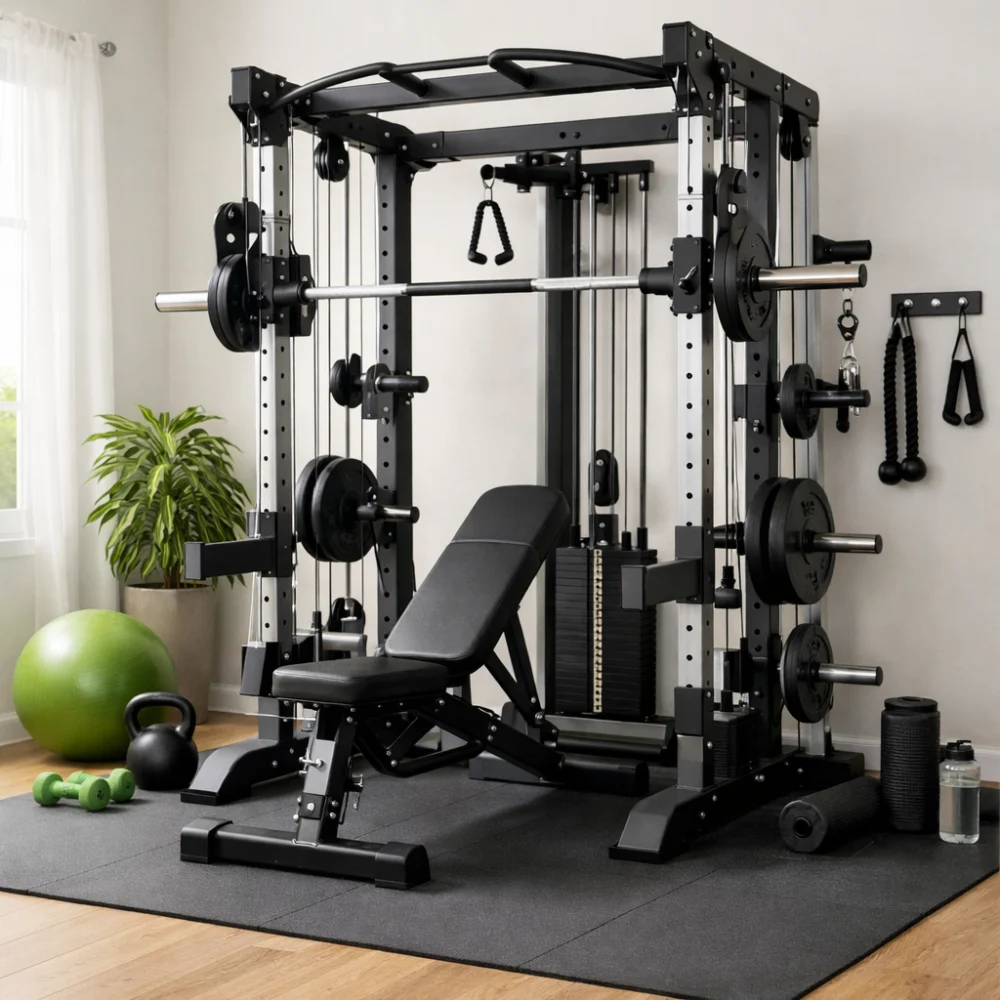
Cable and Smith machines are aimed at buyers who want a more structured home gym setup than free weights alone, with guided lifting and cable-based exercise options in one place. They can suit strength training, accessory work and general home workouts, but the right choice depends on how much space you have and how you plan to train.
Because designs vary, it helps to separate the main decision points before looking at individual products. That usually means checking the footprint, the resistance setup, the exercises you want to do and how much adjustment you need.
What should you look for in a cable and Smith machine?
The best starting point is to match the machine to your training style and your room, not just to the number of exercises it can theoretically support. A compact machine may suit a smaller home gym, while a more elaborate setup can offer more exercise options but usually asks for more floor space and a bigger budget commitment. Specifications vary by model, so always check the individual product page before buying.
| Feature | What it means | Why it matters | What to check |
|---|---|---|---|
| Machine type | Whether the product focuses on cable work, a Smith bar, or both | It affects the exercises you can do and the style of training the machine supports | Confirm the setup matches your main workouts and do not assume every model includes the same components |
| Footprint and height | The space the machine needs on the floor and above it | Home gyms often have tighter room constraints than commercial spaces | Measure the available area and check clearances for use, loading and movement around the machine |
| Resistance system | How resistance is provided for cable exercises or guided lifting | It affects smoothness, load progression and how you train over time | Look for the resistance format used on the individual product page and check what is included |
| Exercise variety | The movements the machine is designed to support | Some buyers want a broad all-in-one station, while others only need a few key movements | Compare the attachment points, pulley layout and Smith bar arrangement against your routine |
| Stability and build approach | The overall structure and how securely the machine is intended to stand during use | Stability affects confidence, comfort and the kind of training the machine is suited to | Check the frame design, mounting requirements and any space or installation notes on the product page |
| Adjustment and accessories | How easily the pulleys, bar position or attachments can be changed | Convenience matters if more than one person will use the machine or you switch exercises often | Check what attachments are included and how adjustable the setup is in practice |
Which features matter most?
Space and layout
Space is one of the biggest practical limits in this category. A machine that seems reasonable in a product listing can feel cramped once you allow for access, movement, and the room needed to load weights or change attachments. If your gym space is shared, think about whether the machine can be used comfortably without blocking other equipment.
Training style
Some buyers want mainly cable exercises for controlled repetitions and accessory work. Others want the guided path of a Smith machine for certain lifts and more structured training. If you are buying for a mixed routine, it is worth checking whether the machine truly supports both uses in the way you expect, rather than assuming “combined” means every movement feels equally natural.
Ease of adjustment
A machine that is awkward to change can become less appealing over time, even if it looks versatile on paper. Smooth pulley movement, sensible handle placement and straightforward adjustments are useful in daily use, especially in a home setting where workouts often need to be efficient.
Load and progression
Different machines suit different progression needs, but the important point for buyers is to understand how resistance is added and what that means for future use. If you are expecting to grow into the machine, check the individual listing carefully rather than relying on a broad category description.
Types and variants
Within this category, the main differences are usually about how the cable system and Smith section are arranged, and whether the machine is more compact or more expansive in layout.
- Combined cable and Smith machines suit buyers who want both guided lifting and cable-based exercises in one unit. The trade-off is that they tend to need more space than a simpler machine.
- Cable-focused machines with Smith functionality may appeal if cable work is a major part of the plan, but you still want a guided bar setup available. Check how central each feature is before assuming both are equally developed.
- More compact home-gym setups can suit smaller rooms or lower-key training plans. Their limitation is usually reduced working room or fewer training options.
Who tends to suit which setup?
| Buyer need | What to prioritise | Why |
|---|---|---|
| Small home gym | Compact footprint and sensible clearances | Space often matters more than maximum exercise variety |
| Mixed training routine | Balanced cable options and Smith functionality | You may want one machine to cover several exercise styles |
| Accessory and isolation work | Cable movement quality and adjustment options | These factors can affect comfort and exercise selection |
| More structured lifting | Stable guided setup and clear loading arrangement | A Smith section can support a more controlled training approach |
| Shared household use | Easy adjustment and practical access | Different users may need to change settings often |
Common mistakes to avoid
- Assuming all-in-one means all exercises are equally convenient. A machine may support many movements, but some will feel more natural than others.
- Ignoring room layout. A machine can fit on paper but still be awkward in a real home gym once you account for access and movement.
- Overlooking what is included. Attachments and accessories can vary, so do not assume the same package contents across products.
- Choosing only by size of the feature list. A simpler machine that suits your routine can be a better fit than a larger setup you rarely use.
Safety and suitability
These machines are heavy, space-taking home gym purchases, so the main buying question is whether the design suits the intended user and room. Check the product page for any assembly, mounting or space requirements before committing, and make sure the machine fits the floor area and ceiling height available. If more than one person will use it, think about whether adjustments are straightforward enough for everyone involved.
Maintenance, storage and ownership
Plan for occasional cleaning, general checking of moving parts and enough room to use the machine comfortably over time. Cable-based equipment may have more moving components than a simple bench or rack, so it is worth choosing a setup you can realistically keep tidy and accessible. If you are placing it in a garage, spare room or dedicated gym area, consider how the environment will affect long-term care.
How to compare options efficiently
- Decide whether you want mainly cable work, guided bar training, or a true combination of both.
- Measure the room carefully and allow space for access, movement and adjustment.
- Compare the resistance setup, attachments and adjustment range against your actual routine.
- Check how stable, compact and practical the machine is for everyday use.
- Read the individual product page closely for included components and any setup notes.
Buyer checklist
- Does the machine fit the room comfortably, including clearance around it?
- Does it support the exercises you actually plan to do?
- Are the cable and Smith features balanced in a way that matches your training?
- Do the attachments and included parts meet your needs?
- Is the adjustment process practical for the people who will use it?
- Have you checked the individual product page for the exact setup and any important limitations?
Frequently asked questions
Are cable and Smith machines good for a home gym?
They can be, if you have the space and want a more complete training station rather than several separate pieces of equipment. They are usually chosen for versatility and convenience, but that comes with a larger footprint than many simpler home gym items.
Do I need a lot of space for one?
Usually, yes, compared with basic home gym equipment. The exact space needed depends on the model, so measure carefully and think about where you will stand, move and adjust the machine as well as where it will sit.
What is the main difference between cable work and Smith training?
Cable exercises are typically used for more varied accessory and isolation movements, while a Smith machine gives a guided bar path for certain lifts. Many buyers want both because they support different parts of a routine.
Is a combined machine better than separate equipment?
Not always. A combined machine can save space compared with several separate stations, but dedicated equipment may suit some users better if they have the room and prefer a more focused setup.
What should I check before ordering?
Check the available floor space, the machine type, the resistance setup, the included attachments and any notes about assembly or installation. Specifications vary by model, so always check the individual product page before buying.
Who is this category most suitable for?
It is usually most appealing to buyers who want a more versatile home gym station and are willing to accommodate the space and setup demands that come with it. It may be less suitable if you want something compact, minimal or easy to move.