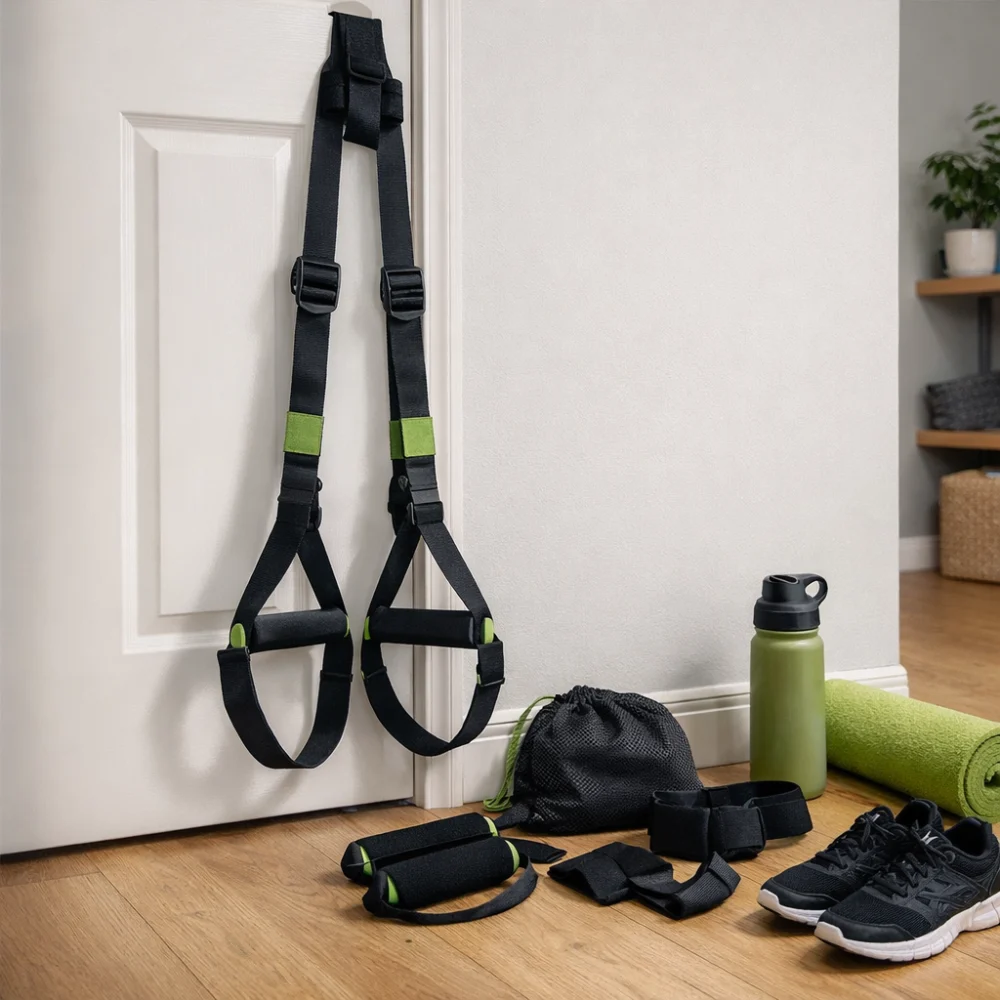
Suspension trainers are a simple way to use bodyweight exercises with a hanging strap system, usually anchored to a door, beam, bar or other suitable fixing. They appeal to people who want compact home training gear, portable workout equipment or a flexible way to work on strength and control.
The challenge is not whether a suspension trainer can be useful, but which one suits your space, training style and confidence with setup. Different kits vary in anchoring options, strap feel, handle comfort and how easy they are to adjust.
This guide helps you compare those choices without assuming that every kit is the same. It focuses on the practical details that make one setup easier to live with than another.
What should you look for in a suspension trainer?
The best starting point is to match the trainer to where and how you will use it. If you need something for a small room or for taking away with you, portability and simple setup matter more than extra accessories. If you want regular home workouts, comfort, stability and reliable adjustment are usually more important.
The main trade-off is between simplicity and flexibility. A more basic kit can be easier to store and use, while a more adjustable set may suit a wider range of movements and anchor points. Specifications vary by model, so always check the individual product page before buying.
| Feature | What It Means | Why It Matters | What To Check |
|---|---|---|---|
| Anchor options | Where the trainer can be attached | Affects where you can train and how easily you can set up | Whether it includes the fixing you need for your space |
| Strap adjustment | How quickly you can change strap length | Useful when switching between exercises or users | Whether the adjustment feels straightforward and secure |
| Handle comfort | The grip area you hold during exercises | Can affect comfort during longer sessions | Grip shape, padding and general feel on the product page |
| Portability | How easy it is to carry and store | Important for travel, small spaces and shared rooms | Pack size, carry options and what is included in the kit |
| Accessory bundle | Extra items supplied with the trainer | May change convenience and setup options | Exactly which anchors, extensions or parts are included |
Key decision criteria explained
Anchoring and setup location
A suspension trainer only works well if you can anchor it safely and conveniently in the place you plan to use it. Some buyers want a door-based solution for indoor sessions, while others may prefer a setup that works with different anchor points. Think about the rooms, fixtures and ceiling height you actually have available.
It is also worth checking whether the kit is intended for indoor use, outdoor use or both. A wider range of anchor options can be helpful, but only if you will genuinely use them.
Adjustment and ease of use
One of the biggest convenience differences between kits is how quickly you can change strap length. If you want to move between rows, presses, lunges and core work, adjustment that feels smooth and repeatable saves time and frustration.
If the trainer will be shared between users, ease of adjustment becomes even more important. A system that is simple to reset between exercises tends to be more beginner-friendly.
Comfort in the hands
Because suspension training often involves repeated gripping, the handles matter more than they first appear. Comfortable grips may make longer sessions easier to manage, especially if you plan to use the trainer regularly.
It is sensible to look at the handle shape and any description of padding or grip surface, but avoid assuming that a more heavily padded handle is automatically better. Comfort is personal and can depend on how you train.
Training intent
Some buyers want a lightweight, portable system for general bodyweight exercise. Others want a trainer that feels more stable for structured strength work. The right choice depends on whether you value simplicity, versatility or a broader exercise setup.
If you mainly want a compact option for travel or occasional sessions, a straightforward kit may be enough. If suspension training is a regular part of your routine, broader adjustment and a more complete bundle may be worth considering.
Types and variants you may see
Suspension trainers are usually grouped by how they anchor and what they include, rather than by dramatic product categories. The most relevant differences are practical rather than technical.
- Basic strap sets: These focus on the core trainer and may suit buyers who already have a suitable anchor point.
- Door-anchor kits: These are often chosen for home use where a simple indoor setup is important.
- Multi-anchor kits: These may include more than one fixing option and suit buyers who want flexibility.
- Accessory-rich sets: These can be convenient if you want a more complete package, but only if the extra parts fit your actual use.

The main limitation of any variant is that it still depends on a suitable anchor point and enough working space. More accessories do not matter if the system does not fit your room or your routine.
Which suspension trainer suits which buyer?
| Buyer need | What to prioritise | Why |
|---|---|---|
| Beginner home user | Simple setup, clear adjustment and comfort | Makes it easier to start without unnecessary complexity |
| Frequent traveller | Lightweight, compact kit with easy packing | Portability matters more than extra accessories |
| Shared household | Fast strap changes and versatile anchor options | Different users may need different settings |
| Dedicated home exerciser | Durable-feeling build and a setup that matches regular use | Convenience and consistency become more important over time |
Common mistakes and misunderstandings
- Choosing for accessories alone: Extra items can be useful, but only if they support the way you will actually train.
- Ignoring the anchor point: A trainer that looks right on paper may still be awkward if your room or fixing point is unsuitable.
- Overlooking adjustment ease: If changing strap length feels slow, the trainer may be less pleasant to use.
- Focusing only on price: A very basic kit may work well, but comfort and convenience can matter more if you plan to train often.
Safety and suitability caveats
Suspension trainers depend on correct use with an appropriate anchor point and enough clear space around the user. Before buying, check the product information for any stated setup requirements and make sure your intended location fits those needs.
Do not assume every kit suits every surface, door or structure. If the space is uncertain, it is better to choose a trainer that clearly matches the intended setup rather than hope it will be fine.
Maintenance, storage and lifespan considerations
These trainers are usually chosen because they store easily, but it still helps to think about care and space before buying. A kit that packs away neatly is often more practical if you train in a shared room or want to keep equipment out of the way between sessions.
General care is usually simple, but the exact needs vary by model and materials. Check the product page for any guidance on cleaning, storage or included parts that may need replacing over time.
How to compare suspension trainers efficiently
- Decide where you will use it most often.
- Choose the anchor style that fits that space.
- Compare how easy the straps are to adjust.
- Look at handle comfort and what is included in the kit.
- Check the individual product page for setup details before you buy.
Summary buyer decision checklist
- Does it suit your main training space?
- Is the anchor method practical for your home or travel use?
- Are the straps easy enough to adjust for your workouts?
- Do the handles and grips look comfortable enough for regular use?
- Does the included bundle match what you actually need?
- Have you checked the product page for any model-specific setup notes?
Frequently asked questions
Are suspension trainers suitable for beginners?
They can be, as long as the setup is simple and the user starts with exercises that match their current ability. Beginners often benefit from a kit that is easy to adjust and straightforward to anchor. Comfort and confidence with the setup may matter more than having lots of extras.
What is the main difference between suspension trainer kits?
The most important differences are usually anchor options, ease of adjustment, comfort and what is included in the box. Two kits may look similar at a glance but feel very different in daily use. That is why it helps to compare the practical details rather than the headline name alone.
Do I need a lot of space to use one?
You do need enough space to move safely and to use the trainer as intended, but the exact amount depends on the exercises you plan to do. A compact room may still work if the setup suits it. Check the product page for any stated space or anchor requirements.
Is a more expensive suspension trainer always better?
Not necessarily. A higher-priced kit may offer more accessories or convenience, but the best choice is the one that fits your space and how often you will use it. If you only need a simple home setup, extra features may not add much value.
Can one trainer suit different users in the same household?
Yes, but ease of adjustment becomes especially important when several people will use it. Look for a trainer that can be reset quickly and that feels comfortable for different grip preferences. A flexible anchor setup may also be helpful.
What should I check before buying for home use?
Confirm where it will be anchored, whether the kit includes the fixing you need and whether the adjustment style suits your routine. It is also sensible to think about storage, especially if the equipment will be packed away after each session.
Can I use a suspension trainer outdoors?
Some kits may be suitable for outdoor use, but that depends on the individual product and its anchor options. Do not assume outdoor use is included unless it is clearly stated. Check the product page for the intended setup and any limitations.