
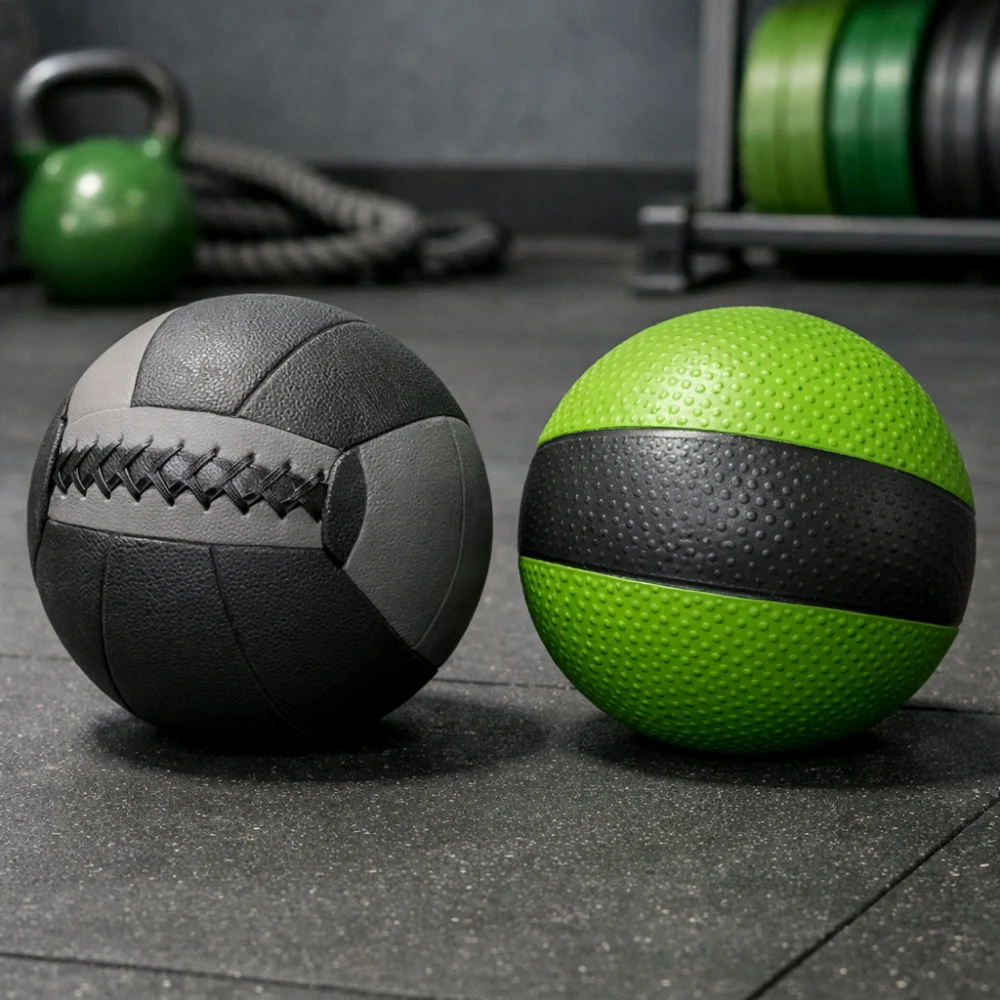
Medicine and slam balls are simple pieces of training equipment, but they are not all designed for the same kind of use. Some are better suited to controlled throws, presses and rotational work, while others are built for repeated impact on the floor.
If you are choosing one for home workouts, circuit training or a gym space, it helps to think about how you will use it rather than starting with the heaviest option. The right choice usually comes down to bounce behaviour, surface grip, weight and how much wear the ball needs to handle.
This guide explains the main differences, the features that matter and the common mistakes that can make a ball feel awkward or unsuitable.
What should you choose in a medicine ball or slam ball?
Start with the movement you want to train. A medicine ball is usually chosen for controlled exercises such as squats, twists, presses and partner drills, while a slam ball is intended for forceful drops and throws against the floor. The main trade-off is control versus durability: a more controlled training ball may feel different from a ball designed to absorb repeated impact.
Specifications vary by model, so always check the individual product page before buying.
Quick comparison of the main buying factors
| Feature | What it means | Why it matters | What to check |
|---|---|---|---|
| Ball type | Whether it is a medicine ball or a slam ball | Each is suited to different movements and impact levels | Use case, bounce description and product wording |
| Weight | How demanding the ball feels to move | Affects exercise control, fatigue and progression | The listed weight and whether it suits your current training level |
| Grip and outer finish | How securely the ball sits in the hands | Helps with handling during carries, throws and catches | Surface material and whether the finish is meant for sweaty hands or repeated floor work |
| Bounce behaviour | How much the ball rebounds after impact | Important for slam exercises and for safer, more predictable use | Terms such as no-bounce or low-bounce where they are stated |
| Size and handling | The physical feel of the ball as weight changes | Some weights are larger or less easy to control than others | Product images and size details on the individual page |
| Construction | How the ball is made to cope with use | Influences durability and where it is best used | Whether the description suits home, studio or high-use environments |
Key decision criteria explained
Ball type and intended movement
The first question is whether you want a ball for controlled strength work or for explosive impact training. Medicine balls are commonly used for presses, twists, lunges and partner exercises, while slam balls are generally chosen for overhead slams and repeated floor contact. Choosing the wrong type can make an exercise feel awkward or shorten the life of the product.
Weight and progression
Weight changes the training challenge more than most buyers expect. A lighter ball is usually easier to control and more versatile for faster movements, while a heavier ball can suit strength-focused work but may limit speed and technique. If more than one person will use the ball, a mid-range option may be the most practical starting point.
Grip, surface and handling
The outside finish affects comfort, handling and confidence during use. A ball that feels secure in the hands can be easier to catch, carry and control, especially in a sweaty training session. If the ball will be used for repeated floor work, look for a finish described as suitable for that purpose rather than assuming all balls are equally robust.
Bounce and impact behaviour
Some training uses benefit from a ball that rebounds, but slam-style work usually calls for a ball that stays where it lands. This is one of the most misunderstood choices because a ball that seems similar at first glance may behave very differently in use. If you want to use the ball for floor slams, a no-bounce or low-bounce design is usually the safer starting point.
Space and training environment
Where you train matters. Home users may need a ball that is manageable in a smaller room and less likely to roll or rebound unexpectedly, while a larger gym space can accommodate more explosive drills. Also think about flooring, nearby walls and whether the ball will be used on a hard surface or a more forgiving training area.
Common types and how they differ
Within this category, the most useful distinction is between medicine balls and slam balls. Medicine balls are generally the more versatile choice for controlled strength, conditioning and coordination exercises. Slam balls are better suited to impact-based drills and tend to prioritise durability and reduced rebound.
Some buyers also see variations in surface texture and construction. Those details can make one ball feel more secure or more appropriate for repeated floor work, but the product page should be checked carefully because the exact specification can vary a lot.
Which ball suits which buyer?
| Buyer need | What tends to suit | Why | Trade-off |
|---|---|---|---|
| General home workouts | A versatile ball with a manageable weight | Useful for a range of exercises without being too specialised | May not be ideal for hard-impact slams if it is not designed for them |
| Explosive conditioning | A slam ball with low or no bounce | Better aligned with repeated floor throws | Less suited to exercises that need a more traditional medicine-ball feel |
| Shared use in a gym or class | A range of weights | Different users can train at the level that suits them | Needs more storage space and clearer organisation |
| Technique-focused training | A ball that feels secure and predictable in the hands | Helps maintain control during catches, carries and rotational work | May not prioritise the toughest impact construction |

Common mistakes to avoid
- Choosing weight before use case. A heavier ball is not automatically better if it makes your movement sloppy.
- Assuming all balls bounce the same. Bounce behaviour affects safety, control and suitability for slam exercises.
- Overlooking surface finish. A ball that feels fine in a photo may not feel secure in use.
- Buying for one exercise only. If you want variety, choose a ball that matches the widest part of your routine.
- Not checking size details. The feel of a ball can change as weight and construction change.
Safety and suitability checks
Medicine and slam balls are straightforward to buy, but it still pays to match the product to the activity. Make sure the ball is intended for the type of training you want to do, especially if you plan to use it for repeated impact work. Check the product page for the listed weight, bounce description and any guidance about suitable use surfaces.
For shared spaces, think about the room around you as well as the ball itself. A controlled training ball may be suitable in more settings than a high-rebound option, and a slam ball is usually best used where impact and noise are not a problem.
Maintenance, storage and lifespan considerations
Most balls in this category are simple to look after, but storage and regular checking still matter. Wipe the surface clean after use if needed and store the ball where it will not be left under strain or in a damp area. If the ball is used frequently, inspect it from time to time for visible wear before the next session.
How long a ball lasts depends on how it is used, where it is used and how well it matches the exercise. A product designed for repeated floor impact is generally a better fit for slam work than a ball made mainly for controlled throws and carries.
How to compare options efficiently
- Decide whether you need a medicine ball, a slam ball or a ball that can cover both styles of training.
- Choose a weight that suits your current exercises, not just your long-term ambition.
- Compare grip, surface and bounce behaviour so the ball feels right in use.
- Check the product page for size details and any use guidance that affects your training space.
- Pick the option that fits your routine most often, not the one with the most extreme specification.
Summary buyer decision checklist
- Have I chosen the right ball type for the exercises I plan to do?
- Is the weight appropriate for control as well as effort?
- Does the bounce behaviour suit the way I want to train?
- Will the surface feel secure in my hands?
- Is the ball suitable for my training space and flooring?
- Have I checked the individual product page for the exact specification?
Frequently asked questions
What is the difference between a medicine ball and a slam ball?
A medicine ball is generally used for controlled exercises such as pressing, twisting and carrying. A slam ball is usually designed for more forceful impact work, especially slams and floor throws. The key difference is not just weight but how the ball behaves during and after impact.
Can one ball do everything?
Some balls can cover a range of exercises, but no single design is ideal for every type of training. A versatile ball may be fine for general home workouts, while more specialised slam work usually benefits from a product intended for that purpose. It is often better to match the ball to your main training style than to expect one item to do every job equally well.
How do I choose the right weight?
Choose a weight that lets you keep good control through the full movement. If the ball is too heavy, technique can suffer and the exercises may feel harder than intended. If you are buying for multiple users, a mid-range weight or more than one ball can be more practical.
Does bounce really matter?
Yes, because it changes how the ball behaves when it reaches the floor. For slam exercises, low or no bounce is usually more predictable and better suited to the movement. For other types of training, a different bounce profile may be less important.
Are larger balls always harder to use?
Not always, but size and weight together affect handling. A ball can feel awkward if it is too large for your grip or if the surface makes it hard to hold securely. The best approach is to check the product details rather than assuming weight alone tells the whole story.
What should I check before using a ball at home?
Make sure the training area gives you enough room and that the ball is suitable for the surface you will use it on. Check whether the ball is intended for impact work if that is part of your routine. It is also sensible to consider noise, storage and whether other people or objects are close by.