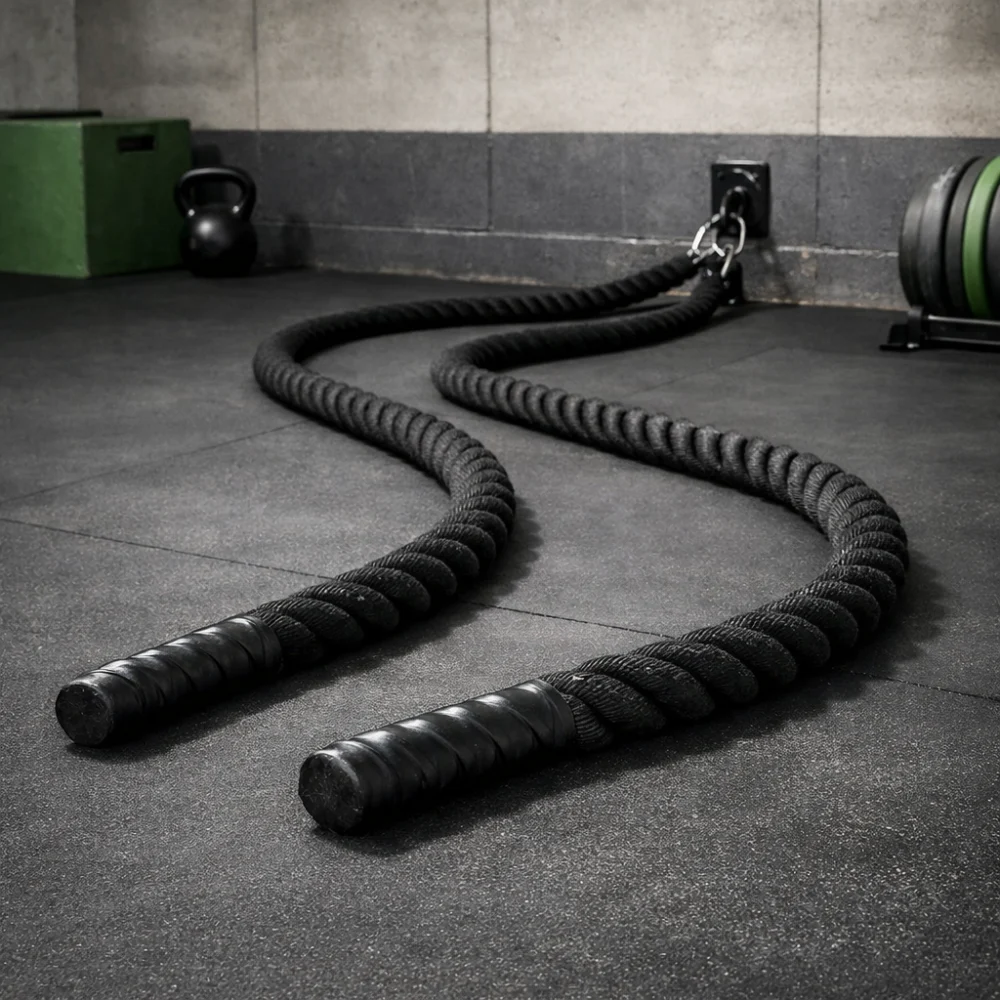
Battle ropes are a simple piece of training kit with a lot of variation behind the scenes. The right choice depends on where you plan to use it, how much space you have and how demanding you want the workout to feel.
If you are comparing options for a home gym, studio or commercial space, it helps to focus on the practical details rather than the headline description. Small differences in length, thickness, finish and anchoring can make a rope feel very different in use.
This guide explains the main buying points so you can narrow the field quickly and avoid choosing a rope that is awkward for your space or harder to use than expected.
What should you look for when buying battle ropes?
The best starting point is to match the rope to your training area and the way you plan to use it. A longer or thicker rope can feel more demanding and may suit more spacious setups, while a shorter or lighter option can be easier to place and manage. Specifications vary by model, so always check the individual product page before buying.
From there, compare the parts that affect day-to-day use: the rope material or finish, whether it includes a protective sleeve, how it is anchored and how much room it needs to move safely. The most suitable rope is usually the one that balances training feel, durability and convenience for your setting.
| Feature | What it means | Why it matters | What to check |
|---|---|---|---|
| Length | The overall rope length available for movement | Longer ropes usually need more space and can change the feel of the exercise | Check the stated length against your floor space and anchor position |
| Thickness | The rope diameter | Thicker ropes may feel more substantial in the hands and during swings | Look at the listed diameter and think about grip comfort and workout intensity |
| Material and finish | The rope construction and outer surface | This affects handling, wear and how the rope feels during repeated use | Read the product details for the rope construction and any protective covering |
| Anchoring method | How the rope is secured for use | A suitable anchor helps keep the rope stable and makes setup easier | Check whether an anchor point, bracket or other fixing is included or required |
| Indoor or outdoor suitability | Whether the rope is intended for a gym floor, garage or external space | Some settings are harder on equipment than others | Review the product page for any use guidance or care notes |
Which features matter most?
Length and training space
Length is one of the first decisions to make because it affects both the movement pattern and the space needed around the rope. If your workout area is compact, a very long rope may be awkward to place and can limit the exercises you can do comfortably. In a larger space, extra length may give you more freedom, but only if you can anchor and use it safely.
Thickness and feel in the hands
Thickness influences how the rope feels when you grip it and how much effort is required to move it. A thicker rope can feel more demanding, but it may also be less comfortable if you are newer to rope training or if you prefer shorter sessions. For most buyers, grip comfort and training goal matter more than chasing the thickest option available.
Construction and durability
Battle ropes are used repeatedly and can be dragged, swung and moved often, so the construction matters. Look for a build that suits the surface and intensity of your training, especially if the rope will live in a garage gym or shared space. Protective sleeves or coverings may help reduce wear in some setups, but the useful question is whether they match your environment.
Anchoring and setup
Some ropes are sold with a way to secure them, while others assume you already have a suitable anchor point. That distinction matters because a rope that looks straightforward online may need extra space or additional hardware in practice. Check what is included, what is required and how the rope is intended to be fixed before you buy.
Types of battle rope setups
There is usually more variation in setup than in the general category itself. Standard battle ropes are the familiar choice for wave and slam-style exercises, while some products are described with protective sleeves or supplied with fixing hardware. Ropeless training products are a different approach again: they aim to create a similar movement pattern without a full-length rope, which can suit buyers with limited space.
Each option has a trade-off. A standard rope gives you the most recognisable training experience, but it needs more room and a suitable anchor. A sleeved or bundled setup may be easier on the rope surface in some environments, but you still need to check whether it suits your training area. Ropeless options can be compact, but they are not the same as a traditional battle rope workout.
Choosing by buyer need
| Buyer need | What to prioritise | What to avoid overlooking |
|---|---|---|
| Home gym with limited space | Compact length, manageable thickness, straightforward storage | Anchor requirements and how much room the rope needs to move |
| More intense conditioning work | Heavier-feeling rope, construction suited to repeated use | Grip comfort and whether the rope feels too demanding for your level |
| Shared training space | Durability, easy setup and clear anchoring | Whether the rope suits the surface and can be stored neatly |
| Beginner or occasional user | Simple setup and a feel that is not overly harsh | Choosing a rope that is too heavy or too long for the intended use |
| Space-conscious buyer | Practical length and clear storage expectations | Forgetting to account for swing room as well as rope length |

Common mistakes to avoid
- Choosing by rope length alone and forgetting about the space around it.
- Assuming a thicker rope is automatically the better option for every user.
- Overlooking whether an anchor point or fixing is needed.
- Ignoring storage and floor-surface considerations until after purchase.
- Assuming a product with a similar name will feel the same in use.
The useful correction is to think about the full setup, not just the rope itself. A battle rope only works well when the length, thickness, anchor and room available all line up with the way you want to train.
Safety and suitability notes
Battle ropes are straightforward training equipment, but they still need enough clear space and a stable setup. Before buying, check whether the rope is suitable for your floor, your anchor point and the users who will handle it. If more than one person will use the same rope, choose based on the least experienced or least comfortable user rather than assuming everyone will want the same feel.
Care, storage and long-term use
How long a battle rope stays in good condition depends largely on where it is used and how it is stored. Keeping it dry, off abrasive surfaces and away from unnecessary dragging can help reduce wear. If the rope includes a sleeve or other protective element, treat that as part of the buying decision rather than an afterthought, because it may affect handling and upkeep.
How to compare battle rope options efficiently
- Decide where the rope will be used and how much clear space you have.
- Choose the general setup that suits that space and your training style.
- Compare length, thickness, construction and anchoring details.
- Check whether the rope feels appropriate for the intended user’s experience level.
- Read the individual product page carefully for what is included and what the rope requires.
Battle rope buyer checklist
- Have I allowed enough space for both the rope and the movement around it?
- Does the length suit my training area and intended exercises?
- Is the thickness likely to feel comfortable and manageable?
- Do I know how the rope is anchored or fixed in place?
- Is the material or finish suitable for how often it will be used?
- Will storage and care be easy in the space I have?
Frequently asked questions
What is a battle rope used for?
A battle rope is used for conditioning drills that involve waves, slams and other dynamic upper-body and full-body movements. It is usually chosen for training that feels demanding without requiring a large amount of separate equipment. The main question for buyers is not whether it works, but whether the rope fits the available space and the intended workout style.
Do I need a special anchor for a battle rope?
Not always, but you do need some way to keep the rope secure during use. Some products include a fixing solution and others assume you already have a suitable anchor point. Check the product page carefully so you know what is included and what you need to provide.
Is a thicker battle rope better?
Not necessarily. A thicker rope can feel more substantial and may suit buyers looking for a more demanding session, but it can also be harder to handle comfortably. The right choice depends on grip comfort, training goals and who will use it.
How much space do battle ropes need?
That depends on the rope length and the type of movement you want to perform. You need room for the rope itself as well as clear space around it so it can move freely. It is worth checking both the stated length and the practical layout of your training area before buying.
Are battle ropes suitable for home gyms?
Yes, provided the room and setup are suitable. They can work well in garages, dedicated home gyms and other open areas, but they are less convenient if the space is tight or shared with other equipment. Storage and surface wear are worth thinking about as part of the decision.
What should I check before ordering one?
Focus on the rope length, thickness, construction, anchoring requirements and the amount of room you have available. It is also sensible to check whether the listing explains what is included and whether any additional fixing hardware is needed. That keeps the choice practical and avoids surprises after delivery.