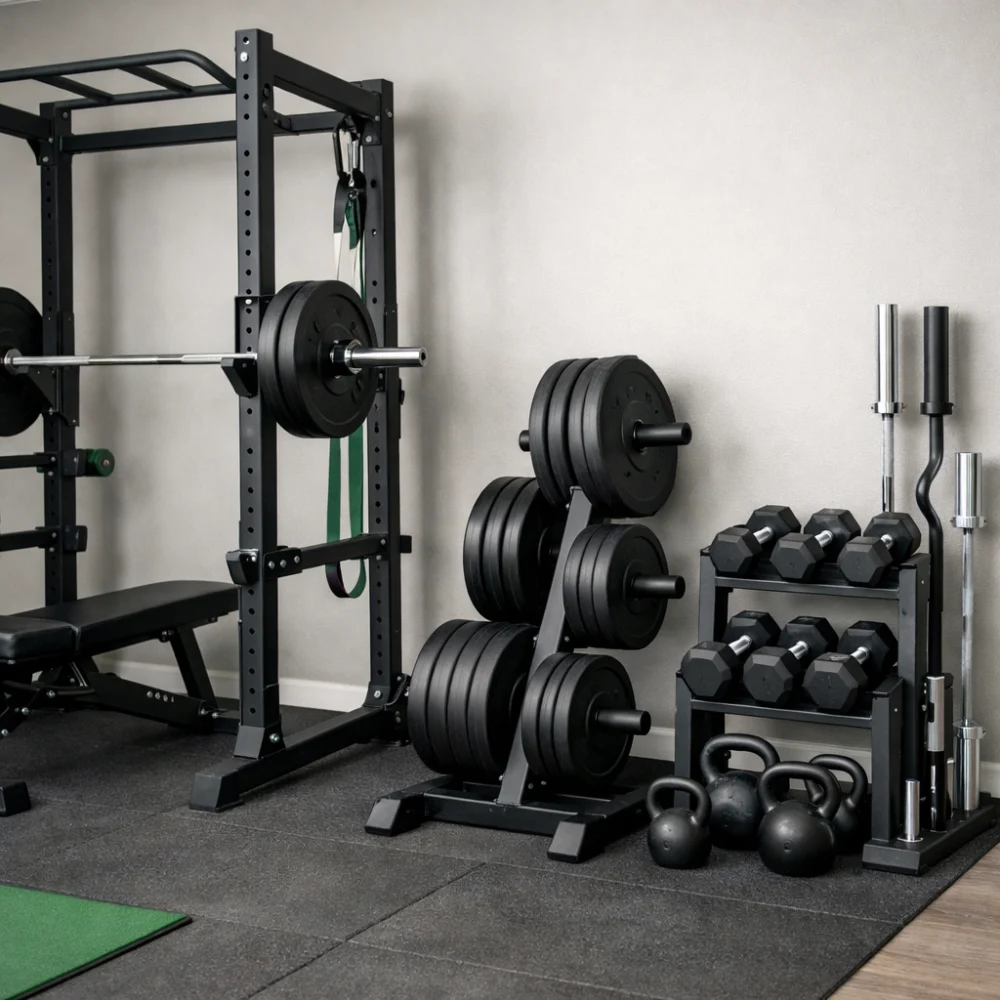
Weight racks and cages cover a few different needs in one category. Some products are mainly for storing dumbbells, plates or other training items neatly, while others are designed to support barbell lifting inside a more structured frame.
The right choice depends on what you want to store or lift, how much floor space you have and how stable the setup needs to feel. It also depends on whether you are building a tidy home gym, upgrading a lifting station or simply trying to keep equipment organised.
If you are comparing this category for the first time, it helps to separate storage racks from lifting cages. That simple distinction removes much of the confusion and makes the remaining choices easier.
What should you look for first in a weight rack or cage?
Start by deciding whether you need storage, lifting support or both. A storage rack is about organisation and access, while a cage or power rack is about creating a defined lifting space. After that, compare the footprint, the type of equipment it is meant to hold and how easy it is to load and unload. Specifications vary by model, so always check the individual product page before buying.
| Feature | What it means | Why it matters | What to check |
|---|---|---|---|
| Product type | Storage rack, plate rack or lifting cage | Sets the main job the product is meant to do | Whether it is for organising equipment, storing plates or supporting barbell work |
| Footprint | The floor space the unit occupies | Affects whether it fits your room comfortably | Overall size and how much clearance you need around it |
| Load handling | How much weight the rack is intended to carry | Important for safe, practical use with your equipment | Check the stated limits and match them to your current and likely future kit |
| Layout | Shelves, pegs, tiers or cage frame | Influences how easy the equipment is to organise and reach | Whether the layout suits dumbbells, plates or barbell training |
| Stability | How solid the unit should feel in use | Helps it suit heavier equipment and frequent use | Base design, frame shape and whether the unit is meant to stand free or be anchored |
| Access | How easily equipment can be loaded and removed | Matters if you use the rack often or share the space | Height, tier spacing and how comfortably you can reach the stored items |
Key decision criteria explained
Storage versus training support
Some buyers only need a place to keep weights tidy. Others need a rack or cage that becomes part of the lifting setup itself. Storage products are usually simpler to choose because the main question is whether they suit the equipment you already own. Lifting cages are more demanding because they need to fit your exercises, your movement space and the style of training you plan to do.
Equipment type and shape
Different racks suit different items. Dumbbell racks tend to focus on tiered access, plate racks focus on disc storage, and cages are built around barbell work. A product can be very practical for one type of equipment and awkward for another, so check what it is designed to hold rather than assuming a general-purpose label will cover everything.
Space and room layout
A rack that seems compact in theory may still feel large once placed in a real room. Think about not only the unit itself, but also the space needed to reach the weights, use a barbell or move safely around the frame. In smaller rooms, easier access can matter as much as storage capacity.
Stability and structure
Heavier equipment and more frequent use usually call for a sturdier frame and a more settled base. A simple rack that works well for light storage may not be the right choice for a busy lifting area. If you expect regular, repeated loading, the feel of the structure matters as much as the listed dimensions.
Ease of use
The most convenient rack is not always the biggest one. A layout that lets you see, reach and return equipment quickly can save time and reduce clutter in daily use. This is especially important if more than one person will use the same setup.
Common product types and how they differ
Within this category, the main difference is between storage-focused racks and lifting cages. Storage racks are usually chosen for dumbbells, plates or mixed home-gym accessories. They are best when the priority is order, access and using floor space efficiently.
Lifting cages and power racks are more specialised. They create a fixed area for barbell exercises and are generally chosen by buyers who want a more defined training station. Their limitation is that they take up more room and need more careful comparison against your exercise goals and available space.
Some products sit between those two ideas, combining storage features with a more training-oriented frame. Those can be useful, but they also deserve closer checking because the category name alone does not tell you how they are meant to be used.
Which type suits which buyer?
| Buyer need | What tends to matter most | Likely fit |
|---|---|---|
| Home gym storage | Compact footprint, easy access, tidy organisation | Dumbbell or plate storage rack |
| Barbell training setup | Frame stability, lifting space, practical layout | Weight cage or power rack |
| Shared exercise room | Clear access, simple loading, efficient use of space | Rack with straightforward shelving or pegs |
| Equipment that may grow over time | Room to expand and sensible load handling | More robust rack or cage with a layout that matches future use |
Common mistakes to avoid
- Choosing by category name alone instead of checking whether the product is for storage or for lifting support.
- Ignoring the space around the unit and focusing only on the footprint of the frame itself.
- Buying a rack that suits one type of weight but not the equipment you already own.
- Overlooking how easy it will be to load and unload items in day-to-day use.
- Assuming a larger unit is always better, when a simpler layout may be easier to live with.
Safety and suitability checks
For this category, the most important buying check is whether the product matches the way you plan to use it. Storage racks are for organising equipment; cages are for structured lifting support. Do not rely on a general label if the layout, size or intended use does not suit your setup.
If you are buying for heavier weights or more demanding training, read the product details carefully and check the stated limits and any assembly requirements. If the unit will sit on a smooth floor or in a shared room, stability and placement matter as much as appearance.
Maintenance, storage and long-term use
Weight racks and cages usually need only simple care, but regular use makes easy cleaning and sensible organisation worthwhile. Dust, chalk and general wear can build up over time, especially in a home gym that is used often. If a unit is moved occasionally, check that it can be repositioned without making daily use awkward.
For storage products, long-term satisfaction often depends on whether the layout still suits your equipment as your collection grows. For cages, the main question is whether the frame continues to suit your training space and lifting habits. It is worth thinking ahead so the unit remains convenient rather than just adequate.
How to compare options efficiently
- Decide whether you need storage, lifting support or both.
- Match the product type to the equipment you own now.
- Check the size, layout and floor space it will need.
- Compare how easy it is to load, unload and keep organised.
- Review the individual product page for limits, dimensions and any model-specific details.
Buyer checklist
- Have I chosen the right type for storage or lifting?
- Does it suit the equipment I already own?
- Will it fit comfortably in the space I have?
- Is the layout easy to use day to day?
- Do the stated limits suit my intended use?
- Will it still work if my kit collection grows?
Frequently asked questions
Is a weight rack the same as a weight cage?
No, not always. A rack is often used for storage or for a simpler frame, while a cage is usually a more enclosed structure associated with lifting support. The exact meaning can vary by product, so check the description carefully.
What is the main difference between a dumbbell rack and a plate rack?
A dumbbell rack is shaped around storing dumbbells in an easy-to-reach layout, while a plate rack is built for weight plates. They solve different storage problems, so the best choice depends on which items you need to keep organised.
How do I know if a cage will suit my room?
Look at the product dimensions and think about the space needed to use it, not just place it. A lifting cage needs enough surrounding room for loading, unloading and movement. A compact-looking frame can still feel large once in use.
Should I choose a simple rack or a more substantial frame?
Choose the simplest option that fits your needs well. If you only need storage, a straightforward rack may be enough. If you plan to use it as part of your lifting routine, a more substantial frame may be the better match.
Do I need a rack with multiple tiers?
Only if tiered access helps with your equipment and space. Multiple tiers can make storage more efficient, but they are not automatically better if the items become harder to reach or the unit becomes less convenient to use.
Can one product handle different kinds of weights?
Some products can store more than one type of equipment, but that is not guaranteed. It is better to check the layout and intended use than to assume a general-purpose design will suit everything equally well.
What should I check before buying online?
Check the product type, dimensions, intended use and any stated limits. If the item is for lifting support, make sure the frame style matches your training plan. If it is for storage, make sure it suits the shape and size of the equipment you own.