

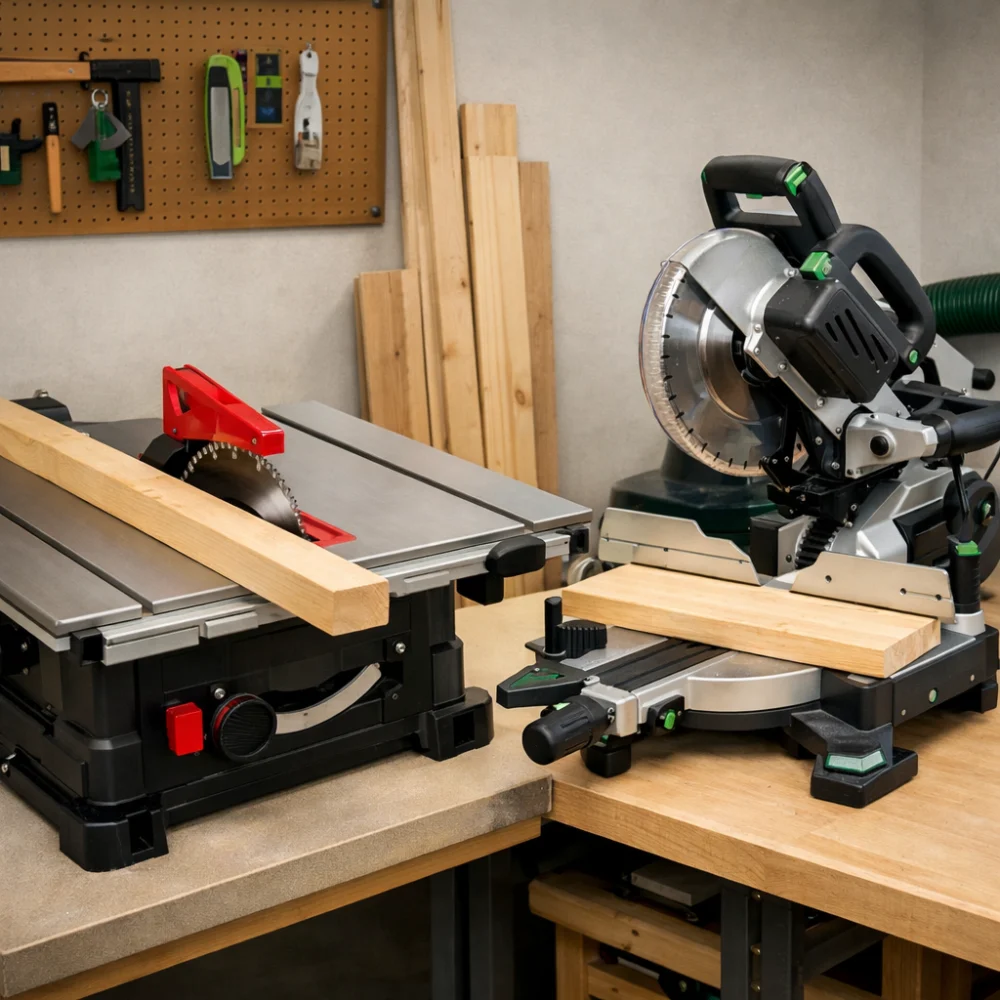

Table and chop saws are both useful for making accurate cuts in timber and other workshop materials, but they suit different jobs. A table saw is typically chosen for repeated straight cuts and sheet or board work, while a chop saw is generally better for quick crosscuts and repeat angle cuts.
If you are comparing them for home improvement, garden construction or general DIY, the key is to start with the cuts you need most often. That will usually matter more than looking only at motor size or blade size.
Because the category covers more than one style of saw, it helps to think about your workspace, the size of the material you will cut and how often you need to move the tool. Specifications vary by model, so always check the individual product page before buying.
Compare Table and Chop Saws


As an Amazon Associate we earn from qualifying purchases.
What should you choose: a table saw or a chop saw?
The right starting point is the cut, not the tool name. Choose a table saw if you need support for longer pieces, repeatable rip cuts or a fixed workshop setup. Choose a chop saw if you mainly need controlled crosscuts, mitre cuts or a tool that is easier to set up and move. The biggest trade-off is capacity versus convenience: table saws often suit more varied cutting tasks, while chop saws are often simpler for straightforward trim and framing work.
| Feature | What it means | Why it matters | What to check |
|---|---|---|---|
| Cut type | Whether the saw is suited to rip cuts, crosscuts or angle cuts | It determines which jobs the saw can do most comfortably | Look for the cut style described on the product page and match it to your most common tasks |
| Material support | How well the saw supports the workpiece during cutting | Better support can make longer or wider cuts easier to manage | Check the table, fence, bed or arm arrangement and any supplied supports |
| Capacity | The size of material the saw can handle | Limits what you can cut in one pass | Check the listed cutting capacity and compare it with your typical boards, trims or panels |
| Portability | How easy the saw is to move and store | Important if you work on site or have limited space | Consider weight, handles, folding stands and whether the saw needs a fixed bench |
| Adjustment and repeatability | How easily you can set angles, stops and guides | Useful for accurate repeat cuts and consistent finishes | Look for fences, mitre adjustments, bevel settings and clear scales |
| Dust management | How the saw handles dust and offcuts | Cleaner extraction can improve visibility and reduce mess | Check whether a dust port or collection arrangement is mentioned |
Key decision criteria explained
1) The main cut you need
Different saw designs make different tasks easier. If most of your work is cutting boards to width, a table saw is usually the more natural fit. If you are cutting skirting, trim, framing timber or repeated lengths at angles, a chop saw may be more convenient. Think about the work you do most often rather than the occasional job you hope to tackle later.
2) Size of material and workspace
Larger material needs more support and room to feed or position safely. A saw that looks suitable on paper may still feel awkward in a small garage or garden workshop if you cannot support the workpiece properly. Measure your bench space, storage space and the longest material you expect to cut, then compare that with the product information.
3) Accuracy features
Fence quality, angle settings and clear adjustment markings can make a real difference if you need consistent results. For many buyers, this matters more than chasing the highest power figure. If accuracy is important, check how the saw is described for setting angles, repeats and guides, rather than assuming all saws will feel the same.
4) Portability versus fixed setup
Some buyers need a saw that stays in one place; others need something that can be stored away or taken to different jobs. Portable convenience can mean a lighter build or a more compact format, but that may reduce support or capacity. Fixed workshop saws may be less convenient to move, yet they can be easier to leave set up and aligned.
5) Dust and cleanup
Cutting wood and sheet materials creates dust and offcuts, so it is worth considering how the saw manages them. A better dust connection can improve visibility and reduce cleanup time, though it is still sensible to expect some mess. If you work indoors or in a shared space, this may influence your choice more than you first expect.
Common types and how they differ
Within this category, the broad split is between table saws and chop saws, but the practical differences are about use rather than labels alone.
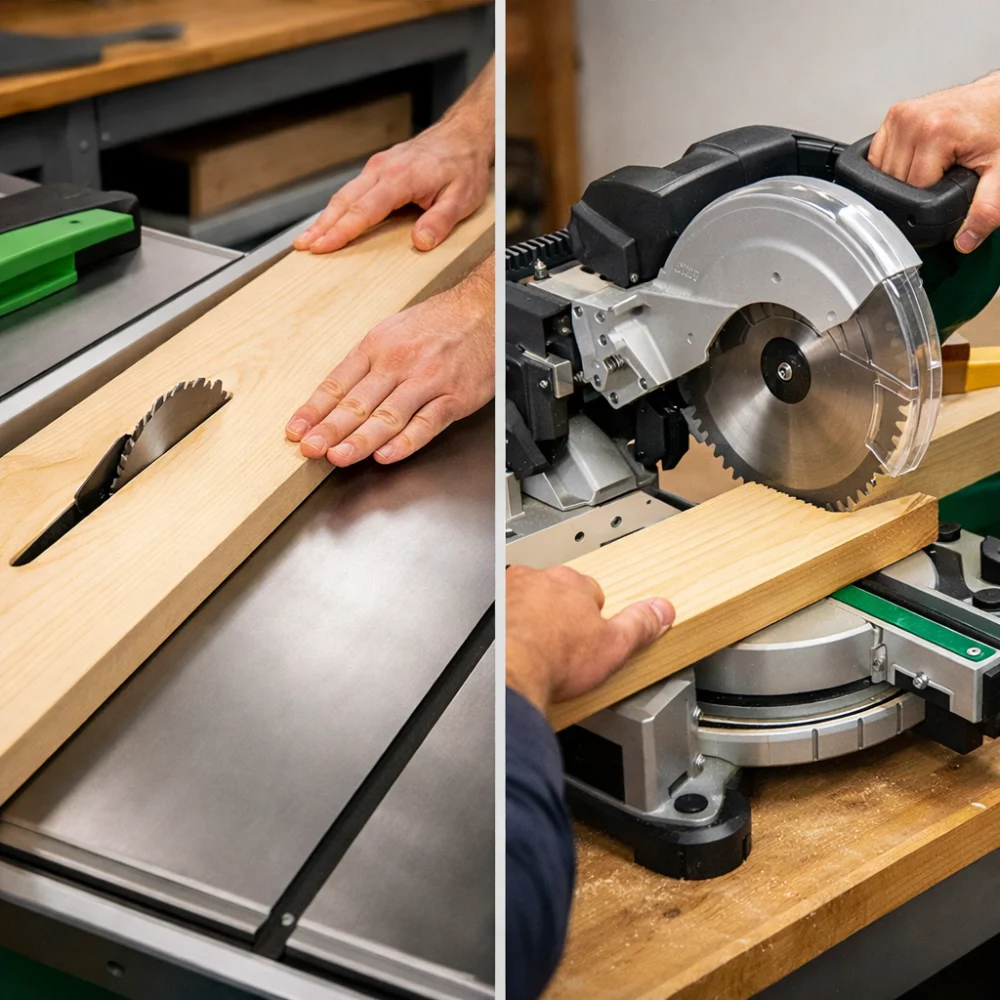
- Table saws suit repeatable straight cuts and workshop-style use, especially when you want a fixed cutting surface.
- Chop saws suit crosscuts and angle cuts where quick setup and straightforward handling matter more than sheet-material support.
- Compound or sliding variants may suit buyers who need more cutting flexibility, but they usually bring more setup complexity and take more room.
If you are unsure which type you need, start with the material you cut most and the space you have to work in. That will usually narrow the choice quickly.
Which type suits different buyers?
| Buyer need | Likely better fit | Why | What to watch |
|---|---|---|---|
| General DIY and occasional cutting | A simpler, easy-to-set-up saw | Convenience often matters more than specialist capacity | Keep an eye on storage size, setup time and the cuts you will actually make |
| Workshop use with repeat cuts | A stable table saw | Fixed support can help with consistency | Check fence, table size and how well the workpiece is supported |
| Trim, framing and angle cuts | A chop saw | It is usually the more direct choice for crosscut work | Look at mitre and bevel adjustment, plus the material size you need to cut |
| Limited storage space | Compact or portable design | Ease of moving and storing may matter most | Balance portability against the cutting capacity you need |
| Frequent on-site use | Portable saw with practical handling | Mobility and quick setup are important | Consider weight, stand options and how easy it is to carry |
Common mistakes to avoid
- Choosing by power alone: a higher power figure does not automatically mean the saw suits your material or cutting style better.
- Ignoring work support: unsupported long pieces are harder to handle, even if the saw itself looks capable.
- Forgetting the available space: some saws need more room around them than buyers expect, especially when handling longer boards.
- Assuming one saw can do everything equally well: many models can cover several tasks, but most are still better at some jobs than others.
Safety and suitability caveats
Table and chop saws are cutting tools, so suitability matters as much as features. Check the material the saw is intended for, the size of work you plan to cut and whether you have enough room to support the work safely and comfortably. Do not assume that a saw advertised for one type of cutting will be ideal for another without checking the individual product page.
Specifications vary by model, so always check the individual product page before buying.
Maintenance, storage and ownership considerations
Think about blade care, cleaning and storage as part of the purchase decision. A saw that is easy to keep clean may be more pleasant to use regularly, especially if dust and offcuts build up in your workspace. If the model uses accessories or blades that wear with use, it is worth checking what replacements or consumables may be needed over time.
If you will store the saw between jobs, make sure you have a dry place for it and enough room for any stands, fences or accessories that come with it.
How to compare options efficiently
- Start with the cut you need most often.
- Decide whether a fixed workshop setup or a portable saw makes more sense.
- Compare capacity, support and adjustment features against the material you plan to cut.
- Check the individual product page for the details that matter most to your job.
- Balance convenience, space and accuracy rather than focusing on one single specification.
Summary buyer decision checklist
- Have you chosen the saw type that matches your main cut?
- Will the saw handle the size of material you use most often?
- Do you have enough space to set it up and support the work safely?
- Are the angle, fence or guide features suitable for your accuracy needs?
- Will portability or fixed stability matter more in your workspace?
- Have you checked the individual product page for model-specific details?
Frequently asked questions
Can one saw replace the other?
Sometimes a saw can cover more than one task, but it is rarely the most efficient choice for every job. Table saws and chop saws are designed around different cutting needs, so it is sensible to choose the one that fits your most frequent work.
Which is better for a small workshop?
That depends on the type of cutting you do. If space is tight and you mainly need crosscuts, a chop saw may be easier to manage. If you need a fixed surface for repeatable straight cuts, a compact table saw may make more sense.
Do I need a stand or bench?
It depends on the model and how you plan to use it. Some saws are best on a stable work surface, while others may be paired with a stand for portability or better work height. Check the product page for the setup that suits the saw.
Is blade size the most important detail?
Blade size is useful, but it should not be the only thing you compare. The saw’s intended cut, capacity, support and adjustment features often matter just as much for everyday use.
What matters more: accuracy or speed?
Most buyers need a sensible balance of both. If you are doing repeated joinery or finish work, accuracy and repeatability are likely to matter most. If you are cutting rough lengths on site, ease of setup and handling may be more important.
Should I buy the most portable option?
Only if portability is a real need. A lighter or more compact saw can be easier to move, but it may offer less support or capacity than a larger fixed model. Choose based on your workspace and how often you need to carry it.
More Table and Chop Saws
See all 246 Table and Chop Saws →



As an Amazon Associate we earn from qualifying purchases.


