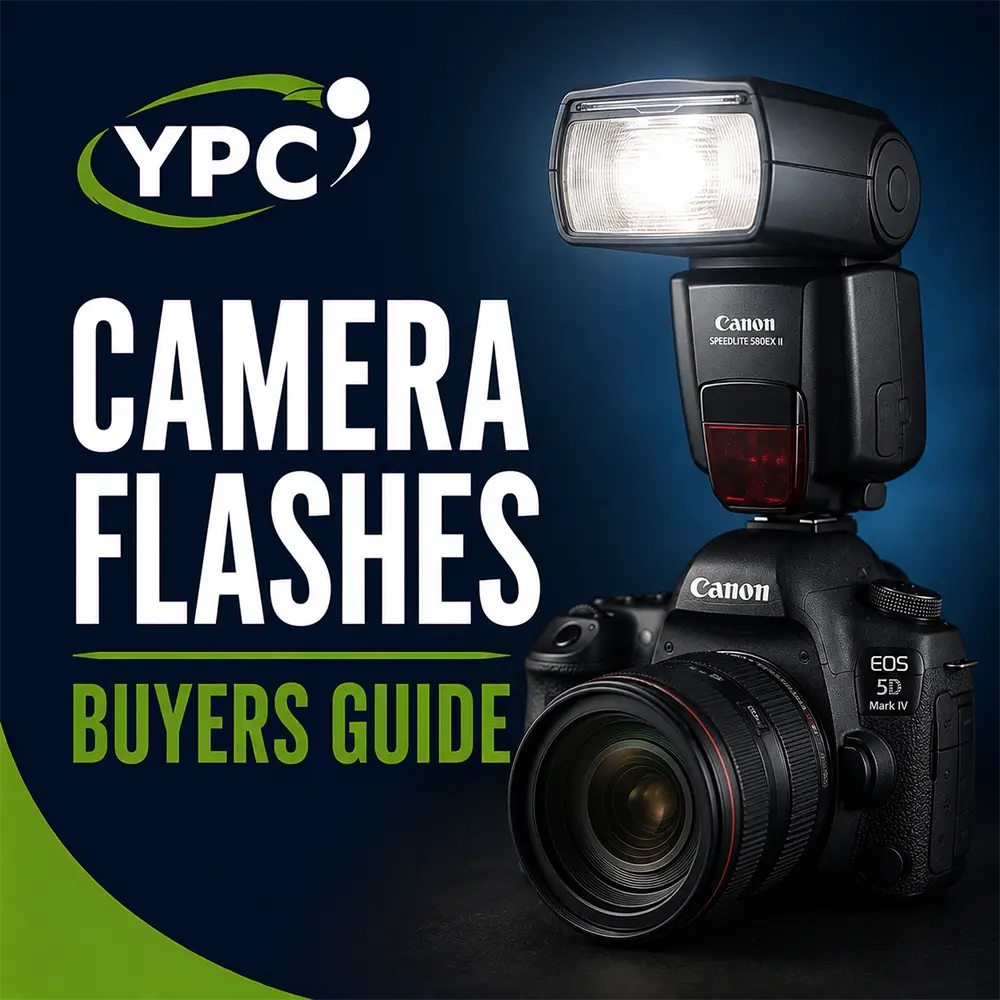
Camera flashes are used to add controlled light at the moment a photograph is taken. This guide explains how different types of camera flashes behave and how to compare them when choosing between options. It focuses on understanding features, compatibility, and suitability rather than recommending specific products. The aim is to support clearer decisions across a wide range of photographic situations.
Quick product comparison framework
The table below outlines common differentiators found within the camera flashes category. Not every product includes every feature.
| Differentiator | What it represents |
|---|---|
| Flash type | Speedlight, ring flash, macro flash, or flash with wireless trigger support |
| Mounting method | On camera hot shoe or off camera use |
| Power source | Battery powered or camera powered |
| Control options | Manual control, automatic modes, or remote triggering |
| Size and weight | Compact units versus larger bodies |
| System compatibility | Designed to work with specific camera systems |
| Intended use context | General photography, close up work, or multi light setups |
Specifications vary — see individual product pages for details.
Key decision criteria explained
When comparing camera flashes, several core factors shape suitability.
Compatibility
Flashes are designed to communicate with specific camera systems. Connection type and control support can differ between brands and camera bodies. Always check stated compatibility.
Power behaviour
Output capability influences how much light a flash can provide in different conditions. Higher output can offer more flexibility but may involve larger size or increased power consumption.
Control flexibility
Some flashes allow finer control over output levels or support remote triggering. Others focus on simple operation with limited adjustment.
Portability
Weight and physical size matter when carrying equipment for long periods or when working in mobile environments.
Learning curve
More control options often bring added complexity. Simpler units may suit users who want predictable behaviour with minimal adjustment.
Product type differentiation and variants
Several distinct flash types sit within this category.
Speedlights
Speedlights are compact flash units commonly mounted on a camera hot shoe. They are used across many photography styles and often support both automatic and manual control. Specifications vary — see individual product pages for details.
Ring flashes
Ring flashes produce light that surrounds the lens. They are often used to reduce shadows in close range photography. Light output and mounting designs differ between products.
Macro flashes
Macro flashes are designed for close up subjects where precise lighting control is needed. They may use dual light heads or specialised mounting arrangements. Specifications vary — see individual product pages for details.
Wireless triggers and flash systems
Some flashes support wireless triggering either built in or via separate trigger units. These allow off camera use and coordinated lighting setups. Compatibility and range support can vary.
Suitability by reader type or need
Different flash types align with different needs.
- General photography across varied scenes often aligns with compact speedlights that balance portability and control.
- Close up photography may suit ring flashes or macro flashes where shadow control is important.
- Multi light setups or creative lighting approaches often benefit from flashes that support wireless triggering.
- Users prioritising simplicity may prefer flashes with limited controls and straightforward operation.
- Those seeking flexibility across many scenarios may look for broader compatibility and adjustment options.
Common mistakes and misunderstandings
Several assumptions commonly affect decision making.
- Assuming all flashes work with all cameras. Compatibility varies and must be checked.
- Equating higher power with better results. Suitability depends on use context, not output alone.
- Overlooking size and weight when planning mobile shooting.
- Expecting a single flash type to suit every photography style equally.
- Confusing continuous lighting equipment with flash based lighting systems.
Safety and suitability caveats
Camera flashes are electronic accessories and should be handled with general care. Suitability depends on compatibility with the camera system and the intended photographic context. No flash offers universal coverage across all situations or camera models.
Maintenance expectations and lifespan considerations
Flash units contain electronic components and moving parts that experience wear over time. Longevity depends on usage patterns, storage conditions, and power cycling frequency. Expectations for lifespan should remain general rather than absolute, as use conditions vary.
How to compare models efficiently
An effective comparison approach focuses on decision clarity rather than features alone.
- Confirm compatibility with your camera system first.
- Identify the primary photography contexts you intend to use the flash in.
- Compare control options only to the level you expect to use.
- Consider size and weight alongside output capability.
- Review power source expectations in relation to your shooting duration.
Summary buyer decision checklist
- Confirm camera system compatibility
- Identify preferred flash type for your main use
- Consider required control complexity
- Assess size and portability needs
- Align power behaviour with shooting environments
- Check support for wireless use if needed
Frequently asked questions
What does a camera flash actually do
A camera flash emits a brief burst of light when a photo is taken. This helps illuminate scenes where available light is limited or uneven.
Are external flashes different from built in camera flashes
Yes. External flashes are separate units and often offer greater flexibility in positioning and control compared to built in flashes.
Can one flash be used for both indoor and outdoor photography
Many flashes are used in both contexts. Suitability depends on output behaviour, portability, and how the flash integrates with your camera system.
Do wireless triggers work with all flashes
Wireless trigger support varies by product and system. Always review compatibility information before assuming interoperability.
Are ring flashes only for macro photography
Ring flashes are commonly used for close up work, but some photographers also use them for other specialised lighting effects. Use suitability depends on creative intent.
For products in this category, visit:
https://www.ypc.co.uk/product-category/outdoor-tech/cameras-and-imaging/camera-flashes/