
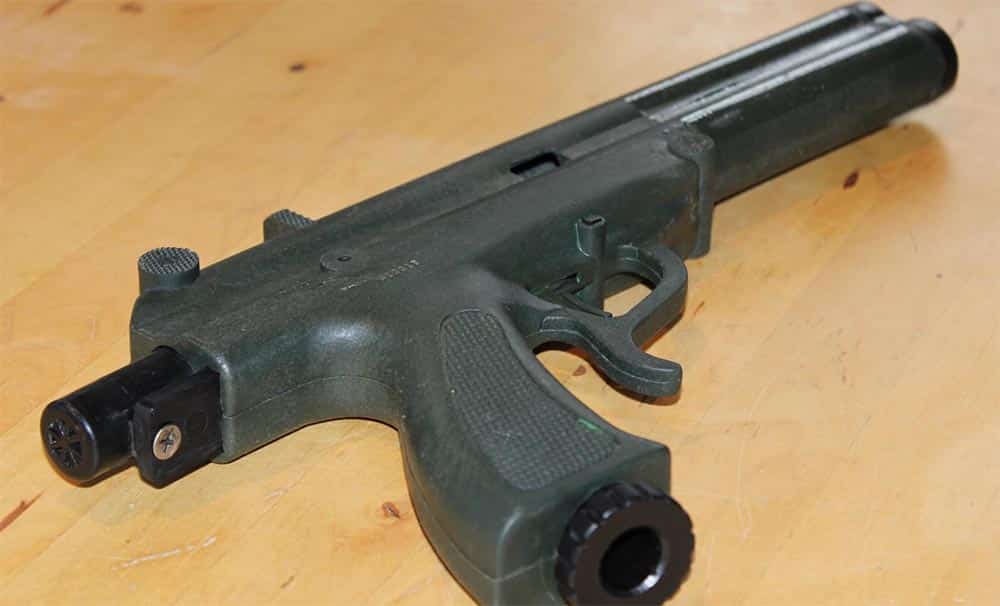
Paintball has changed dramatically since its early days in the 1980s. What began with simple utility markers used for marking trees has evolved into a highly technical sport played worldwide. Alongside that growth, paintball guns, more accurately called markers, have undergone huge technological advances that have reshaped how the game is played.
From crude mechanical designs to electronically controlled systems, modern paintball guns bear little resemblance to their ancestors.
The Early Days – Nelspot 007 and CO2 Power
The story starts with the Nelspot 007. These early markers were never designed for sport. They were built to mark livestock and forestry, powered by CO2, single shot, and mechanically simple.
Accuracy was inconsistent, rates of fire were slow, and reliability depended more on luck than engineering. Yet these markers laid the foundations for paintball as a competitive activity.
As organised games emerged, the limitations of early designs became obvious. Players wanted faster reloads, better consistency, and equipment that could survive repeated use in rough environments.
Electronic Triggers Changed Everything
One of the most significant technological advances in paintball guns was the introduction of electronic trigger systems.
Electronic markers replaced heavy mechanical hammers with solenoids and circuit boards, allowing much lighter trigger pulls and far higher rates of fire. More importantly, they brought consistency. Shots became smoother, recoil reduced, and accuracy improved because markers fired more predictably.
Programmable firing modes also emerged, allowing players to adjust trigger sensitivity, debounce, and firing behaviour. Whether that was good or bad for the sport is still debated, but there is no denying it permanently changed competitive paintball.
Air Systems and the End of CO2
Another major leap forward came with the widespread adoption of high pressure air systems.
CO2 is highly temperature sensitive. As conditions changed, so did velocity, often wildly. High pressure air solved this problem almost overnight. Regulated compressed air provided consistent pressure, smoother operation, and far greater reliability.
Modern air systems also allowed markers to run at lower operating pressures, reducing wear on internals and making guns quieter and easier to control. This single change improved both performance and longevity across the board.
Loader and Hopper Technology
Early gravity hoppers struggled to keep up as markers became faster. Jams, misfeeds, and chopped paintballs were common.
The development of force feed loaders transformed the game. Systems like the HALO and later the Dye Rotor applied constant pressure to the paint stack, allowing paintballs to feed reliably at extremely high rates of fire.
This advance did not just support faster shooting. It reduced downtime, improved consistency, and made modern electronic markers practical in real gameplay rather than just on paper.
Materials, Weight, and Ergonomics
As technology advanced, materials improved too. CNC milling, aerospace grade aluminium, carbon fibre components, and high quality polymers dramatically reduced weight while increasing durability.
Modern paintball guns are not just lighter. They are better balanced, more ergonomic, and designed to reduce fatigue over long game days. Adjustable grips, modular frames, and tool less maintenance have become standard rather than luxury features.
What the Future Holds
Paintball technology continues to evolve, but not always in obvious ways. Connectivity, onboard diagnostics, and data tracking already exist, even if they are not widely adopted.
Markers are unlikely to get much faster, but they will continue to get smarter, more efficient, and more reliable. The focus is shifting away from raw performance and toward usability, durability, and experience.
Despite all the technology, the core appeal of paintball remains unchanged. It is still about movement, teamwork, and decision making, not just equipment.
Conclusion
From the Nelspot 007 to modern electronically controlled markers, technological advances in paintball guns have reshaped the sport entirely. Improvements in triggers, air systems, loaders, materials, and ergonomics have made paintball faster, safer, and more accessible to players of all levels.
Technology will continue to influence paintball, but it will never replace what makes the game special. The marker is just a tool. What matters is how you play walkon paintball.

