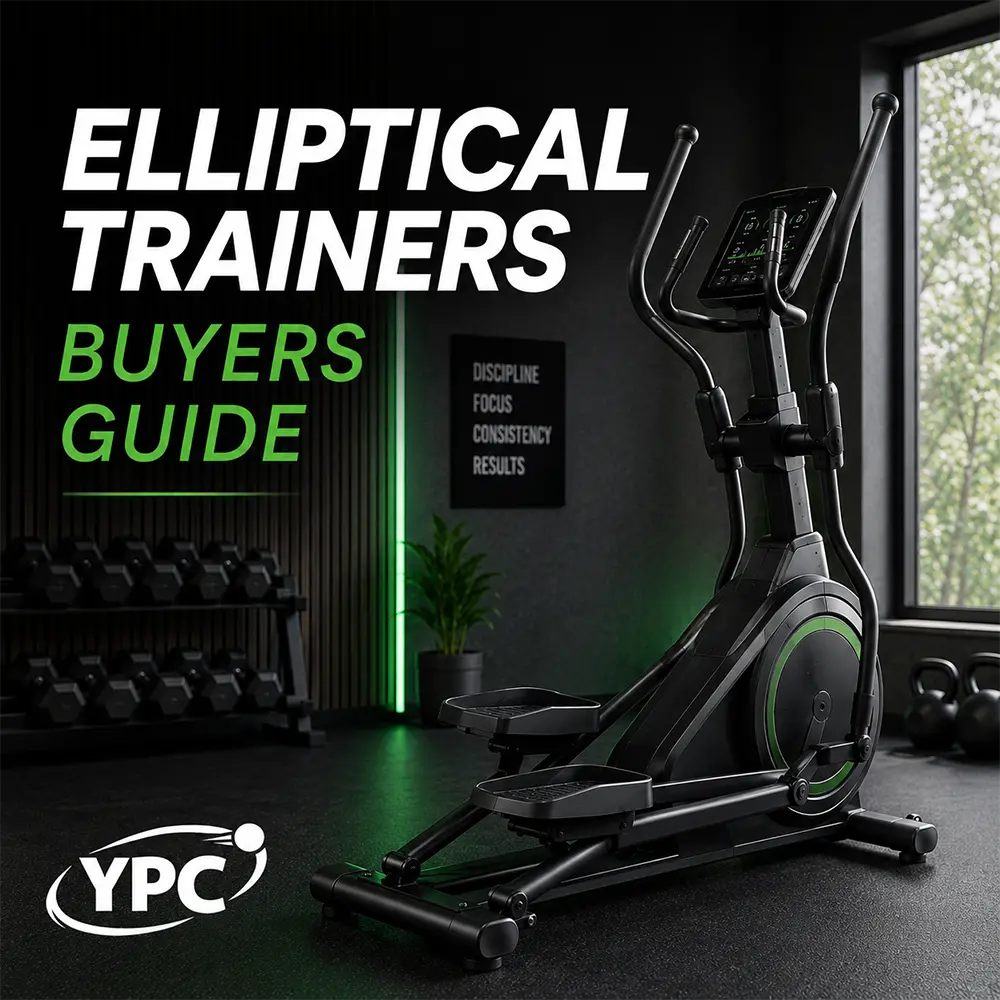
Elliptical trainers are indoor cardio machines that use a guided oval stride motion for structured movement based training. This Buyers Guide explains how ellipticals differ in build, motion feel, resistance systems and space requirements, and how those differences affect suitability for home environments. The aim is to help you compare options clearly and choose a machine that fits your space, comfort preferences and usage needs.
Quick Product Comparison Framework
| Feature area | How options differ |
|---|---|
| Drive type | Front drive, rear drive, compact designs |
| Stride length | Shorter to longer stride paths |
| Resistance system | Manual, magnetic or digitally controlled |
| Frame size | Compact footprints to full size units |
| Handle configuration | Fixed handles or moving arms |
| Console design | Basic displays to more detailed readouts |
| Noise profile | Quieter systems to more audible movement |
| Storage approach | Fixed frames or space saving designs |
Key Decision Criteria Explained
Build quality and durability
Frame construction, joint design and overall rigidity influence how solid the machine feels over time.
Smoothness of motion
Ellipticals vary in how fluid the stride feels through the full movement cycle.
Resistance system feel
Resistance mechanisms differ in how evenly resistance is applied and how easy it is to adjust.
Stride length comfort
Stride length affects natural movement feel and overall comfort, particularly for longer sessions.
Noise levels
Sound output can vary depending on drive system, resistance type and overall build.
Footprint and storage
Overall dimensions and frame layout determine suitability for limited or shared spaces.
Console simplicity
Displays range from basic metrics to more detailed tracking. Ease of use matters for shared households.
Stability and weight capacity
Heavier frames often feel more planted. Weight ratings vary by model.
Ease of use for beginners
Clear controls, predictable motion and simple setup support confidence for new users.
Value for money
Value depends on build quality, feature set and how well the machine suits its intended environment.
Product Type Differentiation and Variants
Front drive ellipticals
Often place the flywheel at the front, influencing frame length and stride feel.
Rear drive ellipticals
Typically position the flywheel at the rear, which can change motion characteristics.
Compact ellipticals
Designed for smaller rooms with reduced footprints.
Ellipticals with moving handlebars
Include upper body involvement through moving arms.
Fixed handle designs
Provide stationary grip points alongside lower body motion.
Specifications vary — see individual product pages for details.
Suitability by Reader Type or Need
- Beginners often prioritise smooth motion, stability and simple controls.
- Beginner to intermediate users may look for adjustable resistance and comfortable stride length.
- Mixed households benefit from intuitive consoles and quiet operation.
- People returning after a break often value predictable movement and manageable resistance changes.
- Weight loss focused users typically look for consistent motion and usability over long sessions.
- Limited space users often favour compact footprints or efficient frame layouts.
Common Mistakes and Misunderstandings
- Choosing based on console features alone rather than motion feel.
- Underestimating the space required once in use.
- Assuming all ellipticals have similar stride lengths.
- Overlooking noise considerations in shared living spaces.
- Expecting compact machines to feel identical to full size units.
Safety and Suitability Caveats
Elliptical trainers are designed for indoor fitness use. Suitability depends on correct placement, stable flooring and appropriate machine selection. No machine eliminates injury risk. Always follow manufacturer guidance and ensure adequate space around the equipment.
Maintenance Expectations and Lifespan Considerations
Ellipticals generally require periodic checks of moving parts and frame connections. Lifespan depends on build quality, usage frequency and care. Over time, wear may occur in joints, resistance components or consoles. Durability varies between models.
How to Compare Models Efficiently
Start by measuring available space. Then compare stride length and frame size. Assess resistance feel and motion smoothness next. Finally review noise levels, console usability and overall build to narrow options logically.
Summary Buyer Decision Checklist
- Available floor space
- Preferred stride length
- Motion smoothness
- Resistance adjustment style
- Noise tolerance
- Console simplicity
- Stability and weight capacity
- Beginner friendliness
- Shared household use
- Budget alignment
Frequently Asked Questions
Are ellipticals suitable for beginners?
Many beginners use ellipticals, but suitability depends on comfort, stability and ease of use.
Do ellipticals take up much space?
Space requirements vary. Compact designs suit smaller rooms, while larger units need more clearance.
Are ellipticals noisy?
Noise levels vary by design and resistance system. Check product details carefully.
Do all ellipticals have the same stride length?
No. Stride length varies significantly between models.
Can ellipticals be used in flats or rental properties?
Many people use them in such spaces, provided size and noise are considered carefully.
For products in this category, visit:
https://www.ypc.co.uk/product-category/diet-fitness-and-exercise-equipment/exercise-equipment/cardio-machines/elliptical-trainers/