
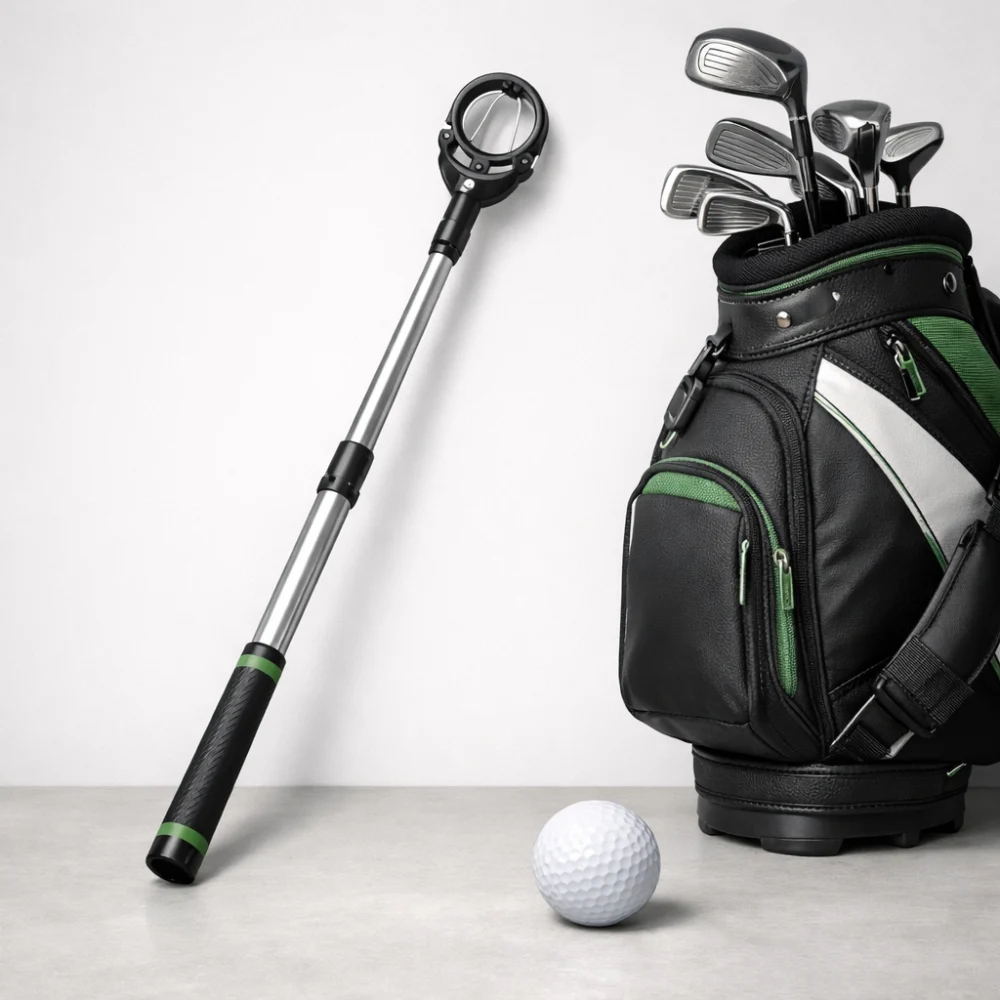
Golf ball retrievers are simple accessories, but the right choice depends on where you usually lose balls, how far you want to reach and how you prefer to carry the tool. Some buyers want a compact helper for the fringe, while others need extra reach for water, rough or awkward banked edges.
The most useful approach is to start with the type of retriever, then compare reach, pickup method and portability. That makes it easier to avoid buying a model that is longer, bulkier or less convenient than you really need.
What should you look for in a golf ball retriever?
The best starting point is the balance between reach and convenience. A longer retriever can help in harder-to-reach places, but it may also be less compact and less comfortable to carry. If you only need occasional help around the course, a lighter and shorter option may be easier to live with.
Choose the pickup style that matches how you like to use it. Some retrievers work as a scoop or grabber, while others are designed to fit onto a putter grip or other carrying setup. Specifications vary by model, so always check the individual product page before buying.
| Feature | What it means | Why it matters | What to check |
|---|---|---|---|
| Reach | How far the retriever can extend or how easily it can access a ball | Determines whether it suits nearby pickups or harder-to-reach spots | Look for the stated length and whether that suits your typical use |
| Pickup method | The way the ball is secured or lifted | Affects ease of use and how quickly you can recover a ball | Check whether it is a grabber, scoop, suction style or putter-mounted design |
| Portability | How easy it is to carry in a bag or pocket | Important if you want it available without adding much bulk | Look for folded size, weight and how it stores when not in use |
| Build style | The materials and overall construction approach | Influences feel, sturdiness and handling | Check the shaft or body material and whether the design seems suited to regular use |
| Ease of storage | How neatly the retriever packs away between uses | Useful if you want it to fit alongside other golf accessories | See whether it collapses, retracts or attaches conveniently to your kit |
Key decision criteria explained
Reach and extension
Reach is often the first thing buyers compare, because it decides where the retriever is useful. If you mainly want help with balls just out of comfortable reach, a shorter design may be enough. If you expect to use it more often in awkward spots, longer reach can be practical, but it may also be less compact to carry.
Pickup style
The pickup mechanism affects how intuitive the retriever feels in use. Grabber-style designs may suit buyers who want a straightforward lift-and-lift-again approach, while suction or cup-style options may appeal to people who prefer a simple press-and-lift motion. The trade-off is usually between speed, grip and how much practice the tool needs.
Portability and storage
Many golfers want a retriever that does not get in the way until it is needed. A compact or foldable model can be easier to keep in the bag, especially if you value a tidy setup. If portability matters most, check the folded length, how it secures shut and whether it feels quick to deploy.
Comfort of use
A retriever should feel manageable in the hand and not awkward to operate. That matters more if you expect to use it often or if you prefer accessories that do not need much fiddling. If a design looks clever but seems hard to handle, it may be less satisfying in real use than a simpler alternative.
Types and variants
Within this category, the main distinctions are usually between telescopic retrievers, grabber or claw-style tools, scoop-style pick-ups and compact putter-mounted accessories. Telescopic designs are aimed at buyers who want more reach, while grabber-style tools focus on a more direct picking action. Compact attachment styles can suit golfers who want a very small, easy-to-carry option, though they may be less versatile.
The right type depends on whether you value reach, simplicity or minimal bulk most. No single style is ideal for everyone, and the best choice depends on how often you expect to use it and where.
Which retriever suits which buyer?
| Buyer need | What tends to matter most | What to prioritise |
|---|---|---|
| Occasional use on casual rounds | Convenience and simple storage | A compact retriever that is easy to keep in the bag |
| More frequent recovery from awkward spots | Reach and dependable handling | A telescopic design with a suitable extension |
| Minimal carry bulk | Size when folded or stored | A small, lightweight option that packs away neatly |
| Simple, low-fuss operation | Ease of pickup | A design with an intuitive grab or scoop action |
| Gift buying | Broad usefulness | A practical model that is easy to understand and store |
Common mistakes to avoid
- Choosing reach without thinking about portability. A very long retriever may be more useful in some situations, but it can be less convenient to carry.
- Assuming all pickup styles feel the same. The way a retriever grips or lifts a ball can make a big difference to how natural it feels.
- Overlooking storage. If the retriever does not fold, retract or pack neatly, it may stay in the bag less often than intended.
- Buying for rare edge cases. It is usually better to match the retriever to your regular use, not the most extreme situation you can imagine.
Safety and suitability notes
These accessories are straightforward, but you should still check that the design suits your normal playing conditions and the way you carry your kit. If a retriever is intended to attach to another item or work in a specific way, confirm that the individual product page describes that clearly. For any model, look carefully at the product information before buying so you understand how it is meant to be used.
Maintenance, storage and lifespan
Most golf ball retrievers are low-maintenance, but they still benefit from basic care. After use, it makes sense to keep them clean and dry before storing them with the rest of your golf accessories. Retractable or moving parts may be more convenient, but they also make it worth checking that the mechanism feels smooth and tidy when stored.
If you plan to leave the retriever in a golf bag, think about how much space it will occupy and whether it could snag on other items. A compact design can be easier to keep handy, while a longer one may need a dedicated place in your setup.
How to compare options efficiently
- Decide where you expect to use the retriever most often.
- Choose the type that best fits your carry style and how much reach you need.
- Compare the pickup method, folded size and ease of storage.
- Check the product page for the exact length, construction and any fitting details.
- Pick the option that balances convenience with the amount of reach you are likely to use.
Summary buyer decision checklist
- Does the retriever offer enough reach for your usual use?
- Is the pickup style one you are comfortable using?
- Will it fit easily in your bag or other storage space?
- Does the design look simple enough to use without fuss?
- Have you checked the individual product page for the exact details?
Frequently asked questions
Do I need a golf ball retriever if I only play occasionally?
Not everyone does, but it can still be useful if you want a simple way to recover balls from hard-to-reach places. Occasional players often prefer a compact model that does not take up much space. The main question is whether the convenience is worth carrying one on your regular rounds.
Are telescopic retrievers better than compact ones?
Telescopic retrievers usually offer more reach, which can be helpful in difficult spots. Compact retrievers are easier to carry and store, which may matter more if you only use one occasionally. The better choice depends on whether reach or portability matters more to you.
Which pickup style is easiest to use?
That depends on what feels natural in your hands. Some buyers prefer grabber-style tools because they feel direct, while others like a suction or scoop style because it seems simpler. The clearest way to decide is to compare the mechanism described on the product page with how you want to use it.
Will a retriever fit neatly in my golf bag?
Some will, but not all in the same way. Foldable or retractable designs are usually easier to stow, while longer fixed-length models may need more space. Check the stored or folded size if keeping your bag tidy is important.
Is a more expensive retriever always better?
Not necessarily. A higher-priced model may offer a different design, more convenient storage or a better feel, but that does not automatically make it the right choice for every golfer. Focus on the features you will actually use rather than the most complex option.
What should I check on the product page before buying?
Look for the reach, pickup style, storage size and any fitting or attachment details. Those are the features most likely to affect whether the retriever suits your routine. If any detail seems unclear, treat that as a sign to compare another option.

