
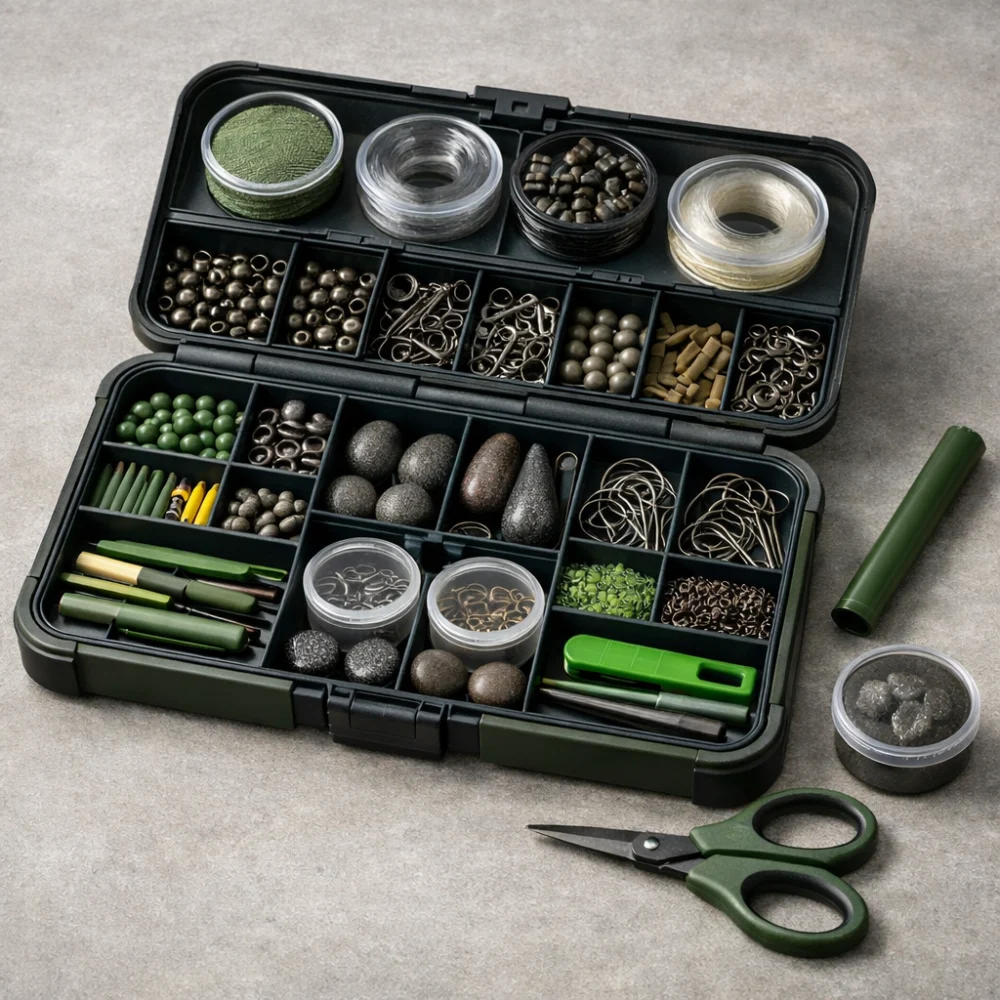
Terminal tackle kits can be a convenient way to gather the small rigging items that sit between your line and the rest of the setup. For many anglers, they are most useful when you want a compact start point for building rigs, topping up missing items or keeping a session bag organised.
The main challenge is that kits vary a lot in what they include and how they are arranged. Some are broad mixed assortments, while others are built around a particular style of fishing. The right choice depends less on the box itself and more on whether the contents suit the rigs you actually use.
Because these kits are often sold as collections of accessories rather than a single standard product, it helps to compare them by contents, convenience and suitability rather than by appearance alone. Specifications vary by model, so always check the individual product page before buying.
What should you look for in a terminal tackle kit?
Start with the rigs you intend to tie and the items you are most likely to use. A good kit is not simply the one with the most pieces; it is the one that gives you the right mix of components without leaving you with lots of parts you will never use. If you fish in more than one way, a broader assortment can be helpful, but if you favour a narrow style, a more focused kit may be better value.
The clearest trade-off is between convenience and specificity. A large mixed kit can be useful for beginners or for a spare bag, while a more targeted set may be better for experienced anglers who already know exactly which terminal items they need.
| Feature | What It Means | Why It Matters | What To Check |
|---|---|---|---|
| Contents | The mix of hooks, swivels, clips, beads, sleeves, stops or other terminal items included | Determines whether the kit suits your preferred rigs or only gives you general spares | Look for the component types you actually use most often |
| Quantity mix | How the contents are balanced across the different items | Some kits offer many pieces of one part but few of another | Check whether the balance matches your likely use, not just the total piece count |
| Storage | Whether the kit comes in a box, organiser or loose pack | Organised storage makes items easier to find and helps keep small parts separate | Consider compartment layout and whether the pack fits your carry system |
| Target style | Whether the kit appears aimed at a specific fishing approach | A targeted kit may be more useful than a generic assortment | Match the kit to the rigs, waters and species you normally fish for |
| Ease of selection | How simple it is to identify and use each item | Clear organisation matters if you are learning or rigging quickly on the bank | Check whether the contents are easy to separate and recognise at a glance |
Key decision criteria explained
Contents and balance
The most important question is whether the kit contains the right categories of terminal tackle for your style of fishing. A useful kit should reduce the need to buy several separate small packs, but it should still include enough of the items you use regularly. If the balance is poor, the kit can look complete while still leaving gaps where it matters.
Suitability for your rigging style
Different anglers build rigs in different ways, so a kit that suits one person may feel limited to another. If you often change setups, a broader assortment may make sense. If you tie the same few rigs repeatedly, a more focused kit can feel more efficient and less cluttered.
Organisation and portability
Small terminal items are easy to lose or mix up. A well-organised kit can save time when you are preparing tackle at home or swapping items during a session. Portability matters too, especially if you want the kit to live in a session bag, seatbox or carry-all rather than on a workbench.
Value versus duplication
It is easy to pay for repeated items you already have. If you own multiple terminal packs already, compare what the kit adds rather than looking only at the headline quantity. A smaller kit with the right mix may be better value than a larger one full of duplicates.
Product types and variants
Within this category, the main difference is usually not a formal product type but the style of assortment. Some kits are broad mixed boxes for general use, while others are shaped around a narrower set of terminal components for a more specific style of angling. There are also compact kits intended mainly for convenience and larger assortments intended to cover more situations.
The broader the kit, the more flexible it may be, but the more likely it is to contain items you do not need. The more focused the kit, the more likely it is to suit a particular routine well, but it may be less adaptable if your fishing changes.
Which kit suits which buyer?
| Buyer need | What to prioritise | Why it helps |
|---|---|---|
| Beginner learning basic rigging | A balanced kit with clear organisation and familiar core items | Makes it easier to gather useful parts without buying each item separately |
| Experienced angler topping up spares | A kit that fills gaps in the items already in your box | Helps avoid duplication and keeps your existing system efficient |
| Angler fishing in different ways | A broader assortment with enough variety to cover several rig styles | Provides flexibility when your approach changes between trips |
| Gift buyer | A generally useful kit with a tidy storage format | More likely to be practical without needing deep knowledge of the recipient’s exact preferences |
| Bank angler who values speed | An organised kit with easy access to the most-used items | Saves time when changing or rebuilding tackle during a session |
Common mistakes and misunderstandings
- Assuming more pieces always means better value. A large count can hide an imbalanced mix, so check whether the right components are included in useful quantities.
- Buying a generic kit without thinking about your rigs. A kit that does not match your normal fishing style can still leave you buying extras separately.
- Overlooking storage. Loose or poorly arranged items are harder to use and easier to misplace, especially in a crowded tackle bag.
- Ignoring what you already own. If you already have several terminal packs, duplication may matter more than headline variety.
Safety and suitability caveats
Terminal tackle kits are chosen for fishing use, so the main buying concern is suitability rather than complexity. Check that the contents suit the species, rig style and waters you actually fish, and avoid assuming that a kit will cover every situation. If you are buying for a younger or less experienced angler, simple organisation and easy identification of parts may matter as much as variety.
Maintenance, storage and lifespan considerations
These kits usually last best when small items are kept dry, separated and returned to their compartments after use. If the kit includes a box or organiser, consider whether it will stay secure in your bag and whether it is easy to open with cold or wet hands. Small components can be consumable in practice, so a good kit is one that makes replenishing individual parts straightforward.
How to compare options efficiently
- Decide which rigs or fishing situations the kit needs to cover.
- Check the contents and decide whether the mix suits those rigs.
- Compare the balance of pieces, not just the total number.
- Look at how the kit is organised and whether it fits your carry setup.
- Confirm on the individual product page whether it fills gaps in your existing tackle rather than repeating what you already have.
Summary buyer decision checklist
- Does the kit include the kinds of terminal items you actually use?
- Are the contents balanced in a way that suits your fishing style?
- Is the storage format practical for your tackle bag or seatbox?
- Will it add useful variety, or mainly duplicate items you already own?
- Does it feel broad enough for your needs without becoming cluttered?
Frequently asked questions
What is a terminal tackle kit used for?
It is used to gather together the small rigging items that sit at the end of the line or help connect parts of a rig. Buyers often choose one to simplify setup, keep spares together or cover a wider range of fishing situations.
Are larger kits always better?
Not necessarily. A larger kit can be useful if you need variety, but it may also include items you will never use. The better choice is the kit that matches your rigs and gives you the right balance of contents.
Should beginners choose the most comprehensive kit?
Usually not by default. A very large kit can be harder to sort through, while a simpler and well-organised one may be easier to learn from. A clear, balanced kit is often more practical for a first purchase.
How do I know if a kit suits my fishing style?
Look at the kinds of components included and compare them with the rigs you normally tie. If the kit contains the parts you reach for most often, it is more likely to be useful than one with a long but unrelated contents list.
Is storage important in a terminal tackle kit?
Yes, because small parts are easy to lose or mix up. A neat organiser can save time on the bank and make the kit more usable over the long term.
Do I still need separate terminal tackle items if I buy a kit?
Possibly. Many kits are useful as a base or a top-up, but they may not cover every exact need. Check whether the kit fills your gaps or simply duplicates what you already have.

