
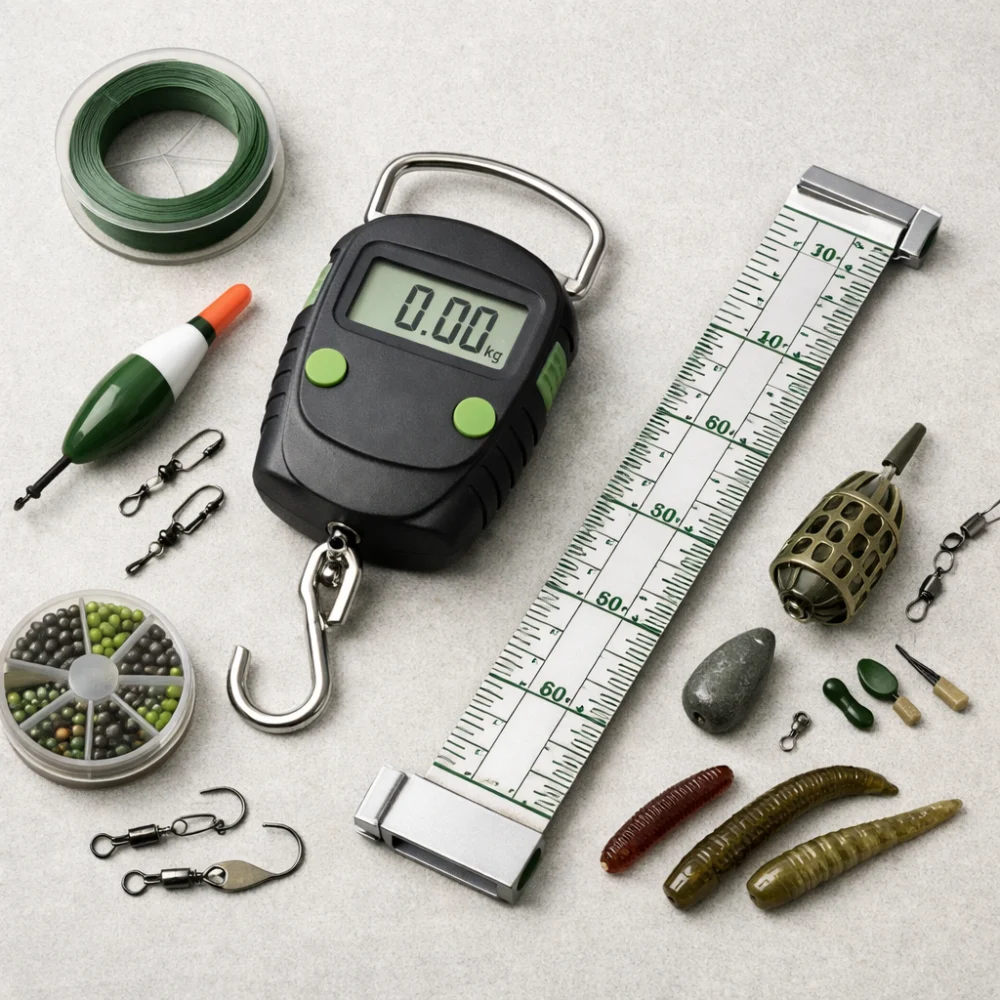
Fishing scales and rulers are straightforward tools, but the right choice depends on how you fish and what you want to record. Some anglers mainly need a quick weight reading, while others want a way to measure length as well as weight before returning a fish or noting a catch.
This guide helps you compare the practical differences between models without getting distracted by features that may not matter for your use. It focuses on ease of reading, handling, measurement format and the small details that make a tool more convenient on the bank or bank-side.
Specifications vary by model, so always check the individual product page before buying.
What should you look for in a fishing scale and ruler?
The best starting point is to decide whether you need a simple hanging scale, a combined scale-and-ruler, or a tool that is easier to read and handle in the conditions you fish in. After that, compare the maximum weight display, the style of the ruler or tape measure, and how the tool is held while weighing. A combined tool can save space, but a separate ruler and scale may suit buyers who prefer a clearer layout.
| Feature | What It Means | Why It Matters | What To Check |
|---|---|---|---|
| Weight display | How the scale shows the fish weight | A clear display is easier to read quickly and accurately | Whether the display is easy to read in the light you usually fish in |
| Measurement range | The range of weights the scale is designed to show | You want a tool that suits the size of fish you expect to weigh | The product page for the stated range and whether it matches your needs |
| Length measuring method | Built-in ruler, tape or separate measuring section | Useful if you want to record length as well as weight | How the ruler is arranged and whether it is long enough for your usual catches |
| Grip or hanging method | How the fish or sling is supported during weighing | A stable hold can make weighing simpler and less awkward | Whether the tool works with your preferred landing or weighing setup |
| Size and portability | How compact the tool is to carry | Important if you travel light or keep kit in a small bag | Whether the product looks easy to store with the rest of your tackle |
Key decision criteria explained
Weight capacity and intended use
Choose a scale that suits the sort of fish you actually expect to weigh. A compact model may be fine for lighter general use, while others are aimed at larger catches. The key is not to overbuy for a rare scenario, but to avoid a scale that feels too limited for your normal fishing.
Readability in use
For many buyers, the display is just as important as the headline measurement range. A clear digital readout can make weighing quicker, especially if you are trying to avoid handling the fish for longer than necessary. Check whether the display layout looks easy to read rather than relying only on the product title.
Ruler format
Some products include a measuring tape or built-in ruler, while others focus mainly on weight. If you often measure fish before release or for your own records, a ruler section can be a useful convenience. If you rarely need length, a simpler scale may be easier to carry and use.
Handling and storage
Consider how the scale will sit in your tackle bag, and whether it looks simple to grab with one hand. A smaller, lighter design may suit mobile anglers, while a more feature-rich tool may be worth the extra space if you want combined functions. The right balance depends on how often you will actually use it.
Product types and variants
Within this category, the main choice is usually between a basic weighing tool and a combined scale-and-ruler. A basic scale suits anglers who only need the weight reading and want to keep things simple. A combined option suits buyers who like having both measurements together, though it can be a little more to handle.
There are also differences in how the display and measurement are arranged. Some models prioritise a simple hanging format, while others add more convenience features. Those extras can be useful, but they are only worthwhile if they genuinely fit the way you fish.
Which type suits different buyers?
| Buyer need | Likely better fit | Why |
|---|---|---|
| Simple occasional use | Basic scale | Easy to carry and straightforward to use |
| Anglers who record length as well as weight | Combined scale and ruler | Combines two common checks in one tool |
| Mobile anglers with limited kit space | Compact model | Usually easier to pack with the rest of the tackle |
| Buyers who want quicker reading | Clear digital display model | Helps when you want a fast, simple weight check |
Common mistakes and misunderstandings
- Choosing by weight range alone. A scale can look suitable on paper but still be awkward if the display or layout is hard to use.
- Assuming every ruler section is equally practical. The measuring format matters if you actually plan to use it regularly.
- Ignoring how it will be carried. A more capable model may still be the wrong choice if it is inconvenient to store with your other gear.
- Buying a combined tool when you only need one function. Simplicity can be an advantage if you want fewer parts to manage.
Safety and suitability caveats
Check that the product suits the species, size and style of fishing you do, and avoid assuming that a listed range automatically makes every model equally suitable for every catch. If you fish in wet conditions, it is sensible to review the product page for any information about protection, handling or care. Specifications vary by model, so always check the individual product page before buying.
Maintenance, storage and lifespan considerations
Fishing scales and rulers are usually chosen for convenience, so basic care matters. Keep the tool clean and dry after use, and store it where the display, tape or hanging point will not be damaged by other tackle. If the model uses batteries or another power source, think about how easy it will be to replace or maintain that part over time.
How to compare options efficiently
- Decide whether you need weight only or both weight and length.
- Check that the measurement range suits the fish you normally catch.
- Compare the display, ruler format and handling style.
- Think about storage space and how often you will carry the tool.
- Read the individual product page for the exact details before choosing.
Fishing scales and rulers buying checklist
- Does it measure only weight, or weight and length?
- Is the stated range suitable for the fish you expect to weigh?
- Does the display look easy to read in your usual conditions?
- Is the ruler or tape format practical for your fishing style?
- Will it fit comfortably with the rest of your tackle?
- Have you checked the individual product page for the exact specification?
Frequently asked questions
Do I need a combined scale and ruler?
Not necessarily. A combined tool is useful if you often record both weight and length, but many anglers will be happier with a simpler scale. The right choice depends on whether you want one tool for both jobs or prefer to keep each task separate.
Is a digital scale better than a basic hanging scale?
It depends on how you use it. A digital display can make readings easier to see, while a simpler hanging format may suit buyers who want a straightforward tool. The most important point is whether the design feels easy to use in your normal fishing conditions.
What matters most when buying for occasional use?
For occasional use, practicality usually matters more than extra features. A clear display, sensible size and a ruler only if you need one are often enough. Avoid paying for features you are unlikely to use.
Can I use one of these for different types of fishing?
Often yes, but only if the scale and ruler suit the fish sizes you expect to handle. Anglers who fish for a wide range of species may want a more flexible model, while specialist buyers should check the product page carefully for suitability.
How do I know if the ruler will be useful?
Think about whether you regularly measure fish as part of your normal routine. If you do, having the ruler built in can save time and space. If not, a plain scale may be the easier choice.
Why does the display style matter so much?
A good display reduces hesitation and makes the tool easier to use in real conditions. If you are trying to weigh a fish quickly and neatly, clarity can matter more than extra functions. It is worth checking the layout rather than assuming all scales read the same way.

