
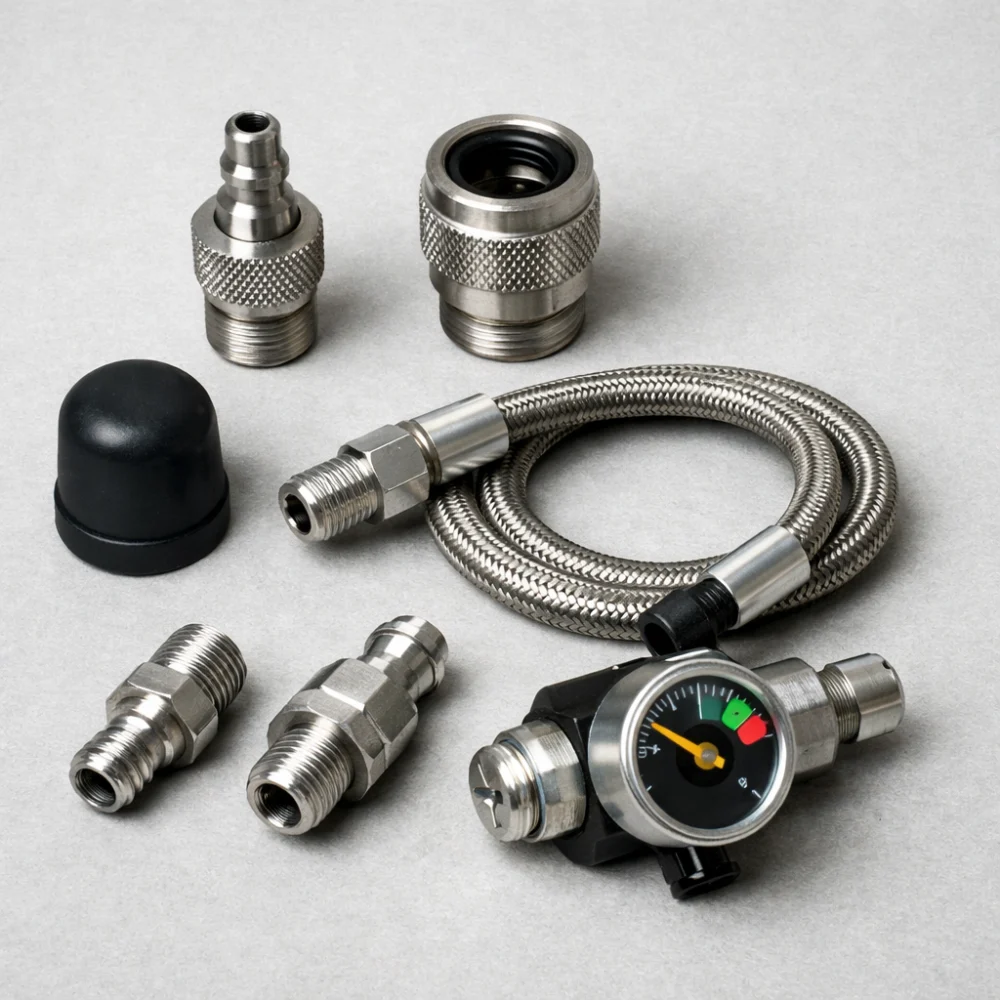
Airsoft air system accessories are the small parts that help an HPA setup connect, fill, seal, protect and monitor correctly. They are often bought as replacements, upgrades or compatibility pieces rather than as stand-alone items.
If you are comparing accessories, the main question is usually not whether a part exists, but whether it matches the rest of your setup. Thread type, connector style and the role of the part all matter, and a small mismatch can make an otherwise suitable item unhelpful.
This guide focuses on the buying decisions that matter most: what each accessory does, how to compare options and what to check on the individual product page.
What should you look for first in airsoft air system accessories?
Start with the exact job the accessory needs to do: fill, connect, regulate, protect or measure. Then check the fittings and connector style against the equipment you already own, because compatibility is usually more important than appearance. After that, compare build approach and practical convenience, such as whether the part is meant for regular fitting and removal or for occasional use. Specifications vary by model, so always check the individual product page before buying.
| Feature | What It Means | Why It Matters | What To Check |
|---|---|---|---|
| Connector type | The way the accessory joins to tanks, hoses or fill equipment | It determines whether parts fit together at all | Match the connector style and any stated thread or fitting format |
| Purpose | Whether the part is for filling, connecting, protecting or reading pressure | Buying the wrong type can leave a gap in your setup | Confirm the accessory’s role and where it sits in the system |
| Compatibility | How well the part works with your existing HPA equipment | Many accessories are only suitable for certain setups | Check the individual listing for intended use and fit notes |
| Material and finish | The construction approach and surface treatment of the part | These can affect handling, durability and corrosion resistance | Look for the stated material and whether a protective cover or cap is included |
| Ease of use | How convenient it is to fit, read, store or protect the accessory | Useful for items handled often, such as caps, covers and connectors | Consider access, grip and how often you will remove the part |
| Maintenance needs | Any regular checking, cleaning or replacement concern | Small parts may wear, loosen or need occasional inspection | Look for notes on care, replacement parts and servicing limits |
Key decision criteria
1. Match the part to the task
Some accessories are there to connect hardware, while others are there to protect fittings or make pressure checking easier. A buyer who needs a fill-related part has different priorities from someone replacing a dust cover or choosing a gauge. The most useful first check is simply whether the item solves the exact problem you have.
2. Check connector and thread compatibility
This is one of the most important checks in HPA-related accessories. Even when two parts look similar, they may not fit together properly if the connector style, thread standard or coupling format differs. If the listing does not clearly match the fittings you already use, treat that as a reason to pause and verify before buying.
3. Decide how much convenience matters
Some accessories are used constantly, while others stay in place for long periods. Items that are handled often may benefit from easy-grip, compact or protected designs, whereas static parts may be chosen more for durability or neatness. The right balance depends on whether the accessory will be moved, stored or connected frequently.
4. Think about protection and wear
Caps, covers and similar accessories can help keep fittings cleaner and reduce nuisance wear during storage or transport. These are simple items, but they can be worth choosing carefully if your setup is carried regularly. Look at how the part sits on the fitting, whether it is meant to stay on during storage, and whether it is easy to remove when needed.
5. Compare readability and access where relevant
If the accessory includes a gauge or other visible indicator, make sure it is easy for you to read in the context where it will be used. If access is awkward, the part may be less convenient than a simpler alternative. In accessories like these, clarity and practicality often matter more than any other visual feature.
Types and variants you are likely to compare
Within this category, the practical differences usually come down to function rather than dramatic product types. The most common buying decisions are between connectors and adapters, protective caps and covers, and parts that help with pressure or fill management.
- Connectors and adapters: useful when joining different pieces of HPA kit, but only if the fitting format is correct.
- Protective caps and covers: suited to people who want to keep fittings cleaner during storage or transport, with the trade-off that they add another small part to keep track of.
- Gauges and monitoring parts: helpful when you want easier pressure checking, but the buyer still needs to confirm the format and intended use.
- Replacement seals or small service parts: useful for maintenance-minded buyers, although they are the most likely to require close compatibility checking.
Which accessory suits which buyer?
| Buyer need | What to prioritise | Why | Typical trade-off |
|---|---|---|---|
| Replacing a worn or missing part | Exact fit and connector match | The accessory must work with what you already own | Less flexibility if you need a very specific format |
| Building a setup from several pieces | Compatibility across the whole chain | Mixed parts often depend on the right adapter or connector | More checking before buying |
| Keeping kit tidy and protected | Caps, covers and secure storage-friendly parts | Protection can reduce dirt and handling wear | Extra small parts to store and remember |
| Checking or managing pressure-related information | Clear display and suitable fitting format | Readability and fit both matter | May be less compact than a simpler accessory |
| Buying for occasional use | Simplicity and straightforward fit | Convenience can matter more than advanced features | Fewer refinement features |
Common mistakes and misunderstandings
- Choosing by appearance only: two accessories can look similar but use different fittings or formats.
- Assuming an adapter fixes everything: an adapter only helps when the underlying parts are suitable in the first place.
- Buying a cover or cap as an afterthought: small protective parts can be useful if you store or transport equipment often.
- Overlooking the product’s intended role: a fill-related part, a monitoring part and a protective part are not interchangeable.
- Ignoring the rest of the setup: compatibility is a system issue, not just a single-item issue.
Safety and suitability caveats
These accessories are part of a pressurised air system, so suitability and compatibility should be checked carefully before use. Avoid guessing at thread or fitting formats, and do not rely on visual similarity alone. If a product page is not clear about intended use, treat that as a sign to verify before buying rather than forcing a match.
Maintenance, storage and lifespan considerations
Accessories in this category are usually simple, but they still benefit from occasional inspection. Caps, covers and connectors may collect dirt or show wear over time, and gauges or seals may need closer attention depending on how often they are used. Store small parts where they will not be lost, and keep them clean and dry where appropriate.
If a part is meant to be removed and refitted often, think about how easy it will be to handle with gloves or in a kit bag. If it is a protective item, check that it still fits securely after repeated use. The practical question is less about the longest possible lifespan and more about whether the part stays reliable in the way you use your setup.
How to compare options efficiently
- Identify the exact problem you are solving, such as connecting, protecting, filling or checking pressure.
- Confirm the connector, thread or fitting format needed for your existing equipment.
- Compare the accessory’s practical role, not just its appearance or general description.
- Weigh convenience against robustness and choose the simpler option if it does the job.
- Check the individual product page carefully before buying, especially where the listing mentions fit notes or intended use.
Summary buyer decision checklist
- Have I identified the exact job the accessory needs to do?
- Does the connector, thread or fitting format match my existing setup?
- Is the part for filling, connecting, protecting or monitoring?
- Will I use it often enough that convenience matters?
- Does the listing clearly explain compatibility and intended use?
- Have I considered storage, handling and maintenance for small parts?
Frequently asked questions
What is an airsoft air system accessory for?
It is a supporting part used with an HPA setup, such as a connector, adapter, cap, cover or gauge-related item. These accessories help the system fit together, stay protected or be easier to manage. The right choice depends on the role the part needs to play in your setup.
How do I know if an accessory will fit my equipment?
Check the fitting style, thread details and the product’s stated intended use. If any of those are unclear, do not assume the part will work just because it looks similar. Compatibility is the key buying point in this category.
Are adapters always the easiest solution?
Not always. An adapter can help when two parts are designed to work together in that way, but it does not solve every mismatch. It is better to start with the correct fitting format if possible.
Do I need a protective cap or cover?
Not every buyer does, but they can be useful if you transport or store your kit regularly. They help keep fittings cleaner and can reduce unnecessary wear. If your equipment stays set up and rarely moves, the benefit may be smaller.
What should I prioritise: durability or convenience?
That depends on how often you will handle the part. If it is fitted once and left alone, durability may matter more. If you will connect, remove or inspect it frequently, easy handling can be the better trade-off.
Can I buy these parts without knowing every detail of my setup?
It is better not to. Small HPA accessories can look interchangeable when they are not, and guessing can lead to a poor fit. A quick check of your current fittings is usually worth the extra time.
Why do some accessories seem very similar?
Because many of them perform closely related jobs and the differences are often in fit, size or intended use. That is why the product page details matter more than a general category name. The right item is the one that matches your equipment and your intended use.

