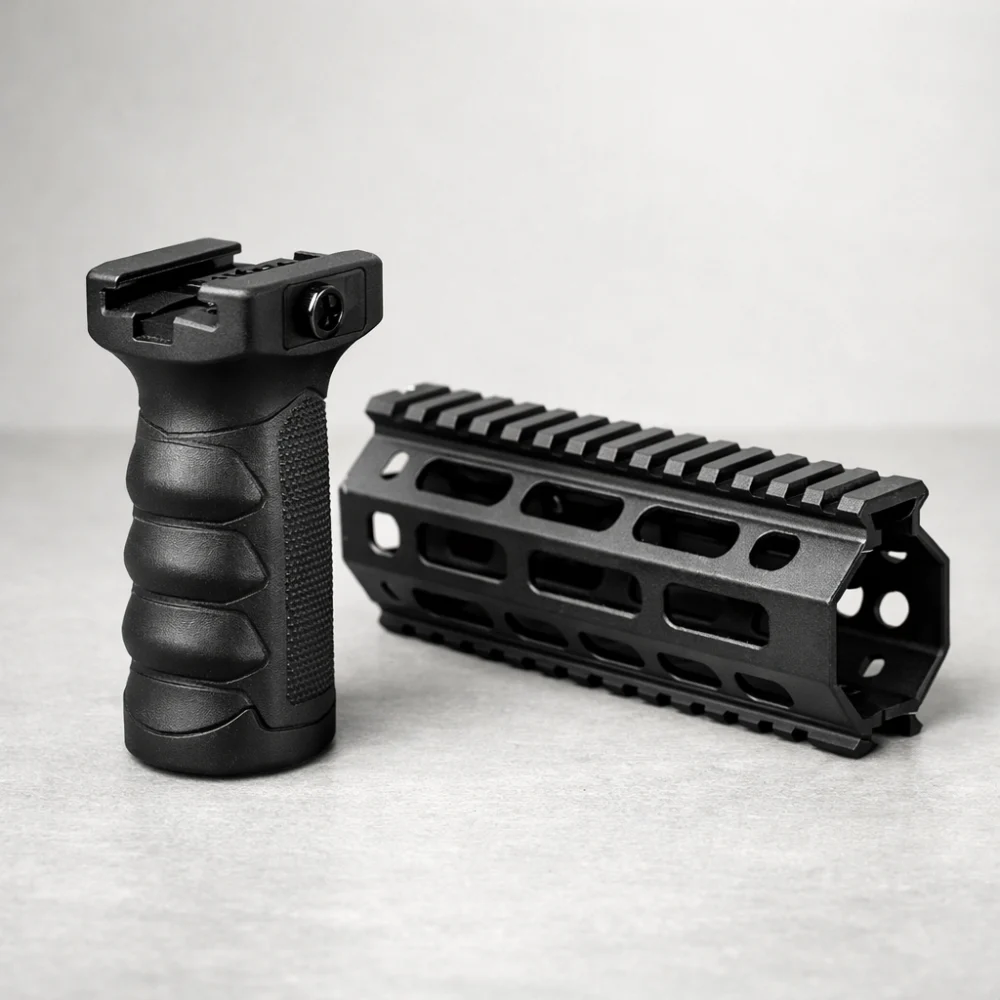
Airsoft foregrips are a simple external upgrade, but the right choice depends on how your replica is set up and how you like to hold it. Some players want a more upright grip for control, while others prefer a smaller stop or angled support that keeps the front end neat and easy to manoeuvre.
This guide focuses on the buying decisions that matter most: rail fit, grip shape, size, weight and whether the foregrip suits your style of play. It is useful whether you are replacing a worn part, changing your setup or choosing a first foregrip for a new build.
Because foregrips are fitted to different handguards and rail interfaces, the main job is to match the mounting system first and the shape second. A grip that feels comfortable in hand is useful, but only if it fits the platform you plan to use.
What should you look for in an airsoft foregrip?
Start with fit, then decide how much support you want from the grip. A full vertical foregrip can feel more secure for some users, while a shorter hand stop or angled grip may suit a lighter, more compact setup. The best starting point is the rail or handguard on your replica, because compatibility is the first thing that can rule an option in or out.
Specifications vary by model, so always check the individual product page before buying.
| Feature | What it means | Why it matters | What to check |
|---|---|---|---|
| Mounting system | The interface used to attach the foregrip | It determines whether the grip can be fitted to your handguard | Match the grip to your rail type or mounting standard |
| Grip shape | Vertical, angled, stubby or hand stop style | It affects comfort, wrist position and how much front-end support you get | Choose the shape that suits your hold and shooting posture |
| Size and profile | How much space the grip takes up on the front end | It changes handling and can affect how compact the replica feels | Check overall dimensions and whether it fits with lights or other accessories |
| Material and finish | The construction and surface feel | It influences durability, weight and grip feel | Look for the material used and whether the finish suits regular use |
| Weight | How heavy the foregrip is | Extra weight on the front can change balance and handling | Consider whether you want a lighter setup or a more substantial feel |
Key decision criteria
Mounting compatibility
Most buying problems come from fit rather than style. Check whether the foregrip is made for the rail or handguard system on your replica, and do not assume that one mounting type works on all platforms. If you already have a specific handguard, the product page should tell you what it attaches to.
Grip style and hand position
Vertical foregrips tend to give a more upright hold, which some players find reassuring for control. Angled grips and hand stops can feel less bulky and may suit a more forward, compact grip. The trade-off is simple: more support usually means more bulk, while a smaller grip often gives a cleaner front profile.
Length, bulk and accessory clearance
Foregrips take up space on the front of the replica, so think about nearby accessories and the way you move the gun. A larger grip may be easier to hold, but it can get in the way if your front end is already busy. A slimmer option can keep the setup tidy, though it may offer less to hold onto.
Material and feel
Foregrips can be made from different materials, and that affects both weight and touch. Some buyers prefer a firmer, more rigid feel, while others want something light and low-profile. The most important point is that the grip should feel secure in the hand without making the front of the replica awkward to carry.
Product types and variants
Within this category, the main differences are usually shape and mounting approach rather than dramatic feature changes. A buyer will normally be choosing between a vertical foregrip, an angled grip or a shorter hand stop style.
- Vertical foregrips: suit buyers who want a more traditional front grip and a solid hand position.
- Angled grips: suit players who prefer a lower-profile front end and a less upright wrist angle.
- Hand stops and compact grips: suit users who want a simple reference point without adding much bulk.
The limitation is that none of these shapes is universally better. The right one depends on how you shoulder and support the replica, and on how much front-end space you are willing to give up.
Choosing based on your needs
| Buyer need | What to prioritise | Why |
|---|---|---|
| First-time buyer | Clear compatibility and a simple shape | It reduces the risk of choosing a grip that does not fit or feels unfamiliar |
| Compact setup | Low profile and minimal bulk | It keeps the front end tidy and easier to manoeuvre |
| More secure front hold | Deeper grip surface and a shape that fills the hand | It can feel more confident during carry and movement |
| Accessory-heavy front end | Space-saving design and sensible clearance | It helps avoid crowding with lights, cables or other fitted parts |
| Upgrade from a basic setup | Better finish, more suitable shape and appropriate mounting system | It improves handling without forcing a full rebuild |
Common mistakes and misunderstandings
- Choosing by appearance alone: a foregrip may look right but still be the wrong mounting type for your handguard.
- Ignoring size: a grip that is too large can make a compact replica feel front-heavy or cluttered.
- Expecting one style to suit every hold: a shape that helps one player may feel awkward to another.
- Overlooking nearby accessories: fitting space matters if your front end already carries other parts.
Safety and suitability caveats
Airsoft foregrips are buyer-choice accessories rather than essential parts, so suitability matters more than universal rules. Check that the grip is intended for your platform and that it will not interfere with other fitted components. If you are unsure about a specific replica, treat the product page as the source of truth for fit guidance.
Maintenance, storage and lifespan considerations
Foregrips usually need little day-to-day care, but a quick check of fittings and general condition is sensible if the replica is used often. Keep the surface clean and store the accessory where it will not be crushed or bent. If the grip uses fixings or inserts, pay attention to how securely it remains attached after repeated use.
How to compare options efficiently
- Confirm the mounting system on your replica.
- Decide whether you want a vertical grip, angled grip or compact hand stop.
- Compare size, weight and how much front-end space each option will use.
- Check the material and finish for the feel you want in hand.
- Read the individual product page carefully before you buy.
Summary buyer decision checklist
- Does the foregrip match your rail or handguard system?
- Is the shape suited to how you hold the replica?
- Will the size fit with your other front-end accessories?
- Does the weight suit the balance you want?
- Have you checked the individual product page for model-specific details?
Frequently asked questions
Do all airsoft foregrips fit the same way?
No. The attachment method depends on the rail or handguard system the grip is designed for. Always check the product page and compare it with your replica before buying.
Is a vertical foregrip better than an angled one?
Not always. A vertical grip can feel more secure for some players, while an angled grip may feel slimmer and more natural for others. The better choice depends on comfort, handling style and the amount of bulk you want on the front end.
Will a foregrip make my replica easier to control?
It can improve how the replica feels in hand, but it is mainly about handling preference rather than a guaranteed performance change. If you already hold the replica comfortably, a foregrip may simply refine that feel rather than transform it.
Should I choose the lightest foregrip available?
Not necessarily. A lighter grip can help keep the front end compact, but some buyers prefer a more substantial feel. Balance, shape and compatibility are usually more important than chasing the lowest possible weight.
Can I use a foregrip with other accessories on the front end?
Sometimes, but space can become limited quickly. Check how much rail or handguard space you have and consider whether the grip will crowd lights, cables or other fitted parts.
What is the simplest choice for a first foregrip?
The simplest choice is usually the one that matches your mounting system and feels natural in your hand. If you are unsure, start with a straightforward shape and avoid designs that rely on a very specific grip style.