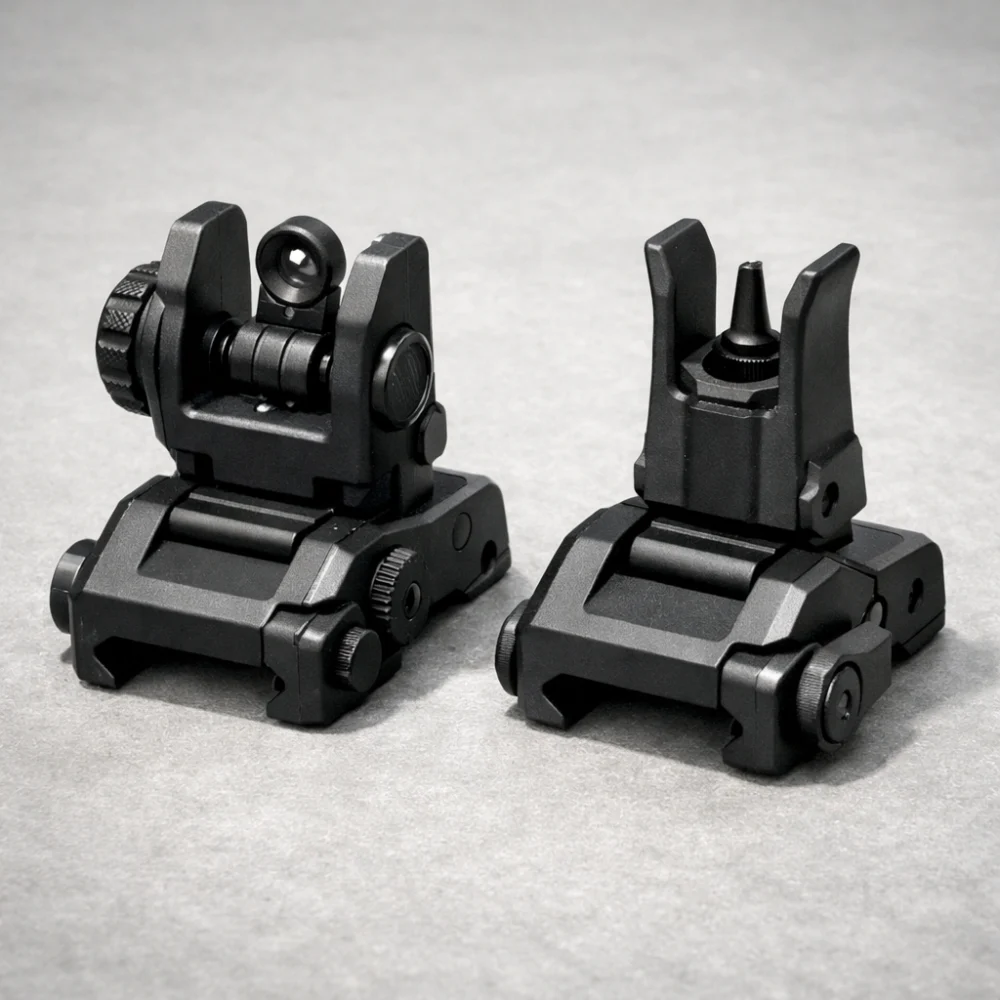
Airsoft iron sights are a simple way to add a mechanical aiming reference to a replica, either as a primary sighting option or as backup to an optic. They are often chosen for their low profile, quick handling and straightforward setup, but the right choice depends on your rail type, your preferred sight picture and how much adjustability you want.
This guide helps you compare the main buying points without getting lost in model names. If you are replacing a missing sight, building a backup setup or choosing between fixed and folding styles, it is worth checking the details carefully because small differences can affect how the sights sit and how easy they are to use.
Specifications vary by model, so always check the individual product page before buying.
What should you look for in airsoft iron sights?
The best starting point is compatibility: the sight has to fit your replica’s mounting system and sit at a height that works with your other equipment. After that, compare whether you want fixed or folding sights, how visible the sight picture is, and how much adjustment is available for zeroing. The main trade-off is usually between simplicity and flexibility: a simpler sight can be quicker to live with, while a more adjustable or folding option may suit a more tailored setup.
| Feature | What it means | Why it matters | What to check |
|---|---|---|---|
| Mounting fit | How the sight attaches to your replica | Decides whether the sight will fit and stay secure | Rail type, attachment style and whether the listing states front, rear or a set |
| Fixed or folding | Whether the sight stays up or folds flat | Affects profile, convenience and backup use with optics | Whether you want a permanent sight picture or one that stays out of the way until needed |
| Sight picture | The shape and style of the aiming reference | Changes how quickly you can line up the target | Aperture, post shape and whether the design looks easy for you to align |
| Adjustment | How the sight can be zeroed | Helps you align point of aim and point of impact | Whether windage and elevation adjustment are included and how accessible they appear |
| Material and finish | The construction and surface treatment | Influences handling feel and everyday wear | Whether the product page indicates metal or polymer construction and the finish you prefer |
| Set or single sight | Whether you are buying a matched pair or one part | Important if you only need a front or rear replacement | Check the listing carefully so you do not buy an incomplete setup by mistake |
Key decision criteria
Rail and replica compatibility
Compatibility is the first filter because a sight that does not mount properly is no use at all. Many buyers are looking for a rail-mounted option, but the exact fit and spacing can vary between models and platforms. Check the product page for the mounting standard described and make sure it matches your replica before you compare anything else.
Fixed versus folding sights
Fixed sights are straightforward and always ready to use, which can suit players who want a simple, no-fuss setup. Folding sights are often chosen when a red dot, scope or other optic is the main aiming tool and the iron sights are mainly there as a backup. The trade-off is clear: folding sights can be tidier, but fixed sights are always visible and ready without extra steps.
Sight picture and speed
Different sight shapes can feel faster or more deliberate depending on how you aim. A simple post and aperture arrangement may feel familiar to some players, while other shapes may be chosen for faster alignment or a clearer front sight reference. If possible, think about how much visual clutter you want in the sight picture, especially if you often switch between close and medium ranges.
Adjustment and zeroing
Adjustment helps you line the sight up more precisely with where your replica is shooting. Some buyers only need a basic backup sight and will not care much about fine tuning, while others want a more adjustable setup for a better match to their preferred hop-up and BB weight choices. Because requirements vary by model and setup, check exactly what the listing says about windage and elevation.
Build style and profile
Iron sights are often selected because they are compact, but their profile still matters. A lower-profile design may sit neatly alongside an optic or accessory, while a taller sight picture may feel easier to acquire for some users. If you value a slim setup, look for the shape and folded height rather than assuming all iron sights will sit the same.
Common types and variants
Within this category, the main differences are usually between full sets and individual components, plus fixed and flip-up designs. A front-and-rear set is useful when you are building a complete sighting setup, while a single rear or front sight can make sense as a replacement. Folding designs suit mixed optic use, whereas fixed sights suit buyers who want a straightforward always-on option.
Some listings may also emphasise style or fit for a particular platform. That can be helpful, but the important question is still whether the sight matches your rail or mount and whether the sight picture suits you. Sample product names can hint at style, but they are not a substitute for checking the product page details.
Which option suits different buyers?
| Buyer need | What usually matters most | Likely fit |
|---|---|---|
| Backup for an optic | Low profile and easy folding or stowage | Fold-up sights that stay out of the way until needed |
| Simple first sight setup | Ease of use and straightforward alignment | Fixed or simple rear-and-front sight sets |
| Replacement part | Exact mounting and matching front or rear piece | Single sights that match the existing setup |
| Compact build | Small footprint and tidy profile | Minimal or folding sights with a lower overall presence |
| More deliberate aiming reference | Clear sight picture and adjustment | Models with an aperture or other easy-to-align shape |
Common mistakes and misunderstandings
- Buying by appearance alone: two sights can look similar but mount differently or provide a different sight picture. Check the listing details rather than assuming style means compatibility.
- Assuming a set is complete for every build: some products are front sights, rear sights or partial sets rather than a full pair. Confirm exactly what is included.
- Overlooking height and clearance: a sight can fit the rail and still not work well with another optic or accessory. Think about the whole top of the replica, not just one part.
- Ignoring your actual use case: if you mainly run an optic, fixed sights may be unnecessary bulk, while if you want a simple backup they may be the easiest option. Choose for use, not just for looks.
Safety and suitability checks
Airsoft iron sights are a buying decision rather than a complex technical one, but it still helps to check suitability carefully. Make sure the sight is intended for your kind of replica or mounting setup, and do not assume a product will fit just because it is described as tactical or universal. If the product page gives fit notes, treat those as more important than general style terms.
It is also worth considering how the sight will sit with any other accessories you already use, especially if your upper rail space is limited. A low-profile sight may be better in a crowded setup, while a more prominent sight picture may suit a player who wants fast visual alignment.
Maintenance, storage and ownership considerations
Iron sights are usually simple items, but they still benefit from occasional checking. If the sight is adjustable or folding, it is sensible to make sure it stays secure and remains free of obvious dirt or grit. Store it as part of the replica or separately if you are keeping spares, and keep any small fixing parts together so they are not lost.
Because finish and material can vary, you may also want to think about how much handling wear the sight is likely to see. A sight used as a backup may spend long periods folded or unused, while a primary sight is likely to be handled more often. That makes the overall build style a useful buying consideration even when the sight itself is simple.
How to compare options efficiently
- Start with the replica and confirm the mounting type you need.
- Decide whether the sight is a main aiming reference or a backup to an optic.
- Compare fixed and folding styles based on how much profile you want.
- Check whether you need a full set or only one sight.
- Review the product page for adjustment, fit notes and any platform-specific guidance.
- Choose the sight that matches your use case with the fewest compromises.
Summary buyer decision checklist
- Does the sight match your rail or mounting setup?
- Do you need a front sight, a rear sight or a matched set?
- Would fixed or folding suit your setup better?
- Is the sight picture likely to feel clear and usable to you?
- Does the product page mention adjustment or fit notes you need?
- Will the sight work alongside any optic or other top-mounted accessory?
Frequently asked questions
Do I need iron sights if I already use a red dot?
Not always, but many players still like them as a backup or a simple reference. Folding sights are often chosen for this reason because they can stay out of the way when the optic is the main aiming tool. Whether you need them depends on how you run the replica and how much redundancy you want.
Are front and rear sights sold together?
Sometimes, but not always. Some listings are for a matched pair, while others are for a single sight or a replacement part. Check the product page carefully so you know whether you are buying a full setup or just one piece.
What is the difference between fixed and flip-up sights?
Fixed sights stay in position all the time, while flip-up sights can fold down when not needed. Fixed sights are simple and always ready, whereas flip-up sights can be neater on a crowded top rail. The better choice depends on whether you want permanence or a lower profile.
Will any iron sight fit any airsoft replica?
No. Fit depends on the mounting system and the space available on your replica. Some sights are made for rail use, but you should still check the exact product description to make sure the fit is suitable.
Why does sight height matter?
Height affects how the sight sits in relation to your eye and any other accessories on the top of the replica. If it sits too high or too low for your setup, it may feel awkward even if it technically fits. This is one of the most important things to check alongside mounting compatibility.
Do adjustable sights make a big difference?
They can, especially if you want a more precise aiming setup or you like to fine-tune your equipment. That said, some buyers only need a simple backup and will not use fine adjustment much. The value of adjustment depends on how much control you want over your sight picture.
Should I choose a more compact sight if I use other accessories?
Often, yes, because top rail space can be limited. A compact or folding design may sit more neatly alongside optics or other attachments. The main question is whether you want the sight to be available at all times or tucked away until needed.