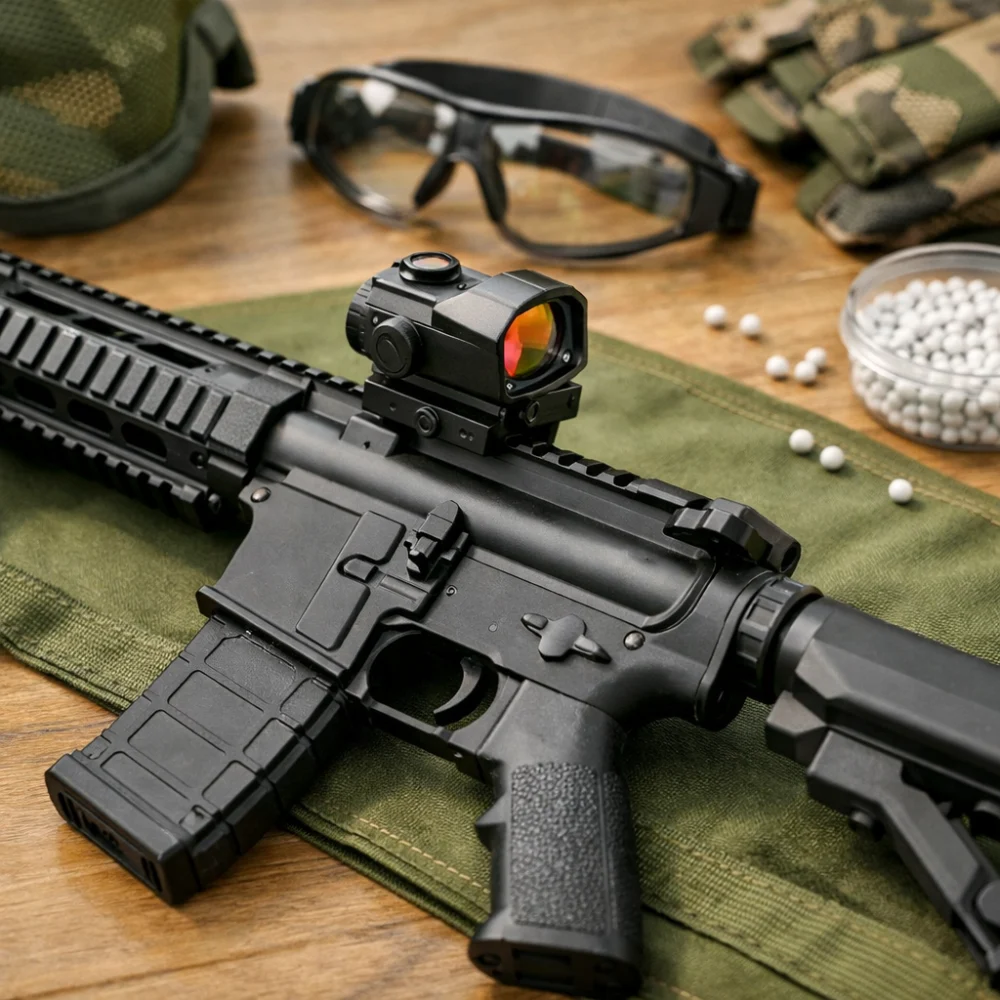
Airsoft dot sights are chosen to make target acquisition faster and sight picture simpler than traditional aiming methods. For many players, the main decision is not whether to buy one, but which style will suit the replica, the rail, and the way they play.
This guide focuses on the buying choices that matter before you commit. It helps you compare reticle style, mounting compatibility, durability and practical usability without drifting into model-by-model speculation.
Because product details vary, it is worth treating each listing on its own merits. Specifications vary by model, so always check the individual product page before buying.
What should you look for in an airsoft dot sight?
Start with fit, then look at how the sight will be used in play. A dot sight that mounts securely, gives you a clear aiming point and suits your preferred setup is usually more useful than one with extra features you will not use. The main trade-off is often between a compact, simple optic and a larger sight with more adjustment or a different viewing window.
| Feature | What It Means | Why It Matters | What To Check |
|---|---|---|---|
| Mounting interface | The rail or attachment system the sight uses | It determines whether the sight will fit your replica securely | Check the rail type and whether any riser or adaptor is needed |
| Reticle style | The shape or dot pattern you see when aiming | It affects how quickly you pick up the target and how busy the view feels | Look for the reticle style described on the product page |
| Size and profile | How compact or bulky the sight is on the replica | It affects handling, balance and how much the sight may obstruct other accessories | Compare overall dimensions and whether the optic suits your setup |
| Adjustment controls | Windage, elevation and brightness settings where provided | They influence how precisely you can set the sight for your preference | Check which adjustments are included and how easy they are to reach |
| Window or lens style | The shape and viewing area of the optic | It changes how wide and forgiving the sight picture feels | Review images and descriptions to see whether the sight is open or enclosed |
| Durability features | General construction and protective features | Airsoft use can involve knocks, transport and field conditions | Check the housing description and whether extra protection is recommended |
Key decision criteria
Mounting and fit
Fit is the first thing to confirm because a sight that does not mount properly is not a practical purchase. Many buyers need to match the optic to a Picatinny-style rail or to another mounting arrangement on the replica. If the sight sits too low or too high, you may also need to think about a riser or a different mounting position.
Reticle and sight picture
The reticle is the point or pattern you use for aiming. Some players prefer a simple dot because it is quick to acquire, while others may like a reticle with more than one aiming reference. The important question is not which style sounds more advanced, but which one remains clear and easy for you to use.
Brightness and visibility
Brightness settings matter when you are moving between different light conditions. A sight that can be adjusted to suit the environment is often more comfortable than one that feels too bright or too dim at one setting. What matters is whether the aiming point is easy to see without distracting your eye from the target area.
Window size and housing shape
A larger viewing area can feel more forgiving when you are bringing the sight onto target, while a compact body may be less intrusive and easier to keep streamlined. There is usually a trade-off between a generous window and a smaller footprint. Consider whether you value quicker visual pickup, a lower profile or a balanced middle ground.
Build quality and protection
Airsoft equipment is often handled, transported and used in changing conditions, so basic robustness matters. That does not mean every sight needs the same level of protection, but it does mean the body, lens area and mount should feel suitable for regular use. If protection is especially important to you, check what the product page actually states rather than assuming all dot sights are equally tough.
Common types and variants
Within this category, the most useful distinctions are usually about form factor and presentation rather than complex technical differences.
- Open reflex-style sights tend to feel lightweight and easy to pick up, which can suit players who want a minimal aiming solution. Their limitation is that the open design may feel less enclosed and more exposed.
- More enclosed dot sights can give a more protected, compact feel on the replica. Their limitation is that they may add bulk compared with simpler open designs.
- Sights with riser mounting options can help when the optic needs to sit at a more usable height for your setup. Their limitation is that the extra height may not suit every replica or preference.
Which sight suits which buyer?
| Buyer need | Likely better fit | Reason |
|---|---|---|
| Simple, quick aiming | Clear single-dot style sight | It keeps the sight picture uncomplicated |
| Compact setup | Smaller-profile optic | It can keep the replica less crowded |
| More flexible mounting | Model with suitable riser or mount options | It is easier to match the optic to the rail height |
| Clearer sight picture in varied conditions | Brightness-adjustable sight | It is easier to fine-tune visibility |
| Transport and regular handling | Robust housing and secure mount | It is better suited to repeated use and movement |
Common mistakes and misunderstandings
- Choosing on appearance alone: a sight can look suitable but still be awkward if the mounting height or rail fit is wrong.
- Assuming every dot sight is the same: sight picture, reticle style and housing shape can change how easy it feels to use.
- Ignoring the rest of the setup: the optic needs to work with your replica, rail and any other accessories you already have.
- Overvaluing extra features: more settings are only useful if they suit the way you actually play.
Safety and suitability caveats
Airsoft dot sights are buying accessories, not universal add-ons. Check that the mount, height and placement make sense for your replica and your use case before ordering. It is also sensible to think about lens protection and general handling, especially if the optic will be used regularly in active play.
Maintenance, storage and lifespan considerations
Dot sights are generally straightforward to own, but they still benefit from sensible care. Keep lenses clean, store the sight safely when not in use and check that mounts remain secure after transport or repeated handling. If a sight uses batteries or another power source, consider how easy it is to replace or manage that supply over time.
How to compare options efficiently
- Decide how you want the sight to support your play style: quick aiming, a compact profile or a more adjustable setup.
- Check the mount and rail fit first so you only compare options that can realistically work on your replica.
- Compare the reticle, brightness and viewing window for comfort and clarity.
- Look at the body shape and mounting height to judge whether it will suit your setup.
- Read the individual product page carefully for model-specific details before you buy.
Summary buyer decision checklist
- Does the sight match your rail or mounting arrangement?
- Is the viewing style clear and easy for you to use?
- Does the size and shape suit your replica?
- Are brightness or adjustment options useful for your needs?
- Have you checked any height, riser or protection considerations?
- Have you read the individual product page for model-specific details?
Frequently asked questions
Are airsoft dot sights suitable for beginners?
They can be, especially if you want a simpler aiming picture than a magnified optic. A beginner-friendly choice is usually one that is easy to mount and uncomplicated to adjust. The key is to keep the setup practical rather than chasing features you may not use.
Do I need a riser for an airsoft dot sight?
Not always. It depends on the sight height, the rail position and how you want to align your eye with the optic. If the product page mentions a riser or shows one in use, treat that as a clue to check fit carefully.
Is a larger window always better?
No. A larger viewing area can feel easier to pick up, but it may come with more bulk. Some buyers prefer a smaller, neater optic because it keeps the replica less cluttered.
What matters more: reticle style or brightness settings?
Both matter, but in different ways. Reticle style affects how comfortable the sight picture feels, while brightness settings affect how visible the aiming point is in changing light. If you are unsure, start with a clear, simple aiming point and enough adjustment to suit your environment.
Can one dot sight suit every airsoft replica?
Not necessarily. Mounting style, rail compatibility and preferred height can vary from one setup to another. It is better to check the individual listing than to assume a sight will fit every replica in the same way.
How do I know if a sight is robust enough?
Look for clear product information about the housing and mounting system, then judge whether that level of construction matches how you plan to use it. Avoid assuming protection or durability beyond what the listing actually states. If you expect regular transport or active use, secure mounting becomes especially important.
What should I check before buying if I already use other accessories?
Make sure the sight will not conflict with existing accessories, rail space or your chosen shooting position. A compact optic may work better on a busy setup, while a larger sight may need more room. Thinking about the whole layout usually prevents awkward surprises.