
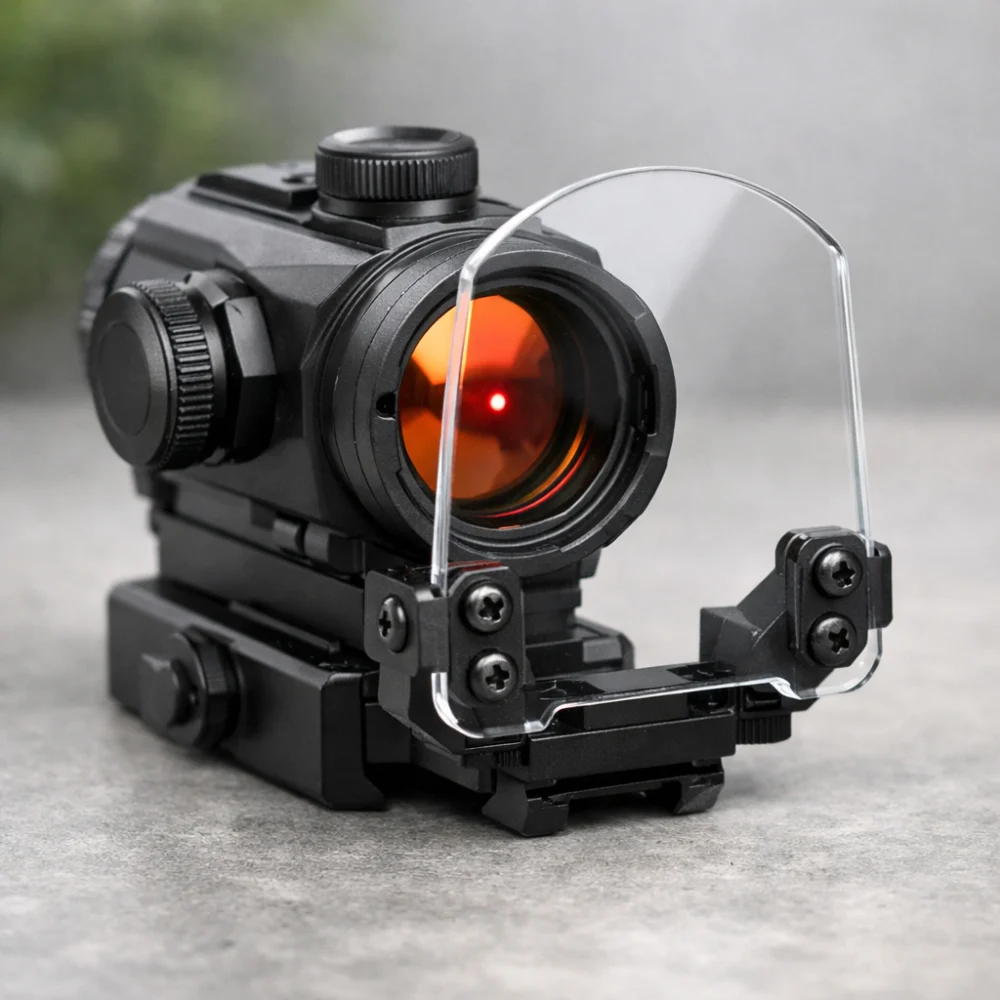
Airsoft sight protectors are a practical add-on for players who want to reduce the chance of damage to optics and lenses during games. They sit in front of the sight or scope and act as a barrier, but the right choice depends on the type of optic, how it mounts and how your replica is set up.
If you are buying one for the first time, the main job is simple: find a protector that fits the space in front of your optic and does not interfere with aiming, magnification or the sight picture. That sounds straightforward, but the details matter because different protectors suit different rails, lens sizes and optic styles.
This guide explains the main buying points so you can compare options quickly and avoid choosing something that looks suitable but does not suit your setup.
What should you look for in an airsoft sight protector?
The most important starting point is fit. A protector needs to sit where it can shield the optic without blocking the view or getting in the way of the mount. After that, look at the style of protector, the intended optic type and whether the design is easy to fold, remove or position for your setup. Specifications vary by model, so always check the individual product page before buying.
| Feature | What It Means | Why It Matters | What To Check |
|---|---|---|---|
| Fit and mounting | How the protector attaches and where it sits in relation to the optic | It must protect the lens without creating clearance problems | Mount style, placement, and whether it suits your sight or scope position |
| Protective style | The physical form of the shield, such as a screen, cover or foldable guard | Different styles balance visibility, convenience and coverage differently | How much of the optic face it covers and whether it can be moved or folded |
| Optic compatibility | Whether the protector is intended for a dot sight, scope or similar optic | A mismatch can leave gaps or make the sight awkward to use | Product wording, intended optic type and any size notes on the listing |
| Field of view | How much of the sight picture remains clear when the protector is fitted | Protection should not make aiming unnecessarily cramped | Any mention of lens coverage, mesh style or clearance in front of the optic |
| Ease of use | How simple it is to fit, remove or adjust the protector | Useful if you change optics or move between loadouts | Whether the design folds, clips or remains fixed in place |
| Profile and space | How much room the protector takes up on the rifle or replica | Compact setups can be sensitive to bulk at the front end | Front-end clearance and whether the guard interferes with other accessories |
Key decision criteria explained
Fit and placement
A sight protector only works well if it is positioned correctly in front of the optic. Too close and it may obstruct the view or touch the lens area; too far away and it may not cover the part most likely to be exposed. Check whether the product is meant to sit on the optic, the rail or a separate mounting point, because that affects how it fits your setup.
Protected area versus visibility
Some protectors prioritise a wider shield, while others are designed to stay as unobtrusive as possible. A larger shield can offer more peace of mind, but it may also be more noticeable when you look through the sight picture. Choose the balance that matches how much visual distraction you are willing to accept.
Optic type
Different optics create different buying needs. A dot sight often needs a different style of protection from a scope or other larger optic because the viewing area and mounting position differ. If you use more than one optic on different replicas, consider whether you want a protector that is easy to move or whether you prefer a more dedicated fit.
Convenience and handling
Some protectors are designed to be quick to fit or fold away, while others are more fixed once installed. Convenience matters if you regularly swap parts, use multiple replicas or need to clear accessories at the front of the gun. A simpler design can be easier to live with, but it may offer less flexibility.
Common styles you may see
Airsoft sight protectors are usually chosen for the way they sit in front of the optic rather than for a large range of technical features. In practice, buyers often compare screens, foldable guards and cover-style protectors. The useful question is not which style sounds more tactical, but which one gives enough protection without creating unnecessary bulk or blocking your aim.
- Screen or mesh-style protectors: Often chosen for a lighter visual presence in front of the optic, but the trade-off is that they may not suit every sight picture.
- Foldable protectors: Useful when you want protection that can be moved out of the way, though the hinge or moving part adds another thing to consider.
- Cover-style protectors: Simple to understand and often easy to fit, but the shape must still suit the optic and front-end space.
Which type suits different buyers?
| Buyer need | What usually matters most | What to prioritise |
|---|---|---|
| First-time buyer | Simple fit and straightforward use | A protector with clear mounting information and minimal setup complexity |
| Player with a dot sight | Clear sight picture and reliable coverage | Low-profile protection that does not interfere with the viewing window |
| Player using a scope | Front-end clearance and lens coverage | Enough space in front of the optic and a style that suits the scope body |
| Frequent loadout changer | Ease of fitting and adjustment | A design that is simple to move, fold or reposition |
| Compact build owner | Minimal bulk | A protector that stays close to the optic and does not crowd accessories |
Common mistakes to avoid
- Buying by appearance alone: A protector can look suitable but still sit too high, too far forward or too close to the lens.
- Ignoring optic type: A product that works well with one sight style may not suit another.
- Forgetting front-end space: Rails, lights and other accessories can reduce the room available for a protector.
- Assuming all mounts are interchangeable: Attachment method and position matter as much as the general shape.
- Overlooking ease of adjustment: If you often change your setup, a fixed design may become inconvenient.
Safety and suitability caveats
Choose a protector as a safeguard for your optic, not as a substitute for careful handling or common sense on the field. Make sure it suits the exact replica, optic and mounting arrangement you plan to use, and check that it does not interfere with the way you aim. If a listing is vague about fit, treat that as a sign to look more closely before buying.
Maintenance, storage and long-term use
Most sight protectors are simple accessories, but they still benefit from occasional checks. Look for loose fittings, wear at contact points and any sign that the protector has shifted out of alignment after use or transport. If your setup is stored in a case, make sure the protector is not forced against other parts, as pressure can affect both the guard and the optic area it is meant to protect.
How to compare options efficiently
- Start with the optic you want to protect and note where the protector can realistically sit.
- Decide whether you want a fixed, foldable or cover-style design.
- Check the product page for fit notes, mounting details and any space requirements.
- Compare how much visual obstruction you are willing to accept versus how much coverage you want.
- Choose the option that matches your setup rather than the one with the most features on paper.
Buyer checklist
- Does it suit your optic type?
- Will it fit the available space on your setup?
- Is the mounting method compatible with your layout?
- Does the design block less of the sight picture than you can accept?
- Is it easy enough to fit or remove for your usual use?
- Have you checked the individual product page for exact fit notes?
Frequently asked questions
Do I need a sight protector for every airsoft optic?
Not every player uses one, but many people like the extra protection for optics that sit exposed on the rifle. The key question is whether your setup leaves the lens vulnerable during play and whether the protector can be fitted without affecting your aim.
Will a protector suit both dot sights and scopes?
Some protectors are broad enough to work with different optic styles, but many are better suited to one type than another. Check the product description carefully rather than assuming a general-purpose shape will fit every sight.
Can a sight protector affect my sight picture?
Yes, depending on its size, shape and position. A well-matched protector should stay out of the way as much as possible, but any object placed in front of the optic can change how open the view feels.
What matters more: coverage or compactness?
That depends on your setup. If you have limited front-end space or prefer a clean profile, compactness may matter more; if your main concern is adding a visible barrier in front of the optic, coverage may come first.
Are foldable protectors better than fixed ones?
Neither is always better. Foldable designs can be more convenient if you change your setup often, while fixed options can be simpler and less fiddly. The right choice depends on how you use your replica and how much adjustment you want.
What should I check before ordering?
Check the optic type, the mounting method, the space available in front of the sight and any notes about fit on the individual product page. If the listing does not clearly explain those points, it is worth pausing before buying.

