
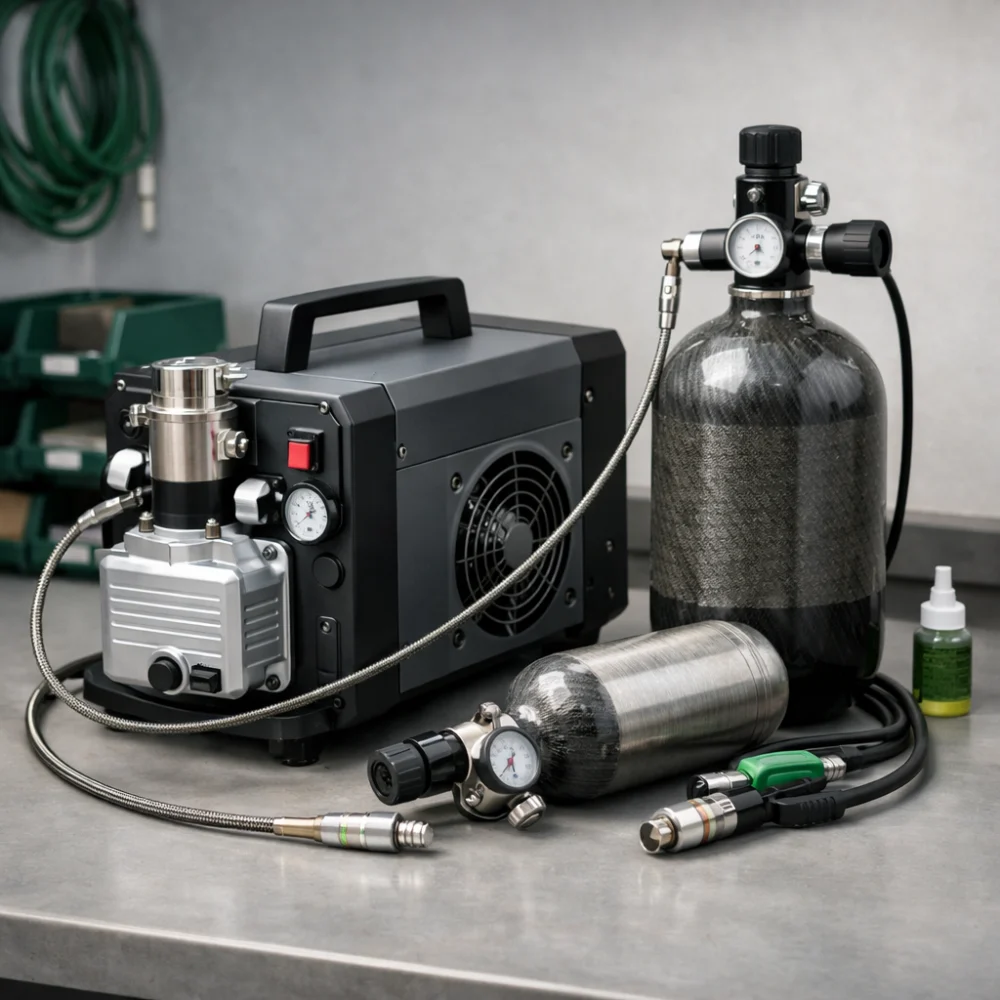
High pressure air compressors are bought by people who need a way to fill HPA tanks or related high-pressure air systems without guessing at the important details. The choice is less about a single “best” compressor and more about matching the unit to how often you fill, where you will use it and how much setup you are comfortable managing.
Because this is a technical category, the useful differences are usually found in the product page details rather than the product name. Things like the power source, stopping method, cooling approach and intended fill pressure all affect whether a compressor is practical for your setup.
If you are comparing options for the first time, start by deciding whether you need a portable unit, a mains-powered workshop-style unit or a simpler hand-pumped alternative. That one decision usually narrows the field more than any other.
What should you look for in a high pressure air compressor?
The most useful starting point is to match the compressor to your filling routine and the equipment you already use. Some buyers mainly want convenience for regular top-ups, while others want a compact unit they can move around or store more easily. The main trade-off is usually between portability, speed, noise, cooling and the amount of attention the compressor needs during use.
Specifications vary by model, so always check the individual product page before buying.
| Feature | What it means | Why it matters | What to check |
|---|---|---|---|
| Power source | How the compressor is powered, such as mains or a vehicle-style supply | Affects where you can use it and how easy it is to set up | Whether it matches your planned filling location and available supply |
| Pressure range | The working pressure the unit is intended to reach | Needs to suit the equipment you want to fill | Rated pressure on the product page and any stated limitations |
| Cooling and filtration | Features that help manage heat and moisture during compression | Can affect convenience, upkeep and fill consistency | Whether the model includes built-in cooling, filtration or other management features |
| Auto stop or manual control | How the unit stops at the target pressure | Changes how closely you need to supervise the fill | Whether the compressor has an automatic stop function or requires manual control |
| Portability | How easy the compressor is to carry, move or store | Important if you have limited space or want to take it between locations | Size, weight and whether the product is described as portable |
| Duty and fill routine | How the compressor is intended to be used over time | Helps you avoid choosing a unit that is awkward for your frequency of use | Any notes on recommended use pattern, cooling pauses or fill cycle guidance |
Which details matter most when choosing?
Pressure capability
The pressure rating is central because the compressor has to suit the fill pressure of the tanks or cylinders you use. Higher-rated products may offer more headroom, but that does not automatically make them the right choice if the rest of the setup is not a match.
Check the stated maximum pressure and compare it with the pressure your equipment needs. Do not assume that a “high pressure” label covers every use case.
Power and location
Think about where the compressor will actually live. A mains-powered unit may suit a fixed filling area, while a portable or 12V-style option may suit someone who needs flexibility.
The practical question is not only whether it can work, but whether it fits your routine without becoming awkward to set up each time.
Cooling, moisture and filtration
Compressing air creates heat and can introduce moisture management considerations, so buyers often look for built-in cooling or filtration features. These are not just technical extras; they affect how much attention the unit needs during use and how tidy the filling process feels in practice.
If you want a simpler ownership experience, look carefully at what the model provides rather than assuming all compressors handle heat and moisture in the same way.
Automation and supervision
Some compressors offer an auto stop function, while others rely more on the user to monitor the fill. For many buyers, this is a major convenience difference because it changes how closely the unit must be watched.
If convenience matters to you, check exactly how the stop function works and whether it is described for your intended pressure range.
Common types and variants
Within this category, the broad distinctions usually come down to power, portability and how hands-on the filling process is. A compact portable compressor may suit a buyer who values flexibility, while a more fixed unit may suit someone filling from the same place every time.
- Portable compressors: suitable when moving the unit matters, but they may require more attention to setup and cooling.
- Workshop-style electric compressors: better when the compressor will stay in one place and convenience matters more than easy carrying.
- Hand pumps: a simpler alternative for buyers who want manual control and do not need powered filling, though they suit different expectations.
The right option depends less on labels and more on how often you fill, how much space you have and how much effort you want the process to involve.
Which compressor suits which buyer?
| Buyer need | What to prioritise | Why |
|---|---|---|
| Occasional home filling | Ease of use, clear pressure rating, sensible storage size | You may value convenience and simplicity over the fastest possible fill routine |
| Frequent use | Cooling, filtration, automation and build suited to repeated fills | Regular use makes heat management and supervision more important |
| Limited space | Compact size and straightforward storage | A bulky unit can be inconvenient if it will not stay set up permanently |
| Portable use | Weight, carryability and power flexibility | You need the compressor to be practical away from a fixed filling point |
| Lower-complexity setup | Simple controls and clear product information | Reduces uncertainty if you do not want a more technical filling routine |
Common mistakes to avoid
- Choosing only by maximum pressure: the pressure figure matters, but it is only one part of suitability.
- Ignoring the power requirement: a compressor can be technically suitable yet awkward if the power source does not suit your location.
- Overlooking cooling and filtration: these features can affect practicality and upkeep as much as the headline specification.
- Assuming all fill setups are identical: different tanks and routines may need different levels of supervision and compatibility checking.
- Buying for convenience without checking size: portability and storage matter if the compressor will not stay in one place.
Safety and suitability notes
High pressure air equipment should be chosen carefully because it involves compressed gas and equipment that must be used within its stated limits. Only buy a compressor if its intended use, pressure range and control features suit your setup.
Do not rely on the category name alone for compatibility. Check the individual product page for the exact pressure rating, power arrangement and any guidance about the type of filling use it is designed for.
How to compare options efficiently
- Start with your filling routine: occasional, frequent, fixed location or portable use.
- Filter by power source and portability so the compressor fits your space and setup.
- Compare pressure capability, cooling and filtration features, and any automatic stop function.
- Decide how much supervision and maintenance you are comfortable with.
- Check the individual product page for the exact specification before making a final choice.
Summary buyer decision checklist
- Does the compressor suit the pressure your equipment requires?
- Is the power source practical for where you will use it?
- Do you want portable flexibility or a fixed setup?
- Are cooling, filtration or auto stop features important to you?
- Have you checked the individual product page for the exact specification?
- Will the size and storage needs work in your space?
Frequently asked questions
Do I need a compressor for every HPA setup?
Not always. Some buyers use a compressor because it is convenient for repeated filling, while others rely on different filling arrangements that suit their equipment and routine. The key is whether owning one makes the process easier and more practical for you.
Is a portable compressor always the better choice?
No. Portability helps if you need flexibility, but a more fixed unit may be better if the compressor will stay in one place. The right choice depends on where you fill and how often you move the equipment.
Why do cooling and filtration matter?
They help with the practical side of compression by managing heat and moisture-related considerations. That can make the compressor easier to live with and may reduce the amount of attention needed during use.
What does auto stop change?
Auto stop can make filling more convenient because the compressor is designed to stop at a set point. If that matters to you, check exactly how the feature is described on the product page rather than assuming every model works the same way.
Can I choose a compressor just by the pressure rating?
It is a useful starting point, but it is not enough on its own. Power source, portability, cooling and the intended filling routine all affect whether the compressor is actually suitable.
How do I know if a model will suit my space?
Look at the size, portability and storage implications. A compact unit is easier to live with if you have limited room, while a larger or more fixed model may suit a dedicated filling area.
Should beginners look for the simplest compressor?
Often, yes. Clear product information, a suitable power source and straightforward controls can make the choice easier. Just make sure simplicity does not mean compromising on the pressure capability or features you genuinely need.
What should I check before buying?
Check the stated pressure rating, power arrangement, portability, cooling or filtration features and whether the compressor has any automatic stop function. Specifications vary by model, so always check the individual product page before buying.

