
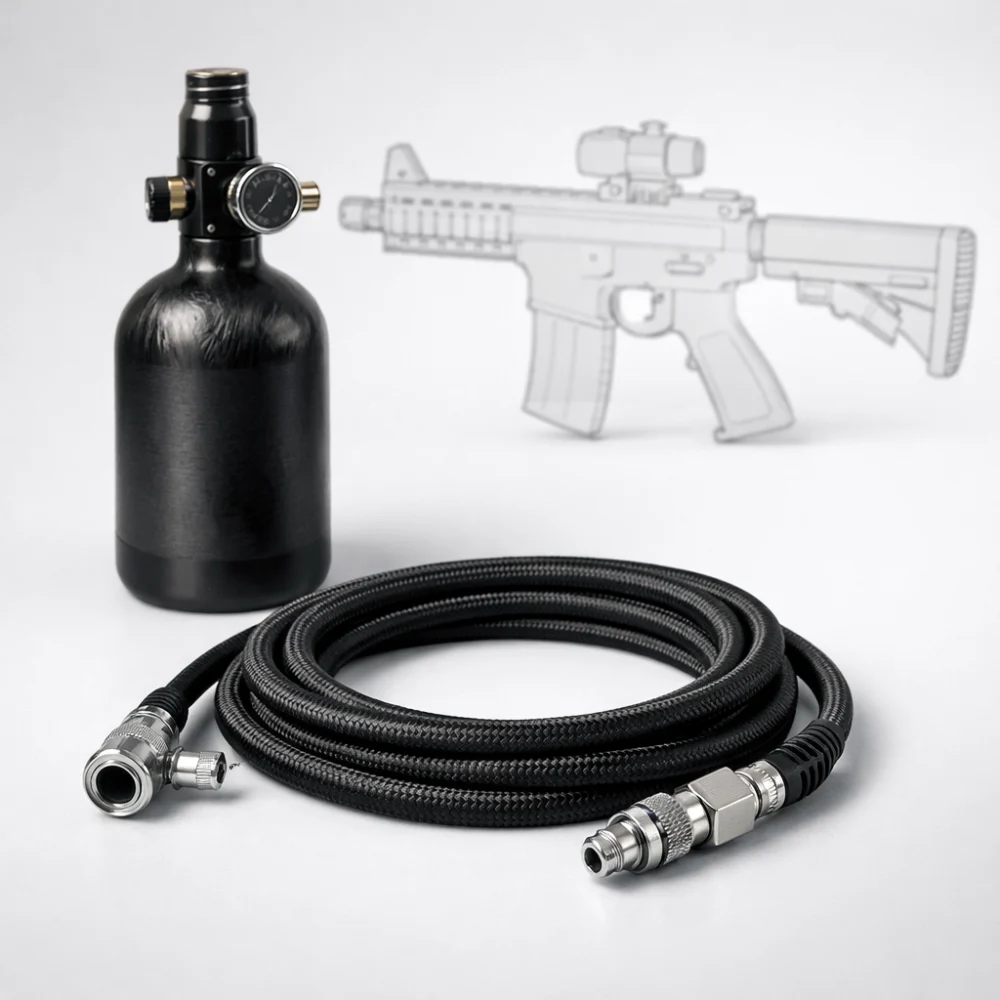
Airsoft remote hoses are part of an HPA setup that lets you connect a tank to a marker without carrying the tank on the marker itself. That changes the feel, balance and handling of the setup, so the main buying decision is less about looks and more about fit, routing and compatibility.
If you are new to HPA, the key is to understand which hose type works with your tank regulator, marker and fittings. Small differences in connectors and hose construction can make a big difference to whether a setup is convenient or awkward in use.
This guide focuses on choosing a remote hose for airsoft use, rather than on tanks, regulators or fill gear. Specifications vary by model, so always check the individual product page before buying.
What should you look for in an airsoft remote hose?
Start with compatibility, then judge how the hose will behave on your kit. The right choice is usually the one that matches your fittings cleanly, gives you enough freedom of movement and does not add unnecessary bulk. If you are choosing between similar options, the most useful differences are usually hose length, connector type, flexibility and how the line is finished at each end.
| Feature | What It Means | Why It Matters | What To Check |
|---|---|---|---|
| Connector compatibility | The fittings at each end of the hose | Determines whether the hose will join your tank regulator and marker setup properly | Thread type, quick-disconnect style and whether adapters are needed |
| Hose length | The distance between tank and marker | Affects movement, comfort and where you can carry the tank | How you plan to wear the tank and how much slack you want |
| Flexibility | How easily the hose bends and moves with you | More flexible hoses can feel less restrictive, but may be less tidy depending on the setup | Whether the hose is described as coil, braided, rubber or reinforced |
| Construction | The hose material and overall build | Influences durability, weight and how the hose handles repeated movement | Material description, reinforcement and connector finish |
| Use case | How the hose is intended to be used in an HPA setup | Some hoses suit compact carry styles better than others | Whether it is designed for a remote line, fill use or a general HPA connection |
Key decisions that matter most
Compatibility comes first
The most important check is whether the hose matches the fittings on your setup. A hose may look suitable but still be the wrong thread or connection style. Check both ends carefully and confirm whether the product is meant for direct connection or needs an adapter.
Length affects comfort and handling
Longer hoses can give you more freedom and make it easier to carry the tank away from the marker, but they can also leave more line to manage. Shorter hoses can feel neater, but may limit how you position the tank. Think about how you move during a game rather than choosing length by guesswork.
Flexibility changes the feel of the setup
Some hoses are designed to be more pliable, while others are built to hold their shape more firmly. A more flexible hose can reduce pulling and snagging, but a stiffer line may be more manageable for some users. The best balance depends on your carrying style and how much kit you already wear.
Construction should suit regular movement
Remote hoses are handled, bent and carried repeatedly, so the overall build matters. Look for clear material information and a finish that suggests the line is intended for repeated use. Do not assume that a more complex-looking hose is automatically better; it still needs to suit your setup.
Common hose types and what they suit
Within this category, the main differences usually come from hose construction rather than from entirely separate product families.
- Coil-style hoses can help keep slack under control and may suit players who want a tidier line.
- Straight hoses are often easier to understand and may suit buyers who want a simpler layout.
- Reinforced or braided hoses may suit users who want a firmer-feeling line and a more robust construction.
- Fill-oriented hoses are for a different task and should only be considered if the product page clearly shows that role.
Choose the type that matches your intended setup rather than assuming one hose style is universally better.
Choosing by buyer need
| Buyer need | What to prioritise | What to avoid |
|---|---|---|
| First-time HPA buyer | Clear compatibility information and a straightforward hose layout | Assuming fittings will match without checking |
| Player who wants a lighter feel on the marker | A setup that moves the tank away from the marker and keeps the line manageable | Choosing a hose that is longer than needed |
| Player who values tidy kit management | Hose length and style that reduce excess slack | A hose that adds more line than your carry style needs |
| Buyer replacing a worn line | Exact connector match and a construction similar to the original setup | Assuming any remote hose will be a direct swap |
Common mistakes and misunderstandings
- Buying on length alone: length matters, but it should be chosen after you confirm the fittings and the way you carry the tank.
- Assuming all connectors are the same: remote hoses can differ in thread or quick-disconnect style, so the end fittings need checking.
- Overlooking how the hose moves: a hose that is technically compatible may still feel awkward if it is too stiff or too long for your setup.
- Mixing remote lines and fill gear: hoses used for carrying a tank and hoses used for filling are not automatically interchangeable.
Safety and suitability checks
Remote hoses are part of a pressurised airsoft HPA system, so they should only be bought for the intended equipment and used with the correct matching components. Check the product page for the exact connection type, intended use and any limits stated by the seller. If anything about the fittings or purpose is unclear, it is better to confirm before buying than to assume a connection will work.
Maintenance, storage and everyday care
A remote hose is a wear item in practical terms, so it helps to keep it clean, dry and free from sharp bends when stored. Avoid letting the hose get trapped under heavy kit or dragged across rough surfaces more than necessary. If the product includes quick-disconnect parts or threaded fittings, those areas deserve careful checking before and after use.
How to compare options efficiently
- Identify the exact role you need the hose to play in your setup.
- Check connector compatibility on both ends before looking at any other feature.
- Compare the length and style against how you actually carry and use the tank.
- Look at the build description to judge how tidy, flexible or robust the hose is likely to feel.
- Read the individual product page carefully for any model-specific details.
Summary buyer decision checklist
- Does the hose match your tank regulator and marker connection style?
- Is the length suitable for how you want to carry the tank?
- Do you prefer a coil, straight or reinforced style?
- Is the hose intended for the same use you have in mind?
- Have you checked the individual product page for any model-specific details?
Frequently asked questions
What does a remote hose do in an airsoft HPA setup?
It links the tank to the rest of the setup so the tank can be carried away from the marker. That can improve how the marker feels in use and may make the load more comfortable depending on your carry style.
Are all airsoft remote hoses compatible with all HPA systems?
No. Compatibility depends on the fittings, threads and connection style used by the hose and the rest of your kit. Always check the product information carefully rather than assuming a universal fit.
Should I choose a longer hose for more comfort?
Not always. A longer hose can give you more movement, but it can also leave more line to manage. The right length is the one that suits your carry position without becoming cumbersome.
Is a coil hose better than a straight hose?
Neither is automatically better. A coil hose may help manage slack, while a straight hose can be simpler and more predictable. The better choice depends on how you wear your tank and how much tidy routing matters to you.
Can I use a remote hose for filling equipment as well?
Only if the product is clearly designed for that purpose. Do not assume that a remote line for carrying a tank is the same as a fill hose or charging line.
What should I check before replacing an old hose?
Match the connector type first, then compare the length and style with your current setup. If the old hose worked well, replacing it with something broadly similar is often the safest way to avoid fit issues.
Does a more expensive hose always mean better performance?
Not necessarily. A higher price may reflect construction or fittings, but the best choice is the one that matches your setup cleanly and suits how you play. Compatibility matters more than price alone.

