

Circular saws are a practical choice for straight cuts in timber, sheet material and many common DIY tasks. They suit people who want faster, more controlled cutting than a manual saw can usually offer, but without moving up to a larger fixed saw.
The right choice depends on the work you plan to do most often, how portable the saw needs to be and how much cutting control you want. A compact saw can be easier to handle for lighter jobs, while a larger model may suit thicker material and longer cuts.
This guide focuses on the buying decisions that matter before you compare product pages: blade size, power, cut depth, visibility, dust control and comfort. Specifications vary by model, so always check the individual product page before buying.
What should you look for in a circular saw?
The best starting point is the material and thickness you expect to cut most often. From there, choose a saw that offers enough cut depth, a comfortable grip and a power source that suits where you work. The main trade-off is usually between portability and capacity: lighter, more compact saws are easier to move around, while larger saws often handle more demanding jobs with less compromise.
| Feature | What It Means | Why It Matters | What To Check |
|---|---|---|---|
| Blade size | The diameter of the blade the saw is designed to use | Helps indicate likely cutting capacity and overall size | Match the blade size to the type of cuts you need and the product page details |
| Power source | Mains-powered or cordless operation | Affects portability, runtime and where the saw can be used | Decide whether you need unrestricted movement or a continuous power supply |
| Cut depth | The maximum thickness the saw can cut in a single pass | Important for sheet goods, timber and thicker materials | Check the stated depth at the angles you plan to use |
| Bevel capability | Whether the saw can cut at an angle | Useful for trimming, framing and some joinery tasks | Look for the range of adjustment rather than assuming every model has the same capability |
| Guide visibility | Features that help you follow a marked line | Can make accurate cutting easier for less experienced users | Check for a clear sightline, guide markings or laser-style aids where relevant |
| Weight and handling | How the saw feels in use | Affects fatigue, control and confidence during longer cuts | Consider balance, grip comfort and whether you will use it one-handed or two-handed |
Key decision criteria explained
Power source
Circular saws are commonly chosen either for mains use or cordless use. Mains models suit longer sessions and continuous access to power, while cordless models are easier to move around a site or garden. Your choice should reflect whether convenience or uninterrupted runtime matters more for the work you do.
Blade size and cutting capacity
Blade size is closely tied to how deep a saw can cut, but it is not the only factor. The exact cut depth can vary with the angle of the cut and the design of the saw base, so it is worth checking the stated figures rather than assuming all saws of a similar size behave the same way. If you often cut thicker material, capacity matters more than a compact form factor.
Accuracy and line of cut
For many buyers, the main difference between a frustrating saw and a useful one is how easy it is to stay on the line. A clear base guide, a stable shoe and good visibility of the blade area can make routine cuts more predictable. Features that help with alignment are especially useful if you are not cutting every day.
Comfort and control
Circular saws can feel quite different even when they look similar. Grip shape, balance and weight affect how much control you have over longer cuts, especially if you are working overhead or in awkward positions. If comfort matters, compare the overall design rather than focusing only on power.
Dust and visibility
Cutting produces dust and chips that can hide your marked line. Any design that helps move debris away from the cut can improve visibility and make work feel tidier. If you will be cutting indoors or in a confined space, this becomes more important.
Common circular saw types and variants
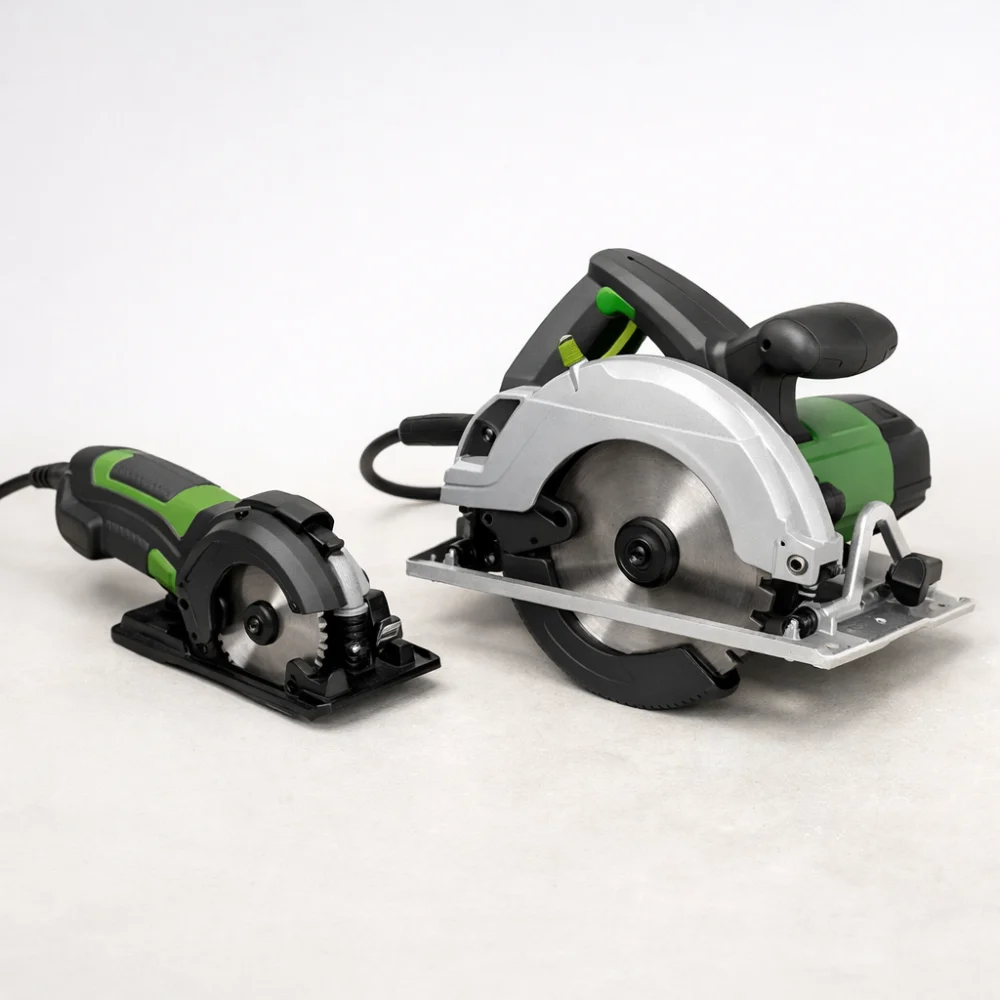
Most buyers will mainly be choosing between standard hand-held saws and more compact versions. Standard saws are generally better when you want a familiar all-round tool for routine straight cuts. Compact or mini saws may suit lighter-duty work, easier storage or occasional use, but they are usually less suited to thicker material.
Some circular saws are aimed at general DIY use, while others are better aligned with more frequent site work or workshop-style tasks. Rather than assuming one label tells you everything, compare the details that affect your use: depth, handling, power source and line visibility.
Which circular saw suits different buyers?
| Buyer need | What to prioritise | Why |
|---|---|---|
| Occasional home DIY | Ease of use, sensible weight and clear line visibility | Simple handling matters more than advanced features if you only use the saw now and then |
| Frequent renovation work | Cut depth, durability cues and comfortable handling | Repeated use makes balance and capacity more important |
| Working away from mains power | Cordless convenience and battery compatibility | Mobility can be more useful than unlimited runtime for on-the-move jobs |
| Long straight cuts in sheet material | Stability, guide visibility and enough blade capacity | These qualities help the saw stay controlled over longer passes |
| Storage-conscious buyer | Compact size and lighter handling | A smaller saw may be easier to keep ready for occasional projects |
Common mistakes to avoid
- Choosing only by power rating and ignoring cut depth or handling. A powerful saw is not always the most practical one for your material.
- Assuming all blade sizes give the same real-world result. Capacity and control still depend on the saw design.
- Overlooking whether you need mains or cordless operation. A convenient power source can matter more than a small performance difference.
- Buying for occasional jobs without considering comfort. A saw that feels awkward can be harder to use accurately.
- Forgetting to check what the individual product page actually states. Specifications vary by model, so always check the individual product page before buying.
Safety and suitability caveats
Circular saws are suitable for confident cutting tasks, but they still need to be matched to the material and the job. Check whether the saw is intended for the thickness and type of cut you plan to make, and make sure you understand what is included with the product, such as a blade or guide features. If you are unsure about suitability for a particular task, compare the product information carefully rather than relying on the name alone.
Maintenance, storage and ownership
Buying decisions should also reflect how much upkeep you are prepared for. Saws and blades benefit from clean storage, and cordless models add battery care to the list of ownership considerations. If you expect infrequent use, choose a model that will be easy to store safely and quick to get ready when needed.
How to compare circular saw options efficiently
- Start with the jobs you need to do most often, especially the material thickness and cut length.
- Decide whether cordless convenience or mains power suits your workspace better.
- Compare cut depth, blade size and the features that help you follow a straight line.
- Weigh portability against handling and capacity, rather than treating one factor as decisive.
- Read the individual product information carefully before you buy.
Summary buyer decision checklist
- Will the saw handle the material you cut most often?
- Is the power source practical for where you work?
- Does the cut depth suit your main projects?
- Do you want a lighter, more compact saw or a larger-capacity model?
- Will guide visibility and comfort make a real difference to your use?
- Have you checked the individual product page for the exact specification?
Frequently asked questions
What is a circular saw used for?
A circular saw is mainly used for straight cuts in timber and sheet materials. It is a useful general-purpose tool for DIY, renovation and site-style cutting tasks where speed and control matter.
Is a cordless circular saw as useful as a mains model?
It can be, depending on how you work. Cordless saws are easier to move around and can be very convenient for jobs away from a socket, while mains saws are better if you want uninterrupted power for longer sessions.
Do I need a large blade size?
Not necessarily. A larger blade can help with deeper cuts, but it may be more saw than you need for lighter work. It is better to match the saw to the material you cut most often than to choose the biggest option available.
What should I check for accurate cutting?
Look for a stable base, clear line visibility and a design that feels comfortable to guide. Accuracy is often more about handling and visibility than about choosing the most powerful saw.
Can one circular saw do every job?
No single saw suits every task equally well. A general-purpose model can cover many everyday jobs, but thicker materials, portability needs and repeated use may point you towards a different type or size.
What matters most for a first-time buyer?
For a first purchase, focus on ease of handling, the power source and whether the saw can cope with the cuts you expect to make. That usually gives a more useful result than chasing features you may not use.
Should I check anything on the product page before buying?
Yes. Check the stated cut depth, blade size, included accessories and whether the saw is mains or cordless. Specifications vary by model, so always check the individual product page before buying.