
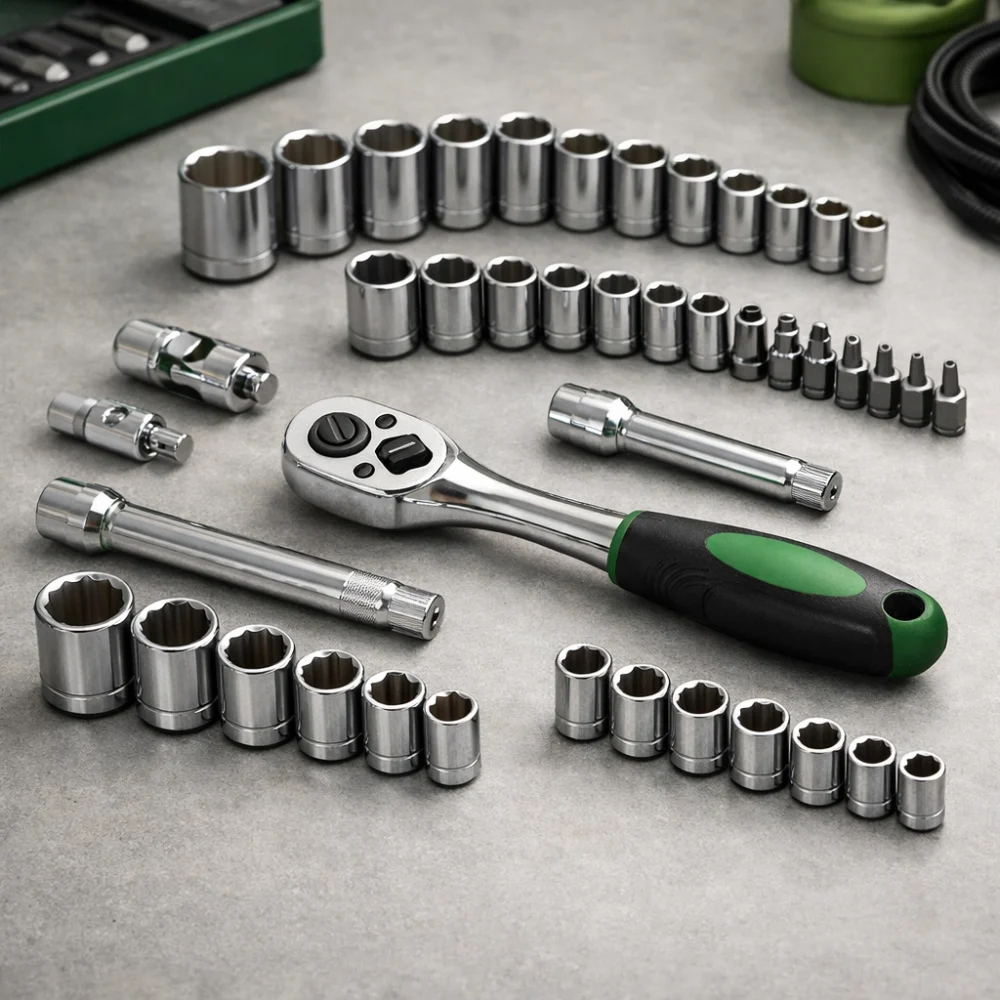
Socket sets are a practical choice for fastening and loosening nuts and bolts with more control than a loose spanner alone. They are used for everyday DIY, vehicle maintenance, furniture assembly and many workshop jobs, but the right set depends on the fixings you need to handle and how often you will use it.
If you are buying your first set, the main decision is usually between a compact general-purpose kit and a more specialised set for a particular job. A sensible choice balances reach, access, durability and the range of sizes you are likely to use most often.
Because socket sets vary widely, it helps to compare the drive size, socket type and included accessories before looking at the box or piece count.
What should you look for in a socket set?
The best starting point is to match the set to the fasteners you work with most often. A small set may be enough for light household jobs, while a larger set can be useful if you need a broader spread of sizes or more specialised sockets. The most important trade-off is usually coverage versus portability: a bigger set offers more options, but a compact set is easier to store and carry.
Specifications vary by model, so always check the individual product page before buying.
| Feature | What it means | Why it matters | What to check |
|---|---|---|---|
| Drive size | The size of the ratchet or driver square that the sockets fit | It affects strength, access and which jobs the set suits | Confirm the drive size matches your existing tools or the work you plan to do |
| Socket type | Standard sockets, deep sockets or specialist bit sockets | Different shapes suit different fixings and access requirements | Check whether the set includes the socket style needed for your fixings |
| Metric or imperial | The sizing system used for the sockets | The wrong system makes selecting the correct fit harder | Match the set to the fasteners you already use most often |
| Piece count | How many tools or accessories are included | More pieces can mean broader coverage, but not always better value for your needs | Look at which sizes and accessories are included, not just the total number |
| Material and finish | The construction and coating of the sockets and ratchet | These can affect durability, grip and ease of cleaning | Check the product description for the stated material and finish |
| Case or storage tray | The way the set is stored and organised | Good storage makes missing parts easier to spot and helps keep the set portable | See whether the case layout suits your storage space and working habits |
Key decision criteria
Drive size
Drive size is one of the most important filters because it influences the sort of work a set is suited to. Smaller drives are often chosen for lighter jobs and tighter spaces, while larger drives are commonly used where more leverage is needed. The trade-off is between compact access and the ability to handle tougher fastenings, so choose the drive that fits your most common tasks rather than the largest available.
Socket type and access
Not all sockets serve the same purpose. Standard sockets are the everyday choice for general fastening, while deep sockets can help when a bolt protrudes further through a nut or when extra reach is useful. Bit sockets suit some screw-head style fixings and specialist fasteners. Check whether the set includes the type you need most often, rather than assuming one set will cover every job equally well.
Size system and coverage
Socket sets are commonly organised by metric or imperial sizing, and the wrong system can be inconvenient even if the rest of the kit looks suitable. Buyers often need a handful of frequently used sizes more than a huge spread of rarely used ones. If you are replacing a lost set or matching existing fasteners, compare the included sizes carefully.
Ratchet and accessories
A socket set is often bought for the sockets, but the ratchet, extensions and adapters can make the set much easier to use. These accessories help with awkward access, recessed fasteners and working at different angles. The useful question is not just whether the set includes extras, but whether those extras are relevant to the spaces you work in.
Storage and organisation
Storage matters more than many buyers expect. A tidy case or tray helps you keep track of sizes, see what is missing and carry the set safely. If you plan to keep the set in a van, toolbox or garage, check the storage format and whether it will suit the space you have available.
Common socket set types and variants
General-purpose sets
These are the most familiar option for household and mixed DIY use. They usually offer a practical range of common sizes and accessories, making them a sensible starting point for many buyers. Their limitation is that they may not include the exact specialist sockets needed for particular repair jobs.
Deep socket sets
Deep sockets are useful when the fastening sits further back or when extra socket depth is needed. They can save time on awkward fixings, but they are not always necessary for everyday tasks. If your work is mostly simple, standard sockets may be enough.
Bit socket sets
Bit socket sets combine socket drive compatibility with bit-style ends for certain screw and fastener heads. They can be handy when you need one set to cover several fastening styles. Their limitation is that they are best chosen for a known task rather than as a universal substitute for a full socket range.
Specialist socket sets
Some sets focus on specific tasks, such as unusual fasteners or particular maintenance jobs. These are worth considering when you already know the fixing type you face regularly. They are less suitable as a first and only set if your needs are broad and varied.
Which socket set suits different buyers?
| Buyer need | What to prioritise | Why |
|---|---|---|
| General home DIY | Common sizes, practical drive size, easy storage | You are likely to value convenience and broad usefulness over specialist coverage |
| Vehicle or machinery maintenance | Relevant socket types, good access options, sturdy accessories | Tasks can involve recessed or awkward fasteners where the right accessory matters |
| Occasional user | Clear labelling, compact case, the sizes you use most | A simple set is often easier to choose and less cluttered to store |
| Frequent workshop use | Coverage, organisation, durability and replacement convenience | Regular use makes storage, access and build quality more important |
Common mistakes and misunderstandings
- Buying by piece count alone: a larger set is not automatically better if many of the pieces are sizes you will never use.
- Ignoring drive size: the wrong drive can make a set awkward to pair with your existing tools.
- Choosing the wrong sizing system: metric and imperial fasteners are not interchangeable, so match the set to the fixings you actually have.
- Assuming one set covers everything: specialist tasks may need deep sockets, bit sockets or a more specific selection.
- Overlooking storage: a well-organised case makes everyday use easier and reduces the chance of parts going missing.
Safety and suitability caveats
Socket sets are straightforward tools, but suitability still matters. Make sure the set is intended for the fastener size and type you need, and avoid forcing a socket that does not fit properly. If you are working near electrical components or on equipment with specific service requirements, choose tools that are appropriate for that environment and check the product information carefully.
Maintenance, storage and lifespan considerations
Socket sets generally last better when they are kept clean, dry and returned to their case after use. Wipe off dirt or residue before storage and keep moving parts, such as the ratchet, free from grit. If a set will live in a garage, van or shed, consider how the storage will protect it from damp and how easy it will be to keep organised.
For buyers who use sockets regularly, it is also worth thinking about replaceability. A set with clear size markings and sensible organisation can be easier to live with over time than one that is difficult to sort through.
How to compare socket set options efficiently
- Start with the jobs you actually need the set for, not the largest bundle on the page.
- Choose the drive size and socket type that suit those jobs.
- Check the size system and the specific sizes included.
- Compare the useful extras, such as extensions, adapters and storage.
- Read the individual product page for any model-specific details before deciding.
Summary buyer decision checklist
- Does the set match the fastener sizes you use most often?
- Is the drive size compatible with your intended work and existing tools?
- Do you need standard, deep or bit sockets?
- Are metric or imperial sizes the right fit for your tasks?
- Are the included accessories genuinely useful for your jobs?
- Is the storage case practical for where you will keep the set?
- Have you checked the individual product page for model-specific details?
Frequently asked questions
What is a socket set used for?
A socket set is used to tighten or loosen nuts and bolts with a ratchet or other driver. It is useful for many DIY, maintenance and assembly tasks because it can be quicker and more controlled than using a separate spanner for every fastening.
What size socket set should I buy first?
For a first purchase, many buyers choose a general-purpose set with the sizes they are most likely to use. The best starting point depends on the fasteners you already have, the type of jobs you expect to do and whether you want a compact kit or broader coverage.
Are deep sockets worth having?
They are worth considering if you often work with recessed fasteners or bolts that protrude beyond the nut. If your tasks are mostly straightforward, standard sockets may be enough and take up less space.
Do I need metric and imperial sockets?
Not always. Most buyers only need the sizing system that matches the fasteners they use most often, but some mixed-use workshops prefer coverage in both systems. Check your equipment or the fasteners you already own before choosing.
Is a bigger socket set always better?
No. A larger set can offer more range, but it may also include sizes you never use and take up more room. It is usually better to focus on the right sizes, the right drive and the right socket type for your work.
What should I check on the product page before buying?
Check the drive size, sizing system, included socket types and any accessories or storage details. Those are the features most likely to affect whether the set suits your work.
Can one socket set do every job?
Not usually. A general-purpose set can handle many everyday tasks, but some jobs call for deep sockets, specialist bit sockets or a different drive size. If you know your needs are specific, it is better to choose for those tasks rather than rely on a single all-purpose assumption.

