
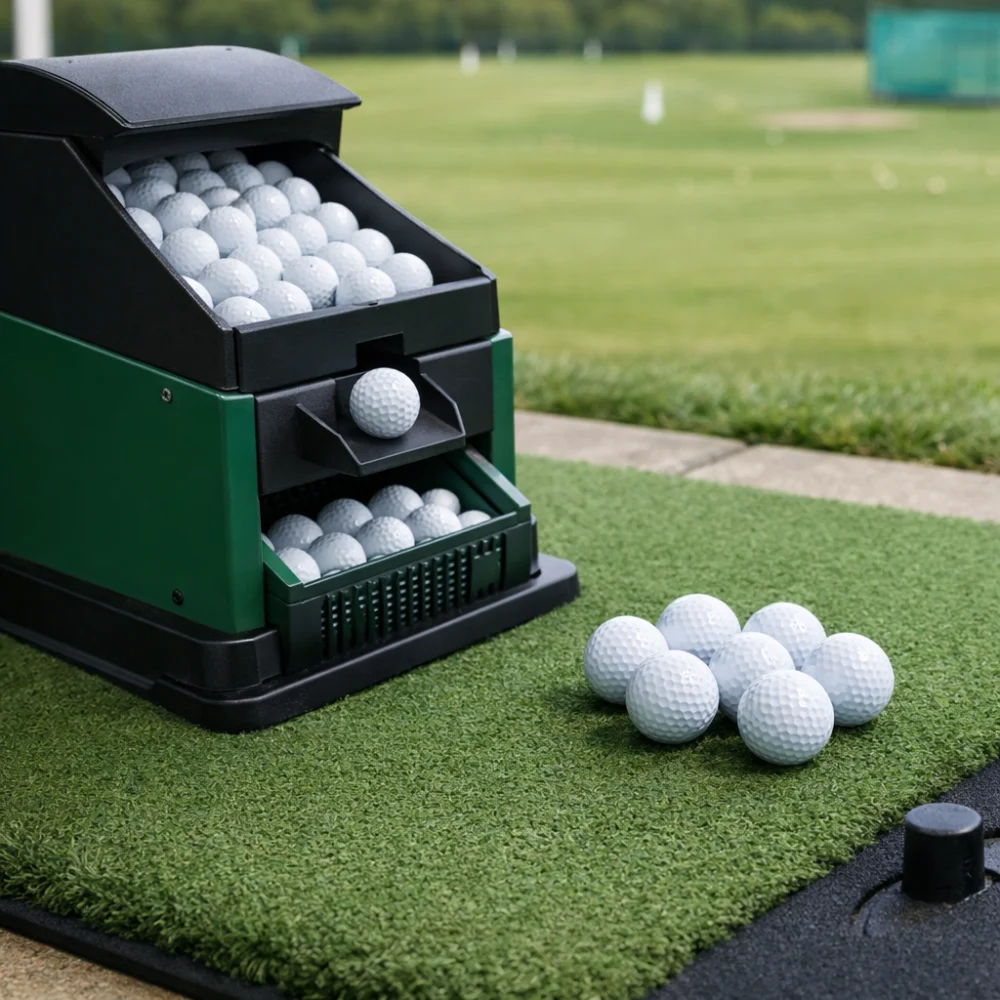
Golf ball dispensers are used to hold and release balls in a controlled way for practice, coaching or range use. For many buyers, the main question is not simply whether a dispenser works, but whether it suits the setting, the way balls will be fed and how much manual involvement is acceptable.
This guide focuses on the decision factors that matter before you compare individual products. It should help you narrow the choice whether you are replacing a worn unit, setting up a practice space or looking for a more convenient way to manage ball supply.
Because the category includes different dispensing approaches, it helps to think about capacity, how the unit is loaded, whether power is needed and how it fits with the surrounding practice setup.
What should you look for in a golf ball dispenser?
The best starting point is the way you want balls presented, stored and released. A simple dispenser may be enough for occasional practice, while a more involved machine may suit a busier training area where repeated feeding matters more than portability. The main trade-off is usually between simplicity and convenience: easier systems tend to be less complex, while more automated ones may need more planning around placement, power or servicing. Specifications vary by model, so always check the individual product page before buying.
| Feature | What it means | Why it matters | What to check |
|---|---|---|---|
| Dispensing method | How balls are released or presented | Affects ease of use and how much manual handling is needed | Whether it is manual, semi-automatic or more automated |
| Capacity | How many balls the unit can hold | Influences how often you need to refill it | Listed capacity and whether that suits your practice volume |
| Power requirement | Whether the unit needs electricity or works without it | Determines where it can be used and how portable it may be | Power source details and setup needs |
| Space and footprint | The room it needs on the ground or bench | Affects where it can be installed or placed | Overall size, clearance and compatibility with your practice area |
| Use environment | Where the dispenser is intended to be used | Some units suit driving ranges better than home practice spaces | Intended setting and any mounting or positioning guidance |
| Handling and upkeep | How easy it is to load, clean and maintain | Important for busy environments and frequent use | Access for refilling, cleaning and routine care |
Key decision criteria explained
Dispensing style
Golf ball dispensers vary in how they feed or release balls. Some are closer to simple storage-and-release units, while others are designed to automate part of the practice routine. The right choice depends on whether you want a straightforward aid or a setup that reduces repeated manual work.
Capacity and refill frequency
Capacity is about convenience and workflow. A larger holder may reduce interruptions, which can matter in coaching or range environments, but it may also take up more space. Smaller units are easier to move and position, though they may need topping up more often.
Power and independence
Some dispensers operate without mains power, while others rely on an electrical supply or other powered mechanism. A non-powered option can be easier to place in flexible locations, whereas a powered model may be better if you want a more automated process. Consider where the unit will be used, how often it will move and whether cabling or charging would create inconvenience.
Size, placement and surroundings
A dispenser should fit the space without getting in the way of play or traffic. This matters in a compact home practice area as much as on a busier range bay. Check that the unit can be positioned safely and that there is enough room for loading, access and any associated equipment.
Types and variants within the category
There is enough variation in this category to make the type worth considering, even when the core function is similar.
- Simple dispensers: Suited to buyers who want a straightforward way to hold and release balls with minimal complexity.
- Semi-automatic options: May suit practice areas where quicker ball supply is helpful but full automation is not necessary.
- Automatic or powered machines: Better suited to higher-use settings where convenience and repeat feeding matter more.
- Portable or compact designs: Useful where space is limited or the unit needs to be moved between areas.
Each type has a trade-off. Simpler units are often easier to understand and place, while more automated designs may be more convenient but also more dependent on setup conditions.
Which dispenser suits which buyer need?
| Buyer need | What to prioritise | Why it helps |
|---|---|---|
| Home practice | Compact size, simple operation, easy storage | Keeps the setup manageable in a smaller space |
| Coaching or frequent repetition | Higher capacity, quicker replenishment, reduced manual handling | Supports a smoother practice session |
| Flexible placement | Non-powered or low-dependency design | Makes it easier to use in different locations |
| Busy range environment | Durable construction, practical loading, workflow-friendly design | Helps the unit fit into repeated daily use |
Common mistakes to avoid
- Choosing only by appearance: A neat design may still be awkward to load or place. Focus on how it will be used day to day.
- Ignoring space: A dispenser that looks suitable on paper may be difficult to position if the available area is tight.
- Overlooking power needs: If a unit depends on electricity, make sure that suits the location and setup.
- Assuming all dispensers do the same job: The release method, capacity and level of automation can vary in ways that affect convenience.
Safety and suitability considerations
Check that the dispenser is intended for the setting where you plan to use it, especially if it will be placed near other practice equipment or in a shared area. If it is powered, confirm the practical requirements before buying so the setup is suitable for the location. For any model, it is sensible to check access, stability and how balls are loaded or released in normal use.
Maintenance, storage and long-term use
Most buyers should think about how the dispenser will be cleaned, refilled and stored when not in use. Simple designs may need little more than routine cleaning and sensible storage, while more complex models may have additional care needs depending on their mechanism or power source. If the unit will live outdoors or in a busy training environment, check what kind of protection or upkeep the product page recommends.
How to compare options efficiently
- Decide where the dispenser will be used and how much space is available.
- Choose the dispensing style that matches how much manual handling you want.
- Compare capacity and refill frequency against your expected use.
- Check whether power is needed and whether that suits the location.
- Read the individual product page for any model-specific limitations or setup requirements.
Summary buyer decision checklist
- Does the dispenser suit your practice space or range setup?
- Is the dispensing method simple enough for your needs?
- Is the capacity appropriate for how often you want to refill it?
- Do you need a powered or non-powered design?
- Will the unit be easy to place, load and maintain?
- Have you checked the individual product page for model-specific details?
Frequently asked questions
What is a golf ball dispenser used for?
It is used to hold and release golf balls in a controlled way, usually for practice, coaching or range use. Different designs aim to reduce manual handling or improve convenience depending on the setup.
Do I need a powered dispenser?
Not always. A powered unit may suit busier or more repetitive use, but a non-powered option can be better if you want simpler placement or fewer setup requirements.
Are all golf ball dispensers the same size?
No, and size can affect both capacity and placement. Check the footprint and the space you have available rather than assuming one dispenser will fit like another.
Is a larger dispenser always better?
Not necessarily. Larger capacity can reduce refilling, but it may also take up more room and be less convenient if you only need occasional practice.
Can I use a dispenser anywhere?
Only if the product is suitable for that location. Consider the surface, available space, power access if relevant and whether the setup is practical for the environment.
What should I check before buying?
Focus on the dispensing style, capacity, power requirement, size and intended use. Those factors usually tell you more about suitability than the product name alone.

