
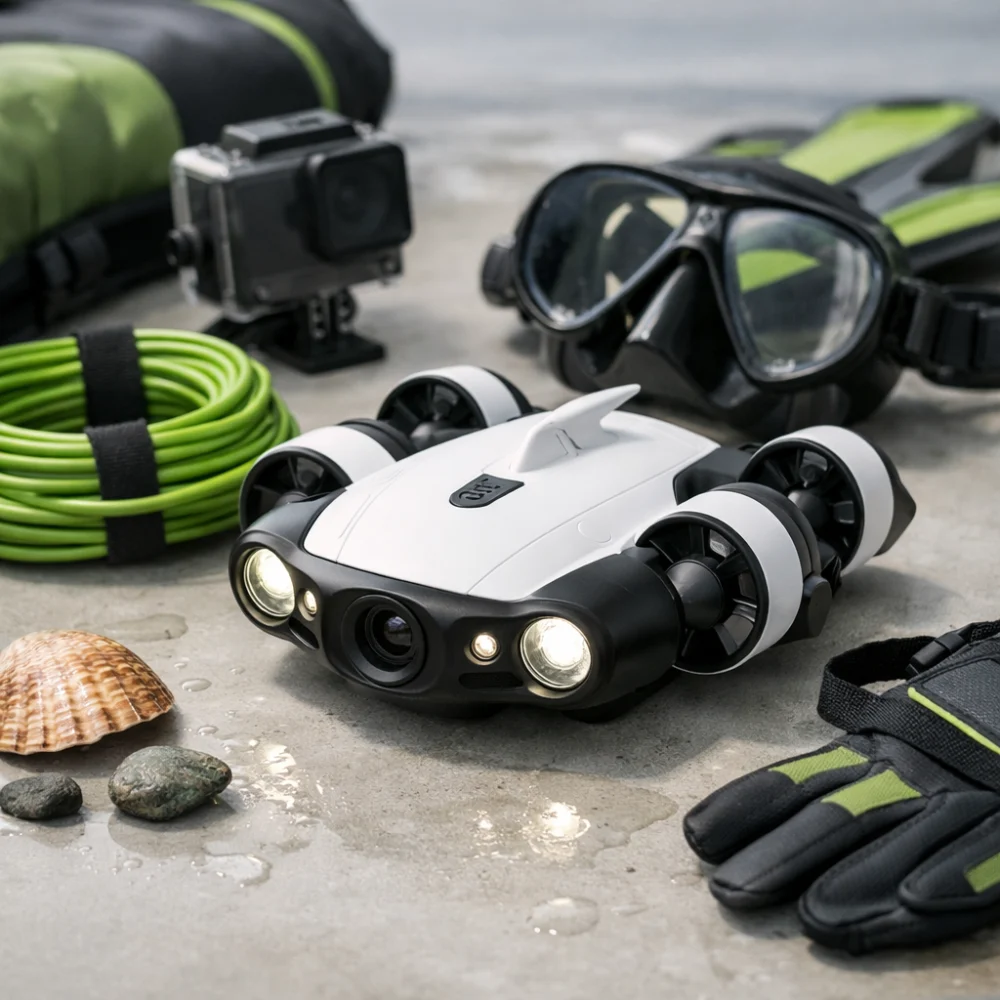
Underwater drones are for buyers who want a remote way to explore, inspect or film below the surface without relying only on a handheld camera or mask-mounted view. They are used in different ways, from recreational viewing to more practical tasks such as checking hard-to-reach areas under a boat or looking around a body of water.
The right choice depends less on the name of the drone and more on how you plan to use it. Depth, tether length, camera quality, control method and handling in water all affect whether a model feels easy to use or frustrating. Specifications vary by model, so always check the individual product page before buying.
Because this category covers several use cases, it helps to start with your main job: filming, inspection, fishing support or general exploration. Once that is clear, the comparison becomes much simpler.
What should you look for in an underwater drone?
Start with the task you need it to do, then compare the few features that matter most for that task. For many buyers, the main trade-off is between simpler, lighter models that are easier to handle and more capable models that offer better imaging, deeper use or extra control features. A good first choice is the one that matches your likely environment and avoids paying for features you will not use.
| Feature | What It Means | Why It Matters | What To Check |
|---|---|---|---|
| Intended use | Whether the drone is aimed at filming, inspection, fishing support or general exploration | Different jobs place different demands on the camera, control and stability | Look for the use case described on the product page |
| Depth and reach | How far the drone is designed to operate from the surface and controller | Determines whether it can reach your intended water conditions or work area | Check the stated operating depth and tether length |
| Camera and viewing | The imaging setup used to see and record underwater | Important if you want clear live viewing or footage rather than basic navigation only | Review the camera description and any live-view details |
| Control and movement | How the drone is steered and how precisely it can move | Affects ease of use in currents, tight spaces and careful positioning | Check how the controller or app is described |
| Handling and accessories | Whether the model includes helpful extras such as a tether, case, light or arm | Accessories can improve convenience and expand what you can do | See what is included with the individual listing |
Key decision criteria explained
Camera quality and viewing needs
If your main aim is to observe or record underwater scenes, camera quality matters a great deal. A clearer image helps with composition, inspection and deciding where to move next. If your priority is only basic viewing, you may not need the most advanced imaging setup, but it is still worth checking how the live feed is presented and whether the viewing setup suits your phone, tablet or controller preference.
Depth, tether and working range
Underwater drones are usually limited by both depth and tether length, so it is sensible to think about the maximum area you need to reach rather than only the headline figure. A longer tether can be useful, but it can also add bulk and make handling less convenient. Choose a combination that fits the places you actually expect to use it, not just the most ambitious scenario.
Stability and manoeuvrability
In water, smooth control often matters more than raw speed. A model that is easier to position may be more satisfying than one with more dramatic specifications but awkward handling. If you expect to work near structures, in changing conditions or in tighter spaces, read the product details carefully for movement controls and any features that support steady operation.
Power, runtime and charging
Power affects how long you can use the drone and how convenient it is to prepare for another session. Some buyers will value a simpler setup that is quick to deploy, while others may prefer a more capable system even if it takes more preparation. Check how the power system is described and whether the product page explains the practical ownership implications.
Common product types and variants
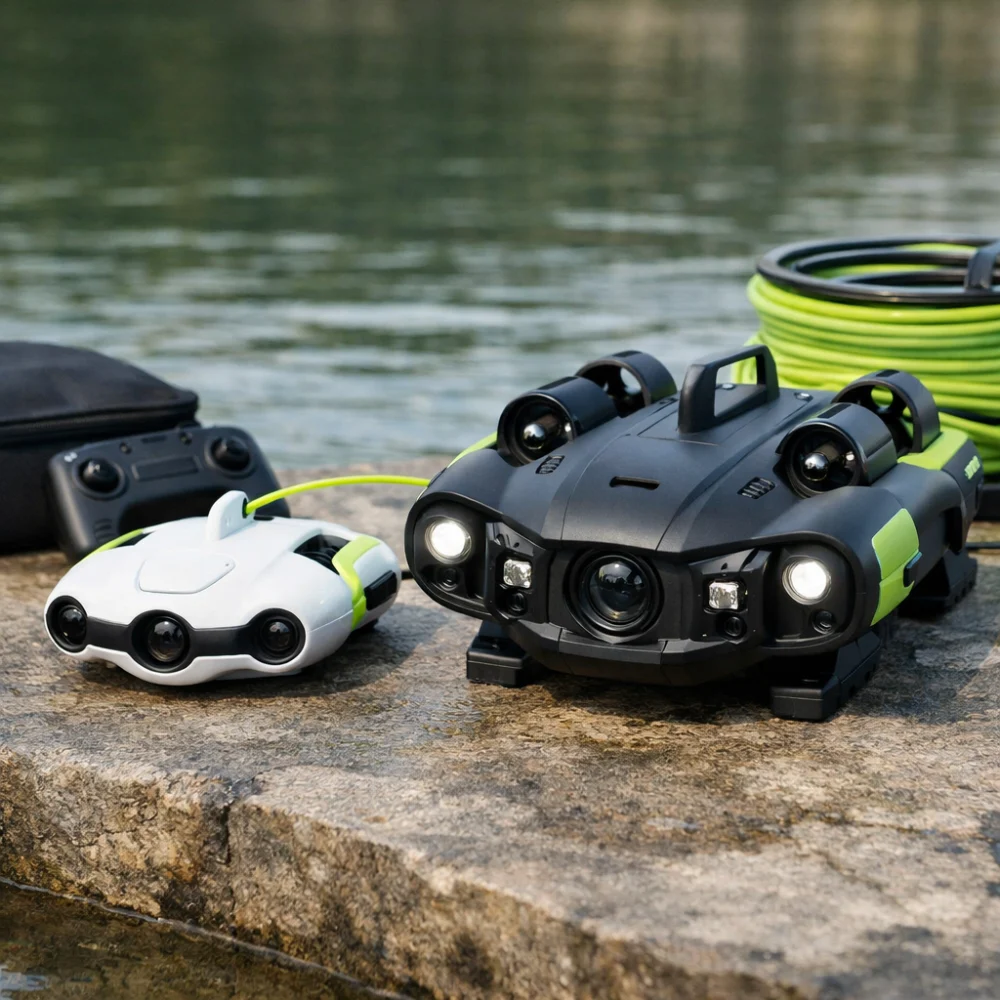
There is no single underwater drone type that suits every buyer. Some models are compact and easier to carry, which can suit casual use or occasional trips. Others are more fully featured and aimed at longer sessions, more detailed viewing or specialist tasks. The main limitation of smaller models is often capability or reach, while larger or more advanced options may be less convenient to transport and set up.
You may also see products positioned around specific activities such as diving observation, fishing support or inspection work. That wording is useful because it often signals the main design emphasis. The important point is to match the variant to the task rather than assuming every underwater drone is equally suited to every job.
Which underwater drone suits which buyer?
| Buyer need | Usually worth prioritising | Why | Possible trade-off |
|---|---|---|---|
| Casual exploration | Simple controls, portable design, easy live viewing | Helps keep setup straightforward | May have fewer advanced functions |
| Filming and recording | Camera quality, stable movement, useful viewing setup | Supports clearer footage and easier framing | May cost more or be more involved to set up |
| Inspection and checking hard-to-reach areas | Reliable control, good reach, practical viewing | Useful when precision matters more than appearance | Appearance-focused features may be less important |
| Fishing support | Useful tether, clear live view, practical handling | Helps when the drone is used as a viewing aid rather than a toy | May be more specialised than general-purpose models |
Common mistakes and misunderstandings
- Choosing by camera headline alone: image quality matters, but so do control, range and suitability for your task.
- Ignoring tether length: a good camera is less useful if the drone cannot comfortably reach the area you want to inspect.
- Assuming all underwater drones are equally portable: some are designed for easier carrying and quicker setup than others.
- Overlooking what is included: accessories and extras can affect how ready the product is to use on day one.
- Buying for a rare use case: it is usually better to choose for the job you will do most often.
Safety and suitability caveats
Always check that the product is suitable for the kind of water and the conditions where you plan to use it. Water movement, visibility, access and depth can all affect how well an underwater drone performs in practice. If you are buying for a child, beginner or gift recipient, prioritise ease of use and straightforward setup over advanced features.
Do not assume that one model suits all environments just because it is labelled as an underwater drone. The product page should tell you enough about intended use, limits and included equipment to make a sensible comparison.
Maintenance, storage and ownership considerations
Underwater equipment usually benefits from careful cleaning, drying and storage after use, especially if it has been used in natural water. Before buying, check whether the product page mentions any care needs, included case or accessory support, and whether the power setup is convenient for your routine. A model that is easy to store and prepare is often more likely to be used regularly.
How to compare options efficiently
- Decide what you mainly want the drone to do: observe, film, inspect or support another activity.
- Compare the reach, control and camera description against that use.
- Check what is included and whether the setup feels practical for you.
- Weigh convenience against capability, rather than chasing the most advanced specification.
- Read the individual product page carefully before you commit.
Summary buyer decision checklist
- Is the drone suitable for your main use case?
- Do the depth and tether length match where you plan to use it?
- Is the camera and live viewing setup detailed enough for your needs?
- Will the control method feel manageable for your level of experience?
- Are the included accessories useful for how you plan to use it?
- Does the product page explain any important limits or setup needs?
Frequently asked questions
What is an underwater drone used for?
An underwater drone is used to remotely view, inspect or record what is below the surface. Buyers use them for recreation, filming, checking underwater areas and other practical tasks. The exact experience depends on the model and how it is designed to be used.
How do I know which one to choose?
Start with your main purpose and then compare the reach, camera and control features that support it. If you are unsure, prioritise ease of use and a practical setup rather than advanced extras. That usually makes the first purchase easier to live with.
Is a longer tether always better?
Not necessarily. A longer tether can increase reach, but it may also make handling less convenient. The right length is the one that comfortably covers your usual use case without adding more bulk than you want.
Do I need the most advanced camera?
Only if image quality is central to your use. For some buyers, a clear live view is enough; for others, footage detail matters much more. Think about whether you are mainly watching in real time or planning to review recordings later.
Are underwater drones difficult to use?
Some are designed to be straightforward, while others are more specialised. Control, setup and viewing method all affect ease of use, so it is worth checking the product description carefully. A simpler model may be the better choice for a first-time buyer.
What should I check before buying for a gift?
Check that the recipient is likely to use it for the intended purpose and that the setup looks manageable. Also confirm that the included accessories and control method feel suitable for a beginner. A practical, easy-to-handle model is usually safer than an overly ambitious choice.

