
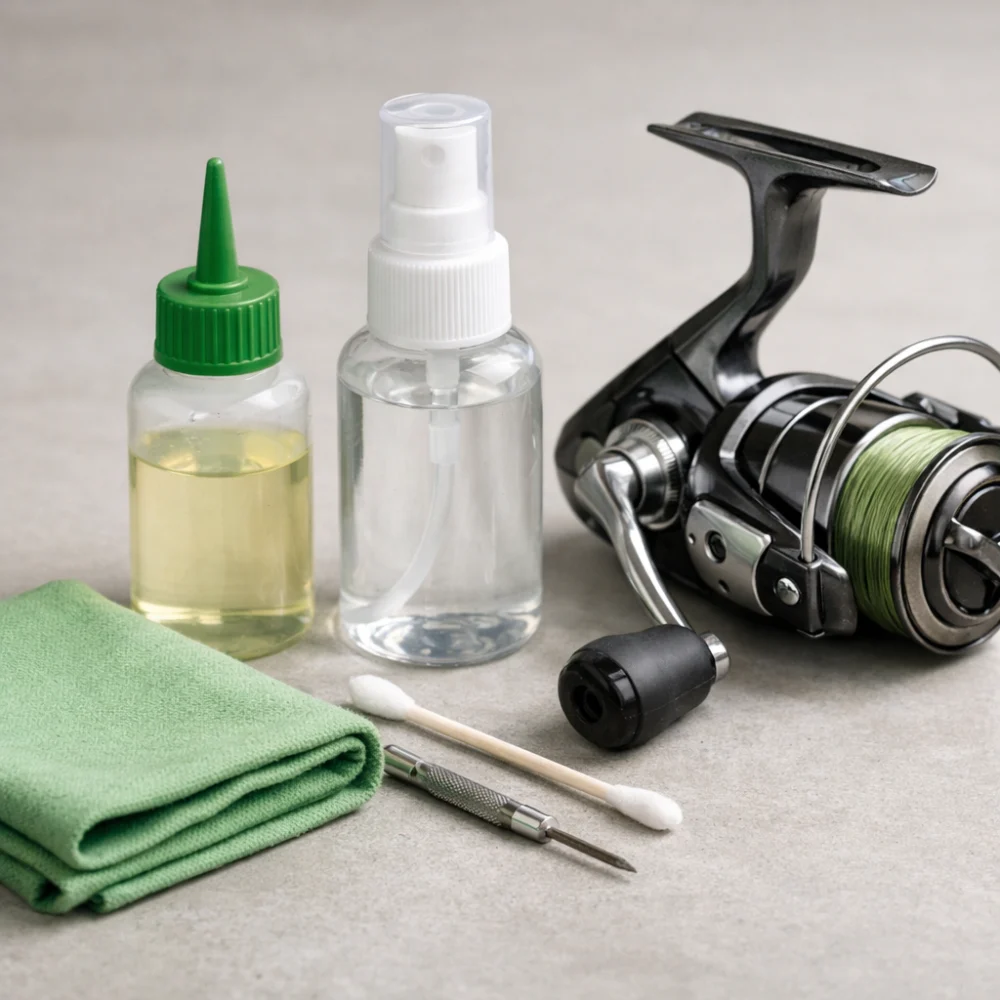
Fishing reel lubricants and cleaners are for keeping reels moving smoothly and helping remove dirt, old residue and moisture build-up. They are not the same thing as general household oils or sprays, and the right choice depends on how you service your reel and how often you fish.
If you are buying for routine maintenance, the main decision is usually between a light oil, a grease, a cleaner, or a kit that combines more than one of these. The best starting point is the reel type and the part you want to treat, because different components need different levels of lubrication and cleaning.
For many buyers, the choice is less about brand names and more about format, ease of application and whether the product suits a simple top-up or a more thorough clean. Specifications vary by model, so always check the individual product page before buying.
What should you look for first?
Start with the job you need the product to do. A cleaner helps remove grime and old lubricant, while oil and grease are for reducing friction and protecting moving parts after cleaning. A small bottle may be enough for occasional maintenance, but if you service several reels you may prefer a kit that covers both cleaning and lubrication.
The most useful comparison is not volume alone, but whether the product matches the reel parts you plan to maintain and whether it is easy to apply accurately.
| Feature | What it means | Why it matters | What to check |
|---|---|---|---|
| Product type | Oil, grease, cleaner, or a combined kit | Different parts of a reel need different treatment | Whether the product is intended for cleaning, lubrication, or both |
| Application format | Dropper, spray, squeeze bottle or kit components | Controls how precisely you can apply it | Whether the format suits small bearings, gears or general maintenance |
| Use case | Light maintenance or deeper servicing | Helps avoid under-treating or over-applying | Product description and intended use on the listing |
| Quantity | How much product is included | Affects value and how long it may last in use | Bottle size or kit contents on the individual page |
| Reel compatibility | Suitability for the reel type you own | Not every lubricant or cleaner is equally suited to every reel | Any compatibility guidance listed by the seller |
Key decision criteria explained
Oil versus grease
Oil is generally used where lighter lubrication and low-friction movement matter, while grease is usually chosen for parts that benefit from a thicker protective coating. The trade-off is between easy movement and stronger staying power. If you are unsure, look at what the product is intended for rather than assuming one formula covers every part of the reel.
Cleaner first, lubricant second
A cleaner removes old residue so fresh lubricant can do its job properly. That makes it useful when a reel has not been serviced for a while or feels gritty. If you only add more lubricant without cleaning first, you may trap dirt rather than improve performance.
Precision of application
Reel maintenance often involves small parts, so the application method matters. A product that is easy to place exactly where needed can be more useful than a larger pack that is awkward to use. If you maintain small bearings or fine mechanisms, look for a format that supports controlled application.
Ease of storage and use
Some buyers want a simple one-bottle solution, while others prefer separate products for different steps. A kit can be convenient if you service reels regularly, but a single-purpose product may be simpler if you only do occasional upkeep. Consider whether you want a quick refresh or a more complete maintenance routine.
Types and variants you are likely to see
The category usually breaks down into three broad choices: lubricant only, cleaner only, and combined maintenance kits. Lubricants suit regular upkeep, cleaners suit removing old residue and dirt, and kits are useful when you want both steps covered in one purchase.
- Oil: Often chosen for lighter lubrication and smaller moving parts.
- Grease: Often chosen for parts that need a thicker protective layer.
- Cleaner: Used to remove grime and old build-up before re-lubricating.
- Kit: Combines more than one maintenance product for a fuller routine.
The limitation with all of these is that the right choice depends on the exact reel part and the way you maintain it. A single product may not be the best answer for every task.
Which option suits different buyers?
| Buyer need | More suitable option | Why it may suit them |
|---|---|---|
| Occasional angler | Simple oil or small maintenance kit | Easier to store and enough for routine top-ups |
| Frequent reel maintainer | Cleaner plus lubricant | Useful when regular servicing is part of the routine |
| Buyer focused on convenience | Combined kit | Reduces the need to choose separate products |
| Buyer servicing more than one reel | Larger quantity or multi-piece set | May be more practical if you maintain several reels |
Common mistakes and misunderstandings
Using the wrong product for the job. A cleaner is not a lubricant, and a lubricant is not a cleaner. Matching the product to the task is the simplest way to avoid disappointment.
Choosing by size alone. A larger bottle is not always the better buy if you only service one reel occasionally. Consider how often you will use it and whether the format is convenient.
Assuming all reels need the same treatment. Different reel parts can need different levels of care. Check the individual product page and use the product where it is intended, rather than treating the whole reel with one product by default.
Overlooking application control. Very small parts can be easy to over-treat. A product that is easy to apply precisely is often more practical than one that is simply larger.
Safety and suitability caveats
These products are intended for reel maintenance, not general-purpose household cleaning. Check that the product is suitable for the reel parts you want to treat and follow the individual listing guidance carefully. If you are maintaining expensive or specialist tackle, it is especially sensible to verify the intended use before applying anything.
Maintenance, storage and lifespan considerations
Reel lubricants and cleaners are consumables, so the main ownership questions are storage, ease of use and how quickly you expect to use them up. Keep caps closed and store products as directed on the packaging or product page so they remain usable when needed. If you service reels only occasionally, a smaller pack may be more practical than a larger one that sits unused for a long time.
How to compare options efficiently
- Decide whether you need cleaning, lubrication, or both.
- Check which reel parts you are maintaining and how precise the application needs to be.
- Compare the product format, quantity and intended use.
- Look for any compatibility guidance on the individual product page.
- Choose the simplest option that matches your maintenance routine.
Summary buyer decision checklist
- Have you identified whether you need cleaner, oil, grease or a kit?
- Does the format suit the parts you plan to maintain?
- Is the application method practical for small reel components?
- Is the quantity sensible for how often you service reels?
- Have you checked the individual product page for suitability guidance?
Frequently asked questions
Do I need both cleaner and lubricant?
Not always. If your reel just needs routine upkeep, a lubricant alone may be enough. If there is old residue or grit, a cleaner can be useful before you apply fresh lubrication.
Is oil better than grease?
Neither is universally better. Oil is usually chosen for lighter movement, while grease is often preferred where a thicker coating is helpful. The right answer depends on the reel part and the maintenance task.
Can I use one product on every part of my reel?
That is not a safe assumption. Different parts can call for different treatment, so it is better to match the product to the task rather than using one formula everywhere.
How do I know if a kit is worth it?
A kit can be worthwhile if you want a straightforward maintenance set without buying each item separately. If you only need one specific product, a single bottle may be simpler and more practical.
What matters more: quantity or format?
For most buyers, format matters first because it affects how easy the product is to apply correctly. Quantity matters too, but only after you know the product is suited to the job.
Do these products work for all reel types?
Not necessarily. Suitability can vary, so check the individual product page and any guidance from the seller before buying. If you use specialist tackle, that check is especially important.

