
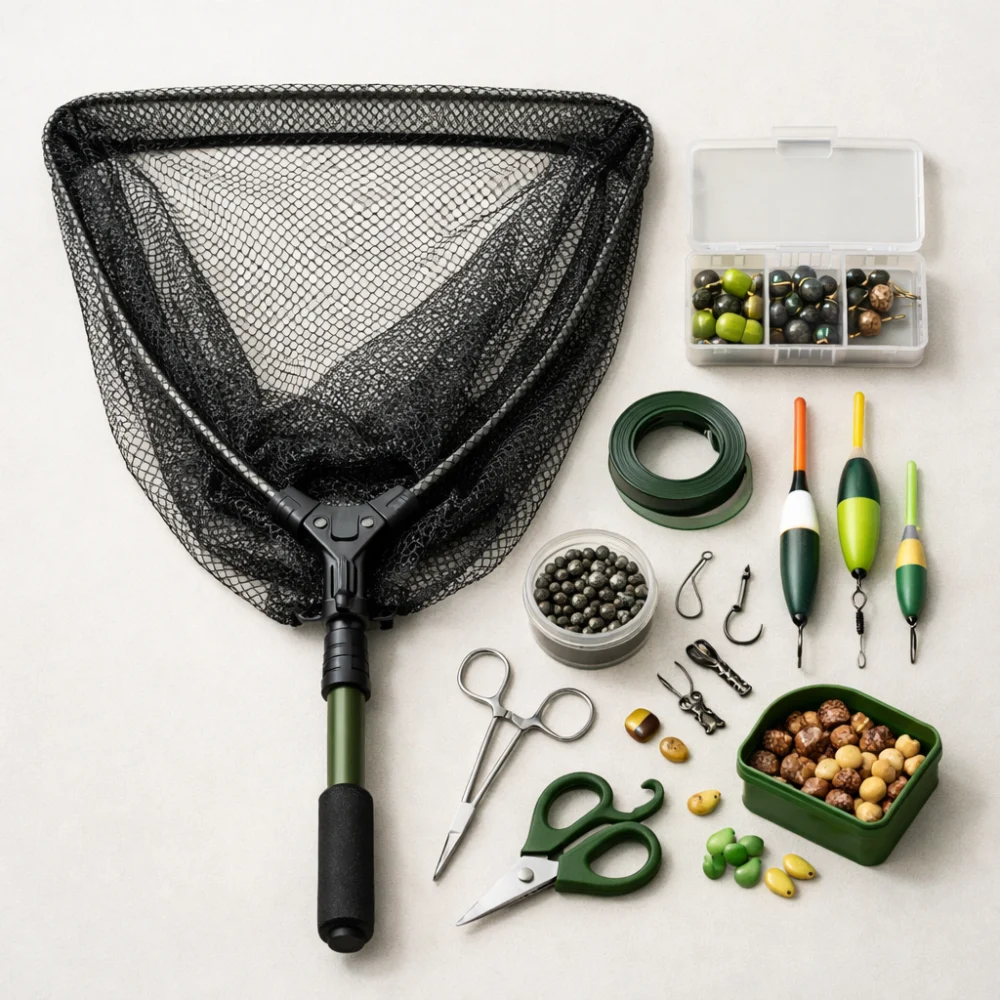
Landing nets are a simple but important part of many anglers’ kit. They help bring fish safely to hand and can make the last stage of the catch easier to manage, especially when you are fishing from the bank or dealing with larger fish.
Choosing one is mostly about matching the net to the way you fish. Handle length, hoop size, mesh style, weight and how the net stores or folds are often more important than appearance.
If you are replacing a worn net or buying one for a specific style of fishing, it helps to compare the practical details rather than focusing on a single headline feature.
What should you look for in a landing net?
The right landing net is the one that suits your fishing method, the species you expect to handle and how far you need to reach. A longer handle can help from awkward banks, while a compact net may be easier to carry and store. Mesh type affects how quickly the net drains and how gentle it feels, so it is worth checking that against your usual fishing conditions.
Specifications vary by model, so always check the individual product page before buying.
| Feature | What it means | Why it matters | What to check |
|---|---|---|---|
| Handle length | The reach of the net shaft or pole | Helps from high banks, wider pegs or when you need extra reach | Whether the length suits your fishing position and transport needs |
| Hoop size | The size and shape of the net frame | Needs to suit the fish you expect to land and the amount of control you want | Frame dimensions and whether the shape fits your usual target species |
| Mesh type | The material and weave of the netting | Affects water flow, snagging and how the net handles in use | Whether it is fine, open or otherwise described for your style of fishing |
| Weight and balance | How heavy the net feels and where the balance sits | Matters if you carry a lot of kit or fish for long sessions | Whether portability or steadiness matters more to you |
| Folded or fixed format | How the net packs away or assembles | Influences convenience, storage and how quickly it is ready to use | Whether it fits your vehicle, tackle bag or storage space |
Key decision criteria
Reach and handle style
One of the first choices is how much reach you need. A longer handle can be useful where banks are steep, swims are awkward or the water edge is hard to access. A shorter or more compact design is easier to carry and may be perfectly adequate where you fish close in.
Think about where you most often fish rather than choosing a handle length purely for general use. A net that is unnecessarily long can feel clumsy, while one that is too short can make the final lift more awkward.
Hoop shape and size
The hoop should be large enough for the fish you are likely to land without becoming awkward to control. Larger hoops can offer more room and confidence, but they may feel bulkier when moving the net through the water or carrying it between swims.
Smaller hoops are easier to handle and store, but they may not suit every target species or fishing style. The right balance is usually the one that matches your usual fishing rather than a theoretical widest use.
Mesh and water handling
Mesh choice affects how the net behaves in use. Some nets drain quickly, which can make them feel lighter when lifted, while others are chosen for a different feel or for the way they move through water. The best option depends on whether you want faster drainage, a gentler catch handling feel or a more streamlined net.
It is worth checking the product description carefully because mesh terms are not always used consistently across the category.
Folding, telescopic or fixed design
Some landing nets are designed to pack down for easier transport, while others prioritise a simpler fixed structure. Folding or telescopic designs can be handy if space is limited, but they may involve more moving parts or assembly steps.
Fixed designs are often straightforward, but they may be less convenient to carry if you travel light. Choose the format that best matches how often you move swims and how much kit you want to carry.
Common landing net types
There is a useful range of landing net styles, even within one category. The main differences are usually in reach, frame size and how they pack away.
- Compact landing nets: suited to anglers who want easy transport and simple handling. Their main limitation is reduced reach or hoop size.
- Long-handle landing nets: useful where extra reach matters. Their trade-off is greater length to carry and store.
- Folding or telescopic landing nets: good for mobility and compact storage. They can be convenient, but buyers should check the locking or assembly format carefully.
- Larger landing nets for bigger fish: designed to give more room and control. They can be bulkier, so portability may be the compromise.
Which landing net suits different buyers?
| Buyer need | What to prioritise | Why |
|---|---|---|
| Bank angler with awkward access | Longer reach and easy handling | Helps when the water edge is difficult to reach |
| Mobile angler or light packer | Compact storage and lower weight | Makes carrying and setup easier |
| Angler targeting larger fish | More generous hoop size and a stable feel | Provides more room and control at the netting stage |
| Beginner buyer | Simple, clear design and practical sizing | Makes the choice easier and avoids overbuying for current needs |
| Replacement buyer | Match the dimensions and format you already prefer | Helps keep your setup familiar and convenient |
Common mistakes to avoid
- Choosing only by handle length: reach matters, but so do hoop size, weight and storage.
- Buying a net that is larger than needed: more size can mean more bulk, even if it sounds more versatile.
- Ignoring how it packs away: a net that is awkward to transport can be inconvenient on every trip.
- Assuming all mesh is the same: the net material can change how easy it is to use and how it feels in the water.
Safety and suitability considerations
A landing net should suit the fishing situation and the fish you expect to handle. Check that the size, handle length and overall format are appropriate for your usual environment, especially if you fish from uneven banks or move around a lot.
It is also worth checking whether the net is intended for the type of fishing you do most often, because some designs are better suited to particular setups than others. That way, you avoid buying a net that looks suitable but feels awkward in real use.
Maintenance and storage
Landing nets are usually straightforward to care for, but they still benefit from sensible storage. Rinse off mud or debris after use where appropriate, let the net dry before packing it away and store it so the mesh and frame are not crushed.
If a net folds, extends or separates into sections, those moving parts are worth checking from time to time. A bit of care can help the net stay easier to use and keep it from becoming stiff or awkward in storage.
How to compare landing nets efficiently
- Start with how and where you fish most often.
- Decide whether reach, portability or size matters most.
- Compare the hoop, handle and mesh details on each product page.
- Weigh the convenience of a compact design against the control of a larger one.
- Choose the model whose trade-offs fit your regular sessions, not just the occasional trip.
Summary buyer decision checklist
- Does the handle length suit your usual banks or fishing position?
- Is the hoop size appropriate for the fish you expect to land?
- Does the mesh type sound suitable for your style of fishing?
- Will the net be easy enough to carry, fold or store?
- Does the overall format match your current tackle setup?
- Have you checked the individual product page for the exact details?
Frequently asked questions
What makes a landing net different from other fishing nets?
A landing net is designed to help bring a fish to hand at the end of the catch. That makes reach, handling and control more important than they would be for other netting tasks. If you already use other nets in your fishing setup, it is worth keeping the intended job of each one clear.
Is a longer handle always better?
Not necessarily. A longer handle can be useful for difficult banks and extra reach, but it can also be heavier or less convenient to carry. The best choice is the shortest handle that still suits your usual fishing position.
Does the mesh material matter much?
Yes, because it affects how the net behaves in use and how it feels when lifting or moving through water. Some anglers prefer a mesh that drains quickly, while others care more about how the net handles overall. It is best to check the description carefully rather than assuming all mesh performs the same way.
Should I choose a compact or a fixed landing net?
A compact net is often easier to transport and store, which suits mobile anglers. A fixed design can be simpler and more straightforward, which suits others who value ease of use over pack size. The better choice depends on whether convenience on the move or simplicity at the water matters more to you.
What should a beginner prioritise?
Beginner buyers usually benefit from a practical, easy-to-understand net that suits their current fishing habits. Focus on sensible reach, manageable size and a format that will be easy to carry and use. It is usually better to choose a straightforward net that fits your actual setup than to over-specify.
Can one landing net suit every fishing trip?
Sometimes, but not always. A general-purpose net can work well if your fishing is fairly consistent, but anglers who move between different banks or target different species may prefer a net with more specific characteristics. The main issue is usually compromise rather than one net being universally right or wrong.

