
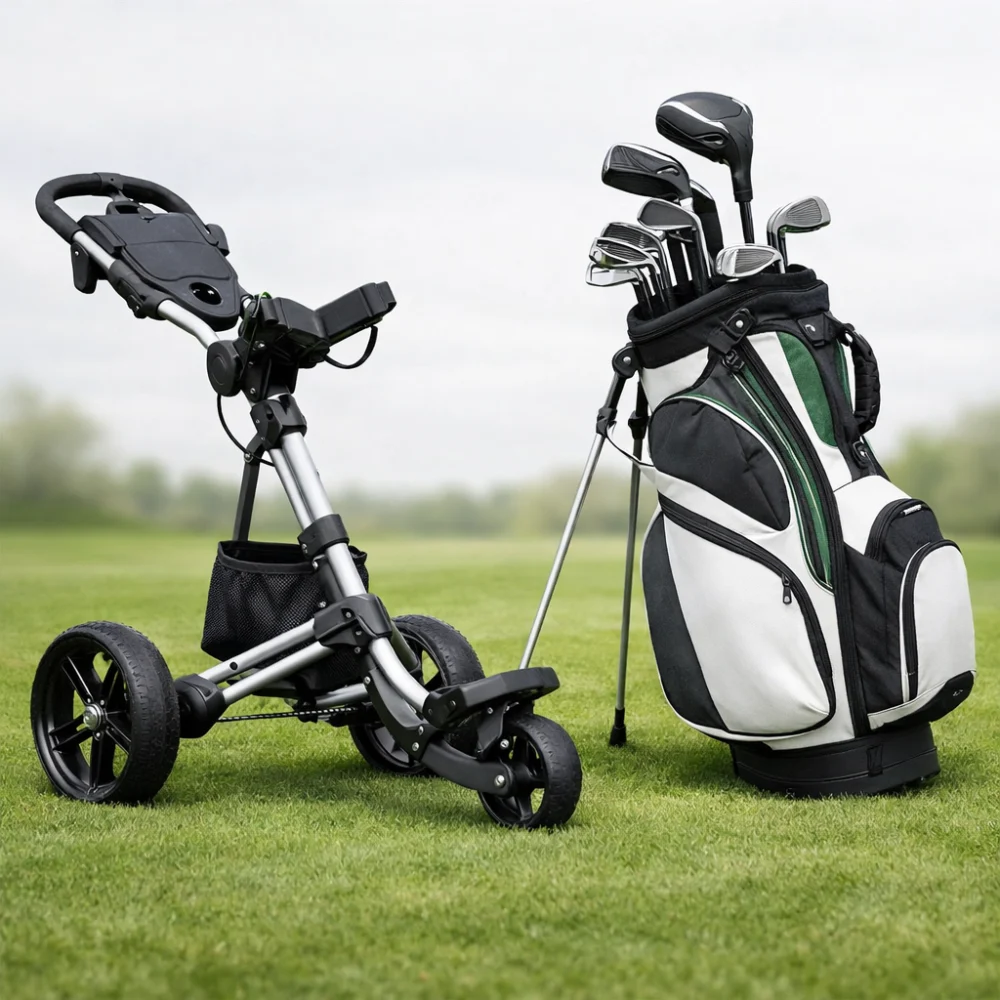
Golf trolleys can make a round feel less tiring by moving your bag, clubs and accessories for you. The main choice is not just price, but whether you want a simple manual trolley, a more compact folding design or an electric model for extra assistance.
This guide focuses on the practical differences that matter when you are comparing options: wheel layout, folding style, handle adjustment, storage convenience and how much effort you want to put in on the course. Specifications vary by model, so always check the individual product page before buying.
What should you look for in a golf trolley?
The right trolley depends on how often you play, how far you walk and how easy you want it to be to lift, fold and store. A lighter, simpler trolley is usually easier to handle, while a more feature-rich model may offer added comfort and convenience.
Think first about how the trolley will fit your routine. If you need to load it into a small car boot or store it in limited space, folding size may matter as much as the way it rolls on the course.
| Feature | What it means | Why it matters | What to check |
|---|---|---|---|
| Wheel design | Two-wheel, three-wheel or four-wheel layouts can affect how the trolley moves and balances. | Different layouts may suit different course conditions and pushing styles. | Check how stable it looks, how easy it should be to steer and whether the wheel setup matches your preference. |
| Folding style | How the trolley collapses for transport and storage. | A compact fold can make day-to-day use much easier. | Look for fold size, folded shape and whether it is likely to fit your boot or storage space. |
| Handle adjustment | Whether the handle can be set at different heights or angles. | A comfortable handle position can reduce awkward pushing or pulling. | Check if the adjustment range suits the main user. |
| Accessory storage | Extras such as holders or storage areas for small items. | These can improve convenience, but they are not essential for every buyer. | Confirm which features are included on the individual model page. |
| Power assistance | Some trolleys are manual, while electric models reduce physical effort further. | An electric trolley can suit buyers who want less pushing, but it adds complexity. | Check battery-related details, charging needs and how much setup you are comfortable with. |
Key decision criteria explained
Manual or electric
Manual trolleys are simpler and usually easier to understand, store and maintain. Electric trolleys are aimed at buyers who want extra assistance and are prepared for a more involved purchase decision. If you are comparing the two, think about effort, weight and how much convenience matters to you.
Wheel layout and handling
Wheel layout can influence balance, turning and how stable the trolley feels when you move it. A two-wheel trolley may appeal if you want a straightforward pull design, while three- and four-wheel layouts are often chosen by buyers looking for easier pushing or steadier support. The practical question is whether you value manoeuvrability, stability or simplicity most.
Folded size and storage
Many buyers underestimate storage needs. A trolley that feels fine in use can still be awkward if it takes up too much room in a boot, garage or locker. Check the folded shape as well as whether it is easy to lift once collapsed.
Accessory features
Some trolleys include holders or storage areas for scorecards, drinks, umbrellas or small personal items. These features can be useful, but they are also easy to overvalue if you do not need them regularly. It is often better to prioritise a trolley that folds neatly and feels comfortable to use, then treat extras as a bonus.
Golf trolley types and variants
Within this category, the most common choices are manual push or pull trolleys and electric trolleys. Manual models suit buyers who want a simpler option with fewer parts to think about. Electric models suit buyers who are mainly looking to reduce physical effort, but they usually require more attention to power and setup.
Wheel count is another useful distinction. Fewer wheels can mean a simpler design, while more wheels may offer a different balance between rolling feel and stability. The best option depends on how you plan to use it rather than on any single design being ideal for everyone.
Which trolley suits which buyer?
| Buyer need | Helpful trolley characteristics | Why it helps |
|---|---|---|
| Simple, low-fuss use | Manual design, straightforward folding and minimal extras | Often easier to live with and store |
| Less physical effort | Electric assistance or a design that is comfortable to push | Can reduce the work of moving your bag around the course |
| Limited storage space | Compact folded size and manageable weight | Makes transport and storage less awkward |
| Frequent rounds or longer walks | Stable handling and practical accessory features | Can make repeated use more comfortable |
| Shared use or gifting | Adjustable handle and a generally versatile design | More likely to suit different users |
Common mistakes to avoid
- Choosing on extras alone. Useful add-ons are welcome, but the trolley still needs to fold well and suit your storage space.
- Ignoring the folded size. A compact-looking trolley in use may still be bulky once folded.
- Overlooking handle comfort. If the handle height does not suit the user, the trolley may feel awkward even if the rest of the design is fine.
- Assuming electric is always better. Power assistance adds convenience for some buyers, but not everyone needs the added complexity.
Safety and suitability checks
Choose a trolley that suits the way you actually play and transport your kit. Check the individual product page for any model-specific limitations, folding details and care needs before buying. If more than one person will use it, make sure the handle and overall design are comfortable enough for that wider range of users.
Maintenance, storage and lifespan considerations
Most golf trolleys are easier to keep in good condition when they are stored dry and folded neatly after use. Before buying, think about how much cleaning you are comfortable with and whether the trolley has any parts that may need extra attention, such as moving joints or power-related components on electric models.
A simpler trolley is often easier to live with over time, while a more feature-rich design may need a little more care. The best choice is usually the one that matches how much effort you want to spend on ownership, not just how it looks on the day you buy it.
How to compare golf trolley options efficiently
- Start with your main need: easier carrying, less pushing effort or simpler transport.
- Choose the trolley type that fits that need best.
- Compare folded size, wheel layout and handle adjustment before looking at extras.
- Check whether the added features are genuinely useful for your rounds.
- Read the individual product page carefully for model-specific details.
Summary buyer decision checklist
- Does the trolley suit your preferred style of use: manual or electric?
- Will the folded size work for your car, home or locker storage?
- Is the wheel layout likely to suit your handling preference?
- Does the handle adjustment look comfortable for the main user?
- Are any accessory features genuinely useful, rather than just nice to have?
- Have you checked the individual product page for model-specific details?
Frequently asked questions
What is the main difference between a golf trolley and a golf bag?
A golf bag carries your clubs and equipment, while a trolley helps move that bag around the course. If you walk most rounds, a trolley can reduce what you need to carry yourself. The key buying decision is whether you want a simple manual model or something with extra convenience.
Are three-wheel trolleys better than two-wheel trolleys?
Not always. Three-wheel designs may feel more stable or easier to push for some buyers, while two-wheel trolleys can suit people who want a simpler pull-style option. The better choice depends on how you prefer to move the trolley and what feels comfortable to use.
Do I need an electric golf trolley?
Only if you want the extra assistance and are happy with the added complexity. Many golfers are well served by a manual trolley, especially if they value simplicity and easier storage. Electric models are worth considering when reducing physical effort is a priority.
How important is folded size?
Very important if you have limited boot space, storage at home or a shared vehicle. A trolley that folds neatly can be much easier to use regularly than one that is awkward to pack away. This is one of the most practical details to check before buying.
Should I prioritise accessories or the basic trolley design?
The basic design usually matters more. Extras like holders or storage spaces can be useful, but only after you are satisfied with how the trolley folds, handles and fits your space. It is usually better to buy a well-balanced trolley with fewer extras than a feature-heavy model that is awkward to live with.
What should I check if more than one person will use the trolley?
Focus on handle adjustment, overall ease of use and whether the folded size is manageable for everyone involved. A more adjustable, straightforward trolley is often the safest choice for shared use. Specifications vary by model, so always check the individual product page before buying.

