
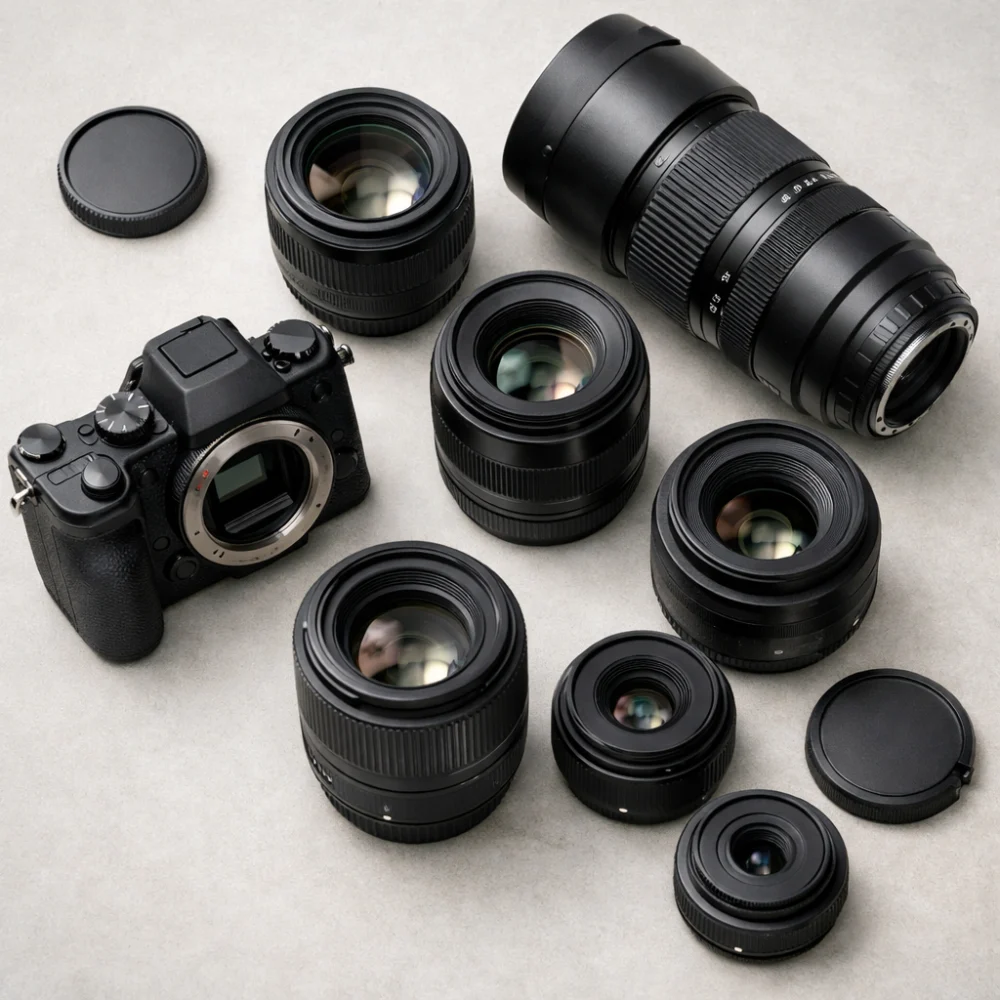
Sony camera lenses cover a wide range of uses, from everyday shooting and travel to portraits, landscapes and closer work. The right choice depends less on the lens name and more on how it matches your camera, your shooting style and the subjects you want to photograph.
If you are comparing lenses for a Sony mirrorless camera, the main decision is usually whether you need a compact prime for low-light use and simplicity, or a zoom for flexibility. Once that is clear, the details to check are mount compatibility, sensor format, focal length and whether the lens includes useful stabilisation or autofocus features for your setup.
Specifications vary by model, so always check the individual product page before buying.
What should you look for in a Sony camera lens?
Start with compatibility and then work outward to image style, handling and intended use. A lens can look suitable on paper but still be wrong if it is built for a different mount or sensor format. The best starting point is to confirm the lens matches your camera body, then decide whether you need reach, width, speed or convenience.
| Feature | What it means | Why it matters | What to check |
|---|---|---|---|
| Mount compatibility | The physical and electronic fit between lens and camera | An incompatible lens will not suit your body | Check the lens mount and your camera model carefully |
| Sensor format | Whether the lens is intended for full frame or APS-C use | It affects field of view and how the lens behaves on your camera | Confirm whether your camera is full frame or APS-C and match accordingly |
| Focal length | The angle of view and framing range the lens gives you | It shapes how close or wide your subject appears | Compare the focal length to the subjects you usually shoot |
| Aperture | How much light the lens is designed to let in | It influences low-light use and depth of field | Look at the maximum aperture and whether you want a prime or zoom |
| Stabilisation | Lens-based image stabilisation, where included | It can help with hand-held shooting in some situations | Check whether the lens includes optical stabilisation |
| Size and weight | The physical handling of the lens | It affects portability, balance and comfort | Consider whether the lens will be carried often or used on location |
How do focal length and aperture affect the choice?
Focal length
Focal length is one of the easiest ways to narrow the field. Wider lenses suit landscapes, interiors and scenes where you want more of the view in frame, while longer lenses are more useful when you need to isolate a subject or bring distant details closer. A mid-range zoom is often chosen for general-purpose use because it covers several everyday situations.
Aperture
A wider maximum aperture is often attractive to buyers who want more light and more control over background blur, especially for portraits or indoor shooting. The trade-off is that larger-aperture lenses can be bigger, heavier or more expensive, while many zooms offer convenience across a range rather than the same speed at every setting. Think about whether you value flexibility or a more specialised look.
Prime or zoom
Prime lenses use a single focal length and often appeal to buyers who want a simple setup, a smaller lens or a particular look. Zoom lenses suit people who want to frame quickly without changing lenses, which can be useful for travel, events or family use. Neither is automatically better; the right choice depends on whether you prefer convenience or a fixed perspective that encourages deliberate composition.
Which Sony lens type is right for different buyers?
The category includes lenses for different shooting habits, and those differences matter more than brand naming alone. Use the lens type to match the task first, then compare the finer details.
| Buyer need | More suitable characteristics | Why this helps |
|---|---|---|
| Everyday general use | Versatile zoom range, manageable size, straightforward autofocus | Makes it easier to cover mixed subjects without changing lenses often |
| Portraits | Short telephoto focal length, wider aperture, pleasant subject separation | Helps frame people naturally and reduce background distraction |
| Travel and walking around | Lightweight design, useful zoom range, balanced handling | Supports carrying the lens for longer periods |
| Landscapes and interiors | Wider focal length, controlled distortion, consistent sharpness across the frame | Helps capture more of the scene in tighter spaces |
| Low-light shooting | Wider aperture, effective autofocus, stabilisation where needed | Can make hand-held shooting more practical, depending on the model |
Common mistakes when choosing a Sony camera lens
- Assuming all Sony lenses fit every Sony camera. Check the exact mount and whether the lens is intended for your camera’s sensor format.
- Choosing only by zoom range. A wide range is useful, but handling, aperture and optical character also affect day-to-day satisfaction.
- Overlooking size and weight. A lens that looks ideal on paper may feel less practical if you plan to carry it often.
- Ignoring the main subject type. A lens that suits portraits may be awkward for landscapes, and a travel zoom may not give the look you want for portrait work.
Safety and suitability checks
This is a low-risk buying decision, but it is still worth checking the practical fit before ordering. Make sure the lens matches your camera body, suits the way you hold and carry your equipment, and is appropriate for the subjects you intend to photograph. If you rely on a lens for an important trip, event or assignment, it helps to read the individual product page carefully rather than assuming the name alone tells the full story.
Maintenance, storage and lifespan considerations
Camera lenses generally reward careful handling and clean storage. Keep lens caps on when not in use, store the lens in a dry place and avoid changing lenses in dusty or wet conditions where possible. If a lens includes stabilisation or autofocus, those features can affect what you notice in use, but they do not remove the need to keep the glass and contacts clean and protected.
When comparing options, it is also sensible to think about whether you will carry the lens regularly, use it in a bag with other gear or leave it attached to the camera. Those habits influence how much importance to place on size, weight and convenience versus specialist performance.
How can you compare Sony lenses efficiently?
- Confirm compatibility with your camera mount and sensor format.
- Decide whether you need a prime or a zoom for your usual subjects.
- Compare focal length, aperture and stabilisation against your real shooting habits.
- Think about size, weight and how often you will carry the lens.
- Check the individual product page for the exact specification and any model-specific details.
Summary buyer decision checklist
- Does the lens match your Sony camera mount?
- Is it intended for full frame or APS-C use?
- Does the focal length suit your main subjects?
- Do you want a prime or a zoom?
- Is the aperture suitable for your light levels and background blur preferences?
- Will the size and weight suit how you plan to use it?
- Have you checked the individual product page for model-specific details?
Frequently asked questions
Do Sony lenses work on every Sony camera?
Not necessarily. You need to check both the mount and the intended sensor format, because some lenses are better suited to APS-C bodies while others are designed for full frame. Always match the lens to the camera you actually own.
What is the difference between a prime lens and a zoom lens?
A prime lens has a fixed focal length, while a zoom lens covers a range. Primes are often chosen for simplicity or a particular look, and zooms are chosen for flexibility. The better choice depends on whether you prefer convenience or a fixed framing style.
Which lens is best for portraits?
Many buyers look for a short telephoto lens with a wider aperture for portraits, because it can help with flattering framing and background separation. The exact choice depends on how close you like to shoot and how much room you have available. Consider the working distance as well as the focal length.
Why does APS-C versus full frame matter?
It affects how a lens behaves on your camera body and can change the angle of view you get. A lens designed for one format may not give the same framing on the other. Check the lens description carefully before buying.
Should I choose the widest aperture available?
Not always. A wider aperture can help in lower light and with background blur, but it may also come with a larger size, higher cost or a narrower practical use case. The best aperture is the one that fits your usual subjects and shooting conditions.
Are stabilised lenses always necessary?
No. Stabilisation can be helpful in some hand-held situations, but it is only one part of the overall decision. If you often shoot in good light or use other support, it may be less important than focal length, aperture or size.
What should I check on the product page before buying?
Check the mount, sensor format, focal length, aperture, stabilisation and any notes about what the lens is designed for. If the listing mentions a bundled or renewed item, read it carefully so you know exactly what is included. That gives you a clearer comparison than the product name alone.

