
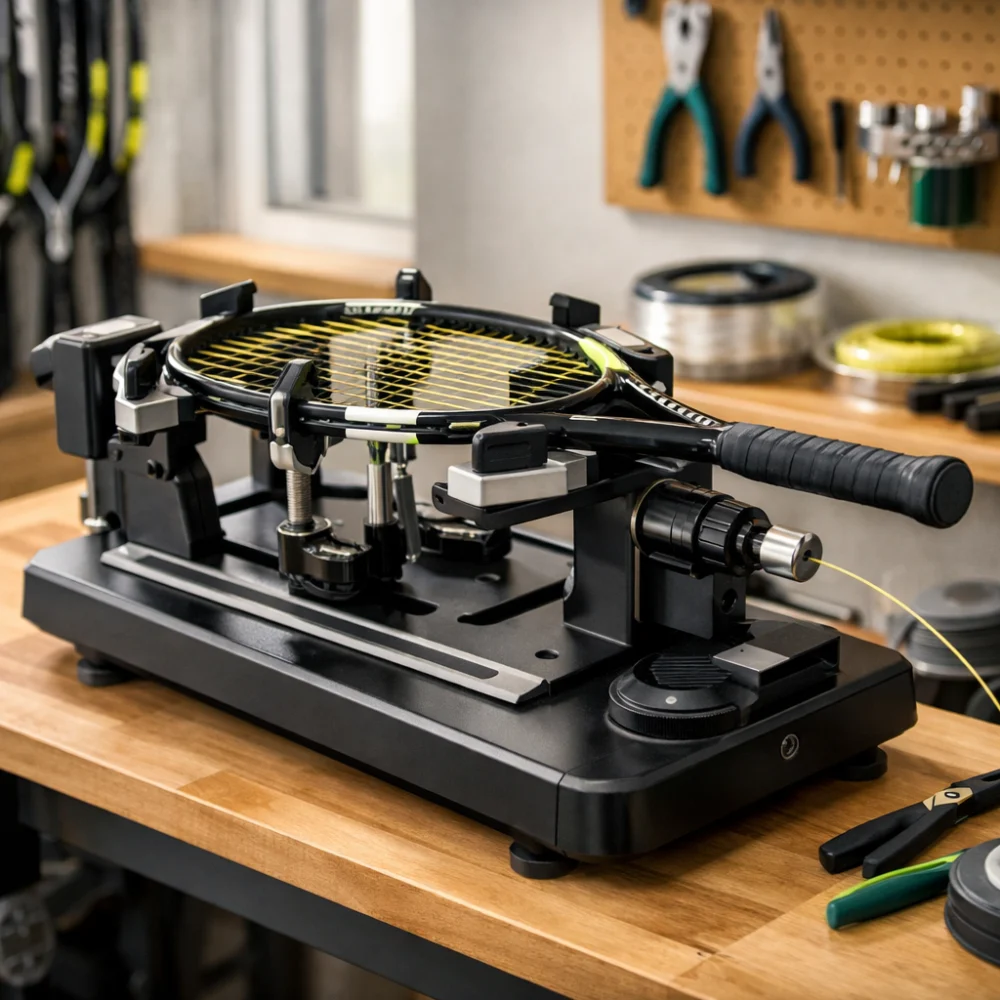
If you are buying a tennis racket stringing machine, the main decision is not just how it looks, but how often you will use it and how much control you want over the stringing process. The right choice depends on whether you are restringing a few rackets for personal use, supporting a club environment or handling rackets regularly.
This guide focuses on the buying factors that matter most: mounting style, tensioning method, ease of use, stability and the practical space needed for setup. It will help you compare machines without getting distracted by features that sound useful but may not matter for your situation.
Specifications vary by model, so always check the individual product page before buying.
What should you look for in a tennis racket stringing machine?
The best starting point is to match the machine to your workload and your comfort level with stringing. A more basic machine can be a sensible choice if you want simple, occasional use, while a more adjustable setup may suit regular stringers who want greater control. The main trade-off is usually between speed and convenience on one side, and precision and adjustability on the other.
| Feature | What It Means | Why It Matters | What To Check |
|---|---|---|---|
| Tensioning method | How the machine applies and holds tension in the string | Affects consistency, ease of use and how much manual involvement is needed | Whether the machine suits your preferred level of control and repetition |
| Mounting system | How the racket is secured during stringing | Helps support the frame and keep it stable while you work | How the racket is held and whether the setup looks practical for your rackets |
| Clamp system | The parts that hold the string in place during the process | Influences efficiency and how smoothly the job proceeds | Whether the clamp arrangement looks suitable for your workflow |
| Machine format | Tabletop or larger free-standing style, depending on the model | Changes the amount of space needed and how portable the machine is | Where it will be used and stored, and whether the footprint is realistic |
| Ease of setup | How straightforward the machine is to prepare and use | Important for beginners, occasional users and busy stringers alike | Whether the control layout and adjustment points seem manageable |
| Build and stability | How solid the machine feels in use | Can affect confidence, repeatability and comfort during longer sessions | Whether the construction appears suited to regular handling |
Key decision criteria explained
Tensioning method
This is one of the most important differences between machines. Some buyers prioritise a simpler approach that is easy to get to grips with, while others want a system that gives more control over each job. If you string often, consistency may matter more than absolute simplicity. If you restring only occasionally, a straightforward machine can be easier to live with.
Mounting and frame support
A racket should be held securely enough for the job you are doing, without making the process awkward. The main question is whether the support system looks suitable for the rackets you plan to string and whether it seems easy to position and release. A more involved mounting setup may offer more control, but it can also take longer to learn.
Clamp design
Clamps are easy to overlook, yet they have a big effect on how efficient the machine feels in use. A practical clamp arrangement can reduce frustration and help the process flow more smoothly. When comparing options, look at how the clamps are placed and whether the setup appears convenient for the amount of stringing you expect to do.
Machine size and placement
Think about where the machine will live when it is not being used. A tabletop unit may be easier to fit into a spare room, workshop or stringing corner, while a larger machine may suit a dedicated setup. The right answer depends as much on your available space as it does on your budget.
Product types and variants
Within this category, the main distinctions are usually about format and how much control the machine gives you. A simpler tabletop machine may suit a home user or someone stringing only now and again. A more substantial machine is more likely to suit regular use, especially if you want a setup that feels more stable and efficient.
Some buyers also need a machine that can handle more than one racket sport, but that does not automatically make it the best choice for tennis-specific use. If tennis is your main focus, check that the overall setup feels appropriate for tennis rackets rather than assuming one general-purpose machine will suit every task equally well.
Which type suits which buyer?
| Buyer need | What to prioritise | Why it helps |
|---|---|---|
| Occasional home restringing | Simplicity, manageable size and easy setup | Makes ownership less complicated and reduces the learning curve |
| Frequent personal use | Consistency, stability and a practical clamp system | Supports repeated work and a smoother routine |
| Club or shared use | Durability, ease of operation and repeatable adjustment | Helps different users work with less confusion |
| Space-limited setup | Compact footprint and sensible storage needs | Makes the machine easier to keep and use in one place |
| Buyer comparing value | The features you will actually use, not extras you may not need | Helps avoid paying for complexity that does not improve your routine |
Common mistakes and misunderstandings
- Choosing only by appearance: a machine can look substantial without being the best fit for your workload or space.
- Overestimating how much control you need: some buyers want a highly adjustable setup, but a simpler machine may be more practical if use is occasional.
- Ignoring storage and setup space: even a good machine becomes inconvenient if it is awkward to position or keep ready for use.
- Focusing on one feature alone: the clamp system, mounting method and tensioning approach need to work together.
Safety and suitability caveats
Choose a machine that suits the rackets you intend to string and the environment where it will be used. If you are new to stringing, it is sensible to prefer a setup that feels straightforward rather than one with a steeper learning curve. Do not assume that a general description means every racket or every use case will be covered in the same way.
Maintenance, storage and lifespan considerations
A stringing machine is usually easier to keep useful if it is stored in a dry, stable place and kept clear of unnecessary clutter. Moving parts, clamps and adjustment points may need regular attention over time, so buyers should think about how easy the machine looks to keep in order. If you expect frequent use, a machine that is easier to set up and put away may be more appealing than one that demands more handling each time.
How to compare options efficiently
- Decide how often you will string rackets and who will use the machine.
- Choose the machine format that fits your space and working style.
- Compare the tensioning method, mounting system and clamp arrangement.
- Check whether the setup looks easy enough for your experience level.
- Read the individual product page carefully before deciding.
Summary buyer decision checklist
- Does the machine suit your expected volume of stringing?
- Is the size practical for your available space?
- Does the mounting and clamp setup look manageable?
- Will the tensioning method feel comfortable for your experience level?
- Does the overall design seem suitable for tennis rackets as you plan to use it?
- Have you checked the individual product page for the exact details?
Frequently asked questions
What is the main difference between a basic and a more advanced stringing machine?
The main difference is usually how much control, stability and convenience the machine offers. A basic machine can be easier to live with for occasional use, while a more advanced setup may suit regular stringers who want a smoother workflow. The right choice depends on how often you will use it and how much you want to adjust during the process.
Is a tabletop stringing machine enough for home use?
It can be, especially if you only need to string occasionally and want something that is easier to accommodate. The key is whether the tabletop format gives you enough stability and convenience for your space. If you plan to string often, you may want to compare it carefully with larger options.
Do I need to know a lot about stringing before buying?
Not necessarily, but beginners should look for a machine that feels straightforward rather than overly complex. It helps to choose a setup that matches your confidence level, because a machine that is hard to use can be frustrating even if it has more features. Simpler does not always mean worse; it can mean more practical.
Are tennis stringing machines suitable for every racket?
Not automatically. You should check that the machine’s setup looks suitable for the rackets you plan to string and that the support system makes sense for those frames. Specifications vary by model, so always check the individual product page before buying.
What matters more: clamps or tensioning method?
Both matter, because they affect the way the machine feels in use. The tensioning method influences the main workflow, while the clamps affect how efficiently you can move through the job. It is usually better to compare them together instead of treating one as the only important feature.
How much space should I allow?
Allow enough room not just for the machine itself, but also for access around it while you work. A compact machine may still feel awkward if it is squeezed into a tight corner. Think about where it will sit, how it will be stored and whether you can use it comfortably for the full job.
What should a buyer check on the product page before ordering?
Check the machine type, the mounting and clamp arrangement, the intended level of use and any details that affect fit or setup. If you are comparing several options, focus on the features you will actually use rather than extra details that do not change your routine much.

