
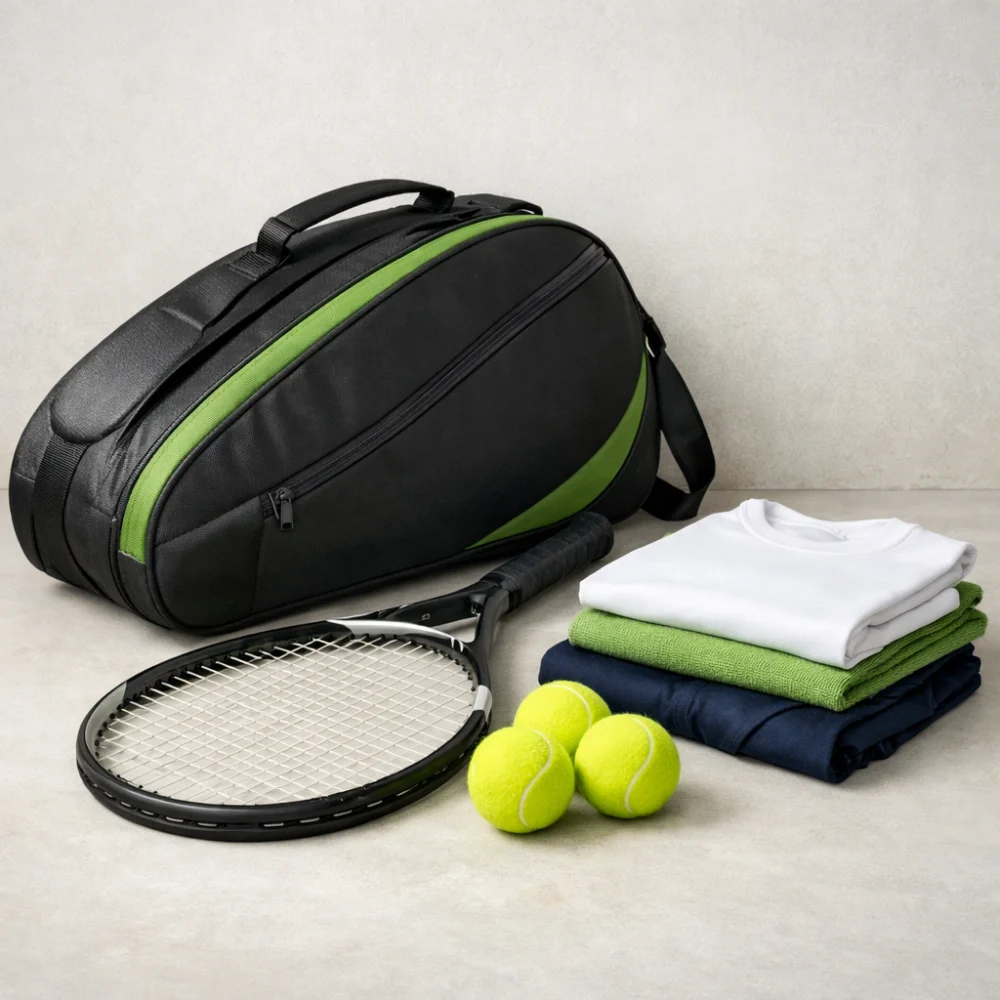
Tennis bags are a practical way to carry a racket, balls, clothing and other match-day essentials in one place. The right choice depends less on appearance and more on how much you need to take, how you travel, and whether you want a simple cover, a backpack or a larger racket bag.
Because tennis bags vary quite a bit in shape and carrying style, it helps to compare the options against your routine rather than choosing by size alone. A bag that feels ideal for a weekly club session may be awkward for coaching, league play or regular travel with extra kit.
Use this guide to narrow down the features that matter most, avoid overbuying and choose a bag that fits your equipment and your day-to-day use.
What should you look for in a tennis bag?
The best starting point is to match the bag to the amount of kit you actually carry. A compact cover or backpack may suit lighter loads, while a larger racket bag is more useful if you need space for several rackets, shoes, clothing and accessories. The main trade-off is usually between capacity and portability: more space can mean a bulkier bag to carry and store.
Specifications vary by model, so always check the individual product page before buying.
| Feature | What it means | Why it matters | What to check |
|---|---|---|---|
| Capacity | How much equipment the bag is designed to hold | Determines whether it suits light sessions or fuller match-day kit | Look at the stated size, racket count or litre capacity if shown |
| Bag style | Whether it is a cover, backpack or larger racket bag | Affects how easy it is to carry and how much it can organise | Choose the shape that fits your travel habits and kit volume |
| Organisation | Separate sections, pockets or compartments | Helps keep rackets, shoes, clothing and small items apart | Check whether the layout suits your routine and what you usually pack |
| Carrying comfort | How the bag is worn or held | Important if you walk, cycle or commute to court | Look for straps, handles and a format you can carry comfortably |
| Protection | How well the bag keeps rackets and contents separated or covered | Useful for reducing scuffs and keeping kit together | Check the padding, structure and whether rackets are fully enclosed |
| Storage and size when empty | How bulky the bag feels when not full | Matters if you store it in a car boot, locker or small home space | Consider the bag’s overall shape, not only its capacity |
Key decision criteria
How many rackets do you carry?
This is one of the clearest ways to narrow the choice. Some players only need space for one racket and a few small items, while others prefer a bag that can take multiple rackets alongside clothes and accessories. Choosing too much capacity can leave you carrying a larger bag than necessary, but choosing too little can be inconvenient if you regularly bring spare kit.
Do you want a backpack or a racket bag?
Backpack-style bags are often convenient when you want hands-free carrying and a smaller profile. Traditional racket bags usually suit players who want more dedicated space for tennis kit and a clearer internal layout. The better option depends on whether you prioritise ease of carrying or separation for different items.
Is organisation important to you?
If you like a place for shoes, clothing, grips and personal items, look closely at the compartments and pocket layout. Some bags are simple and straightforward, while others are built to keep different items apart. More organisation can be useful, but it can also make the bag more structured and less flexible for odd-shaped items.
How will you travel to court?
If you usually drive, bulk may matter less than capacity. If you walk, cycle or use public transport, a lighter and more manageable bag may be easier to live with. Think about straps, balance and how comfortable the bag is when fully loaded, not just when empty.
Common tennis bag types
- Single-racket cover – A simple option for carrying one racket with minimal extras. It suits light use but offers limited room for other kit.
- Backpack – A compact choice for players who want a more casual carry and space for everyday essentials. It may feel less specialised than a larger racket bag.
- Multiple-racket bag – Designed for players who carry more than one racket or extra match-day kit. The main drawback is that it can be bulkier to transport and store.
- Full-size racket bag – A larger format for players who want more room for clothing, accessories and several rackets. It is practical for frequent sessions but may be more than some casual players need.
Which tennis bag suits different buyers?
| Buyer need | What to prioritise | Likely best fit | Trade-off to remember |
|---|---|---|---|
| Casual player | Simple carrying, modest space, easy storage | Backpack or single-racket cover | Less room for spare clothing or extra accessories |
| Regular club player | Good organisation and enough room for match-day kit | Mid-sized racket bag | More capacity can mean a larger bag to carry |
| Player with several rackets | Extra racket space and structure | Multiple-racket bag | Bulk and weight may increase when loaded |
| Commuter or cyclist | Comfortable straps and manageable shape | Backpack-style bag | May offer less specialised compartment space |
| Gift buyer | Broad usefulness and easy carry style | Backpack or versatile racket bag | Needs a sensible middle ground if you do not know the recipient’s exact kit load |
Common mistakes to avoid
- Choosing by appearance alone – A good-looking bag can still be the wrong size or shape for your routine.
- Overestimating how much space you need – Bigger is not always better if you usually carry only one racket and a few essentials.
- Ignoring how you travel – A bag that is fine for the car may feel cumbersome on foot or on public transport.
- Forgetting about organisation – If you want separate spaces for shoes or wet kit, check the compartment layout before buying.
Suitability and care
Tennis bags are generally straightforward to use, but it still helps to think about where and how the bag will be used. If you often carry damp clothing or shoes, a more organised bag can make packing easier, while a simpler design may be enough for lighter use. It is also worth checking whether the materials and structure suit the amount of loading you expect, especially if you plan to carry the bag often.
For ownership over time, think about cleaning, storage and general wear. A bag that is easy to empty, wipe down and store neatly is usually more convenient for regular use. If you keep rackets and accessories in the bag between sessions, make sure the interior layout suits that habit rather than making it harder to stay organised.
How to compare tennis bags efficiently
- Start with your typical load: one racket, several rackets, or a full match-day kit.
- Choose the broad style that suits your travel habits, such as a cover, backpack or larger racket bag.
- Check the layout, pockets and compartments against what you actually carry.
- Compare comfort, bulk and storage needs so the bag fits your routine, not just your equipment.
- Read the individual product page carefully before deciding, especially where specifications differ by model.
Buyer checklist
- Does the bag fit the number of rackets you usually carry?
- Is the style suitable for how you travel to court?
- Is there enough room for clothing, shoes and accessories if you need it?
- Does the compartment layout match the way you pack?
- Will the bag be comfortable to carry when full?
- Is the overall size practical for storage at home or in a car?
Frequently asked questions
What is the difference between a tennis backpack and a racket bag?
A tennis backpack is usually a more compact, casual carry option, while a racket bag tends to offer more dedicated space for tennis kit. Backpacks can be easier to take around day to day, but racket bags may be better if you want more separation for rackets and clothing. The right choice depends on how much you carry and how you travel.
How many rackets do I need to carry a bag for?
If you usually play with one racket and only take a few extras, a smaller bag may be enough. If you like to carry spares, training rackets or more match-day kit, a larger bag is more practical. It is sensible to choose based on your regular use rather than the occasional trip.
Are larger tennis bags always better?
Not necessarily. Larger bags can be useful, but they are often bulkier and may be more than a casual player needs. The best bag is the one that balances space with comfort and ease of carrying.
Should I choose a bag with separate shoe storage?
That depends on how you organise your kit. If you often carry shoes, damp clothing or other items you prefer to keep apart, separate storage can be helpful. If you only carry a racket and a few small accessories, a simpler design may be enough.
Is a tennis bag useful if I only play occasionally?
Yes, if you want a straightforward way to keep your racket protected and your essentials together. Occasional players may prefer a simple, lighter format rather than a large multi-compartment bag. The most useful bag is usually the one that fits your actual routine.
What should I check before buying online?
Check the bag style, carrying format, room for your racket or rackets, and any compartments you think you will use. It also helps to look closely at the product description so you understand the intended size and layout. Specifications vary by model, so always check the individual product page before buying.

