
What This Product Is Used For
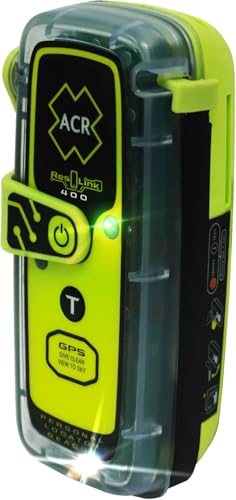
The ACR ResQLink 400 is a satellite personal locator beacon designed to alert international search and rescue authorities in a genuine emergency, offering a far more reliable solution than relying on a mobile phone in remote terrain or offshore waters.
When activated, it transmits a 406 MHz distress signal along with homing signals to guide rescuers directly to your location. With GPS and Galileo GNSS positioning, it provides accurate location data through the global COSPAS SARSAT and MEOSAR satellite systems.
It is designed for hikers, hunters, boaters, anglers and outdoor professionals who may operate beyond mobile coverage and require dependable global rescue alert capability.
Who This Product Is Best Suited To
This beacon is best suited to serious outdoor users who travel in remote or high risk environments where emergency response may depend entirely on satellite communication.
It is particularly valuable for long distance hikers, offshore boaters and expedition style travellers who want a compact, no subscription rescue solution.
It also suits users who prefer a dedicated emergency device rather than relying on multi function consumer electronics.
Pros and Cons
Pros
Global satellite coverage via COSPAS SARSAT and MEOSAR
406 MHz distress and homing signals support accurate rescue
GPS and Galileo GNSS improve positioning precision
LED and infrared strobes enhance night time visibility
No subscription fees required
Cons
Designed strictly for emergency activation rather than everyday communication
Requires manual activation in a genuine emergency situation
Real World Performance and Day to Day Use
In normal use, the ResQLink 400 can be carried in a pocket, attached to a pack or stored in a grab bag. Its compact form factor makes it easy to include in hiking or boating gear without noticeable weight.
If an emergency occurs, activation transmits a 406 MHz distress alert through the COSPAS SARSAT and MEOSAR satellite systems. GPS and Galileo GNSS positioning provide accurate coordinates to assist rescue teams.
The integrated LED and infrared strobes improve visibility during night time recovery or low light conditions, supporting both aerial and ground search efforts.
Why We Like This Product
From the YPC Team perspective, global satellite coverage without subscription fees makes this a dependable long term safety investment.
A common mistake is assuming a smartphone is enough in remote areas. Without signal coverage or battery life, it becomes ineffective. A dedicated satellite PLB provides an independent emergency pathway that does not rely on mobile networks.
Comparisons With Similar Systems
Compared with AIS MOB devices
AIS MOB units transmit to nearby vessels equipped with AIS. The ResQLink 400 communicates via satellite to international rescue authorities, making it more suitable for remote land or offshore use without nearby traffic.
Compared with the ACR ResQLink 410 UK programmed model
The 400 model is designed for global use and programming flexibility, whereas the 410 is pre programmed for United Kingdom registration.
Compared with water activated strobe lights
Strobes improve visual detection but do not transmit satellite distress signals. The ResQLink 400 is built for global emergency alerting rather than short range visibility alone.
Alternatives Worth Considering
If your primary need is rapid vessel to vessel recovery in busy coastal waters, an AIS MOB beacon may provide faster local positioning. If you only require enhanced visual visibility for night time marine activities, a high intensity water activated strobe light may be sufficient.
Tips for Getting the Best Performance
Complete official registration with the appropriate authority before use.
Carry the beacon where it is easily accessible in an emergency.
Familiarise yourself with activation procedures before heading into remote areas.
Include it in your pre departure safety checks.
Monitor battery service intervals in line with manufacturer guidance.
Full Technical Specification
Product type Personal locator beacon
Distress transmission 406 MHz distress and homing signals
Satellite systems COSPAS SARSAT and MEOSAR global coverage
Positioning GPS and Galileo GNSS
Visual signalling LED strobe and infrared strobe
Subscription No subscription required
Primary use Outdoor and marine emergency rescue alert
Box contents
ACR ResQLink 400 personal locator beacon
Buyer’s Guide
Buy this if you travel in remote areas and want a subscription free satellite personal locator beacon with global coverage and precise GNSS positioning.
Do not buy this if you require two way voice communication or a local AIS based recovery system for nearby vessels only.
Frequently Asked Questions
Does the ResQLink 400 require a subscription?
No. It operates without any ongoing subscription fees.
What satellite system does it use?
It transmits through the global COSPAS SARSAT and MEOSAR satellite systems.
Does it use GPS?
Yes. It uses GPS and Galileo GNSS for accurate positioning.
What is the 406 MHz signal?
It is the international distress frequency used by satellite rescue systems to identify emergency beacons.
Does it have a visual light for night use?
Yes. It includes both LED and infrared strobe lights for improved visibility.
Is it suitable for hiking and hunting?
Yes. It is designed for a range of outdoor activities including hiking, hunting and fishing.
Can it be used at sea?
Yes. It is suitable for boating and marine emergencies.
Does it allow two way communication?
No. It is designed to transmit a distress alert rather than provide voice communication.
Is registration required?
Yes. Registration is required to link the beacon to your identity and support faster rescue response.
Is it bulky to carry?
No. It is compact and lightweight for easy carrying during outdoor activities.
Looking for more options?
Browse our full range of Personal Location Beacons for other great choices to suit your space, goals, and budget.


