
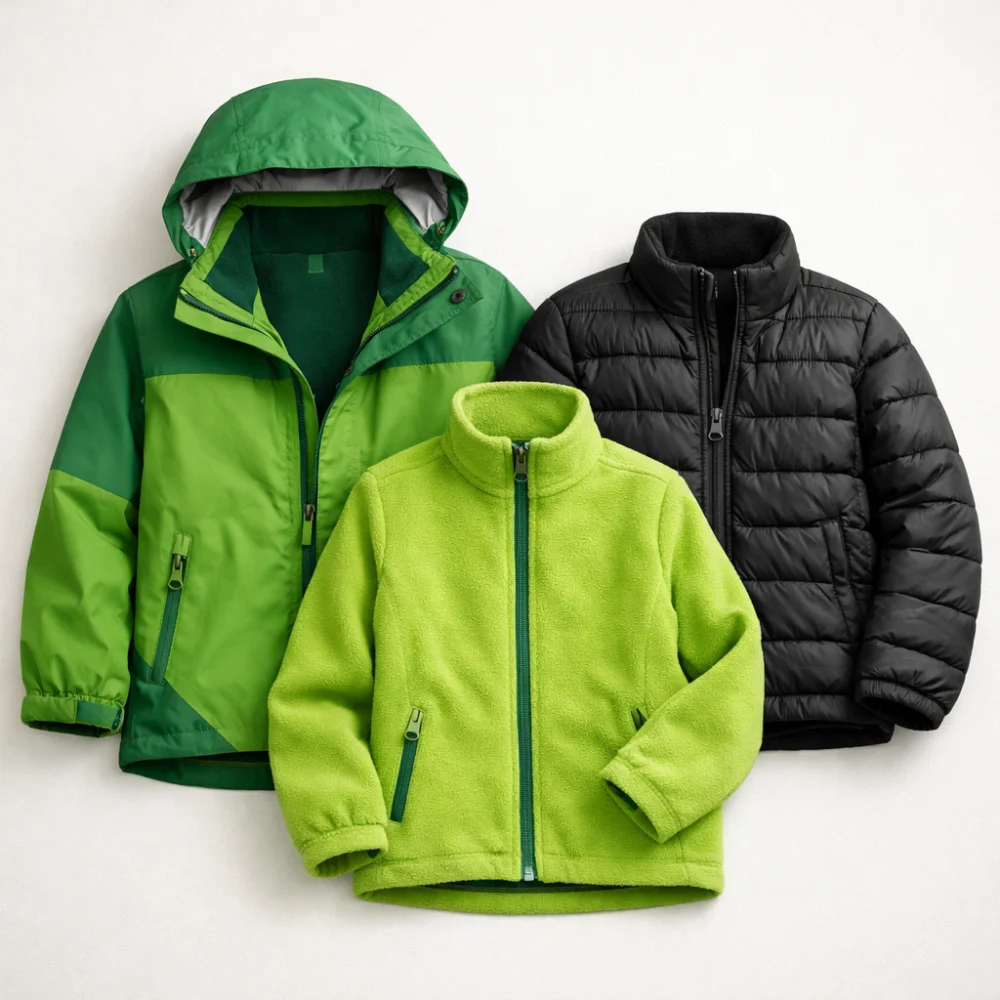
Kids 3 in 1 jackets are designed for changeable weather and busy days outdoors. They combine an outer jacket with a removable inner layer, so one garment can cover a wider range of conditions than a single jacket alone.
That makes them a useful option for walking, days out and everyday wear when the forecast is unpredictable. The main buying decision is not simply how warm or waterproof the jacket looks, but how the two layers work together and whether the design suits your child’s use.
This guide explains the features that matter most, the trade-offs to expect and the checks worth making on the individual product page.
What should you look for in a kids 3 in 1 jacket?
The best starting point is to think about how often the jacket will be used in cold, wet or mild conditions. A 3 in 1 jacket gives flexibility, but that flexibility only helps if both layers are comfortable enough to wear separately and together. Look for a fit that allows movement, a shell that suits the weather you expect, and a liner that your child will actually want to wear.
Specifications vary by model, so always check the individual product page before buying.
| Feature | What it means | Why it matters | What to check |
|---|---|---|---|
| Outer shell | The jacket’s weather-facing layer | Helps with wind and rain protection | Material, hood, fastening and whether it suits the weather you expect |
| Inner layer | The removable liner | Adds warmth and changes how the jacket feels | Whether it works on its own and how bulky it feels |
| Fit and layering room | Space for both layers and movement | A jacket that is too tight can feel restrictive | Size, sleeve length and room over school clothes or jumpers |
| Weight and bulk | How heavy or bulky the jacket feels | Affects comfort, packing and all-day wear | Whether the jacket seems suitable for a child to carry or wear for long periods |
| Fastenings and adjustments | Zips, cuffs, hem and hood adjusters | Helps improve comfort and keep layers in place | Ease of use for children and whether adjustments are simple |
Key decision criteria explained
Weather protection
The outer jacket is the part that deals with wind, rain and showers. If your child will wear it for outdoor walks or the school run, that outer layer is often the most important part of the purchase. Think about whether you need a jacket that is mainly for damp days, or one that is likely to be used more often in wet weather.
Warmth and flexibility
The inner layer is what makes a 3 in 1 jacket adaptable. Some liners are more like light fleece layers, while others are designed to add more warmth. The key trade-off is that a warmer liner may feel bulkier, while a lighter one may be more useful across seasons. Consider whether the child will wear the liner on its own, because that often affects value and versatility.
Fit over layers
Children’s jackets need enough room for movement, but too much extra space can feel awkward. A jacket that fits well over a jumper is usually more practical than one that only works over a thin top. Check sleeve length, body length and whether the hood sits comfortably when both layers are worn together.
Ease of use
Children benefit from jackets that are easy to put on, take off and adjust. Simple zips, smooth cuffs and a hood that stays manageable can make a big difference in day-to-day use. If a child will be removing the liner regularly, it is worth checking that the fastening system looks straightforward.
Types and variants within the category
Within 3 in 1 jackets, the main difference is usually how the two layers are designed to work together. Some are aimed at wetter weather with a more protective outer shell, while others lean more towards everyday comfort and warmth. The liner may be a fleece-style layer or another removable inner layer, and that changes how the jacket feels in different seasons.
For some families, a jacket that can be worn in several combinations is the main advantage. For others, a simpler single-purpose jacket may be easier if the child only needs one clear use case. The trade-off is usually flexibility versus simplicity.
Which jacket suits which kind of buyer?
| Buyer need | What to prioritise | Why it helps |
|---|---|---|
| School run and everyday use | Easy fastenings, comfortable fit, reliable outer layer | Makes the jacket practical for frequent use |
| Weekend walking and trips | Flexibility, removable liner, sensible hood and layering room | Helps the jacket adapt to changing conditions |
| Growing child | Enough room over layers without looking oversized | Improves comfort while leaving room for movement |
| Child who dislikes bulky clothing | Lighter-feeling design and simple layering | Can be easier to wear for longer periods |
| Family wanting one jacket for more seasons | A liner that is useful on its own and an outer shell suited to rain and wind | Increases the number of situations the jacket can cover |
Common mistakes and misunderstandings
- Choosing on looks alone. Colour and style matter, but the useful part is how the jacket performs as a layered system.
- Assuming all 3 in 1 jackets feel the same. Liners and shells vary a lot in warmth, bulk and comfort.
- Forgetting to check the liner on its own. If it is not comfortable separately, the jacket loses some of its value.
- Ignoring fit over layers. A jacket that only fits over a T-shirt may not work well for walking in colder weather.
- Overlooking ease of use. If a child cannot manage zips or layers comfortably, the jacket may be used less often.
Safety and suitability caveats
A kids 3 in 1 jacket should be chosen for the activity and weather conditions you expect, not just for general appearance. Check the product page carefully for the details that matter to your child’s use, including fit, lining and outer-layer features. For children’s clothing, comfort and freedom of movement are usually just as important as weather protection.
Maintenance, storage and lifespan considerations
Because these jackets combine two layers, it is worth thinking about how easy they are to care for before you buy. A removable liner can be convenient, but it also means there may be more pieces to wash, dry and store. If the jacket will be used often, look for a design that seems practical to keep in regular rotation rather than one that feels awkward to reassemble.
Storage can matter too, especially if the jacket is worn only in certain seasons. A bulkier jacket may take up more space in a hallway or school bag, while a lighter design may be easier to keep ready for everyday use.
How to compare options efficiently
- Decide where the jacket will be used most often, such as school runs, walking or weekends away.
- Choose the level of flexibility you need from the removable liner and outer shell.
- Compare fit, comfort and ease of movement before focusing on style.
- Check how the hood, cuffs and fastening system look in the product details.
- Review the individual product page carefully so you understand the specific combination of layers and features.
Summary buyer decision checklist
- Does the jacket suit the weather and activity you have in mind?
- Will the outer layer and liner both be useful in practice?
- Is there enough room for layering without the jacket feeling bulky?
- Will your child be able to wear and use it comfortably?
- Do the product details match the way you plan to use it?
Frequently asked questions
What does a 3 in 1 jacket actually include?
It usually includes an outer jacket and a removable inner layer. The two pieces can often be worn together or separately, which is what gives the jacket its flexibility.
Is a 3 in 1 jacket suitable for year-round use?
It can be useful across more than one season, but that depends on how the individual jacket is designed and how warm or protective each layer is. A lighter liner may be handy in milder weather, while the full combination may suit colder days better.
Should I size up for a child’s 3 in 1 jacket?
Not automatically. The right size depends on how much room the jacket already allows for layering and how it fits at the sleeves and shoulders. It is usually better to check the size guidance on the product page rather than guessing.
Can the inner layer be worn on its own?
Often yes, but not always in a way that feels equally useful for every child. It is worth checking whether the liner looks like something your child would actually wear separately.
Are 3 in 1 jackets heavier than standard jackets?
They can feel more substantial because they contain two layers and extra fastenings. The advantage is flexibility; the trade-off is that they may be less minimal than a single jacket.
What is the main reason to choose a 3 in 1 jacket over a single jacket?
The main reason is adaptability. If your child needs one jacket for mixed weather, a 3 in 1 design can offer more ways to wear it than a single-purpose coat.

