Bouncy castles can turn a garden gathering into a more active, structured play session, but the right choice depends on far more than the number of inflatable features listed in a title. Space, setup, supervision needs and who will be using it all matter when you are comparing options.
This guide helps you narrow the choice before you look at individual products. It focuses on practical buying factors so you can compare types more confidently and avoid picking something that looks exciting but does not suit your garden or your users.
Specifications vary by model, so always check the individual product page before buying.
What should I look for in a bouncy castle?
The best starting point is the space you have, followed by the number and age range of the children who will use it. After that, compare the layout, setup requirements and any extra features that add value without making the inflatable too large or awkward for your garden. A simpler model can be the better choice if you want easier setup and less to store.
It also helps to separate the fun features from the practical ones. Slides, hoops, obstacle sections and pools may sound appealing, but the main question is whether the design still leaves enough usable bounce area and fits the available space safely and comfortably.
| Feature | What it means | Why it matters | What to check |
|---|---|---|---|
| Footprint | The space the inflatable needs once set up | Determines whether it will fit your garden with enough clearance around it | Overall dimensions and the room needed around the product |
| Intended users | The children or age group the design is meant to suit | Affects comfort, enjoyment and whether the layout feels appropriately sized | Product description, age guidance and capacity information on the individual page |
| Design style | Whether it is a simple bounce area or a more elaborate multi-feature layout | More features can increase versatility but may reduce space for bouncing | How much of the footprint is dedicated to bouncing versus extras |
| Setup requirements | What is needed to inflate and secure the castle | Influences convenience and whether it suits occasional or frequent use | Inflation method, time needed and any listed accessories |
| Storage and transport | How the product is packed away when not in use | Important if you have limited shed, garage or indoor storage space | Packed size, weight and whether it can be moved by one person comfortably |
| Surface and location needs | The type of ground or outdoor area it is intended for | Helps you judge whether it matches your garden layout | Any notes about grass, level ground or sheltered placement |
Key decision criteria explained
Size and garden fit
Size is usually the first limiting factor. A castle that looks manageable in a product photo can still dominate a small garden once it is fully inflated. Think about not only length and width, but also the practical space around it for access, supervision and any movement at the edges.
Capacity and user mix
Some inflatables are better suited to a small group of younger children, while others are designed to cope with more varied play. If the children using it differ widely in age or size, a design that feels too busy or cramped may be less suitable. Check the stated capacity and think about whether your usual use is one child at a time, a sibling pair or a larger group.
Feature balance
Extra elements can make a bouncy castle more versatile, but they also change how the space is used. A slide, ball pit or obstacle section may be appealing, yet these additions can leave less uninterrupted bouncing room. Choose the features that match the way children actually play rather than assuming more parts automatically mean more value.
Setup, takedown and storage
For occasional family use, easy setup may matter more than a complicated feature set. If you expect to use it regularly, convenience becomes even more important because a product that is awkward to inflate, pack away or store may end up being used less often. Consider where it will live between uses and how easy it is to handle after deflation.
Material feel and durability expectations
You may see different descriptions that suggest toughness or heavy-duty use, but the useful question is whether the construction suits the way you plan to use it. Occasional garden fun has different demands from regular entertaining. Check the individual product information for the material description and any notes that help you judge suitability for your intended use.
Common bouncy castle types and variants
There is a wide range of styles within this category, but the main differences are usually about layout rather than a completely different product type.
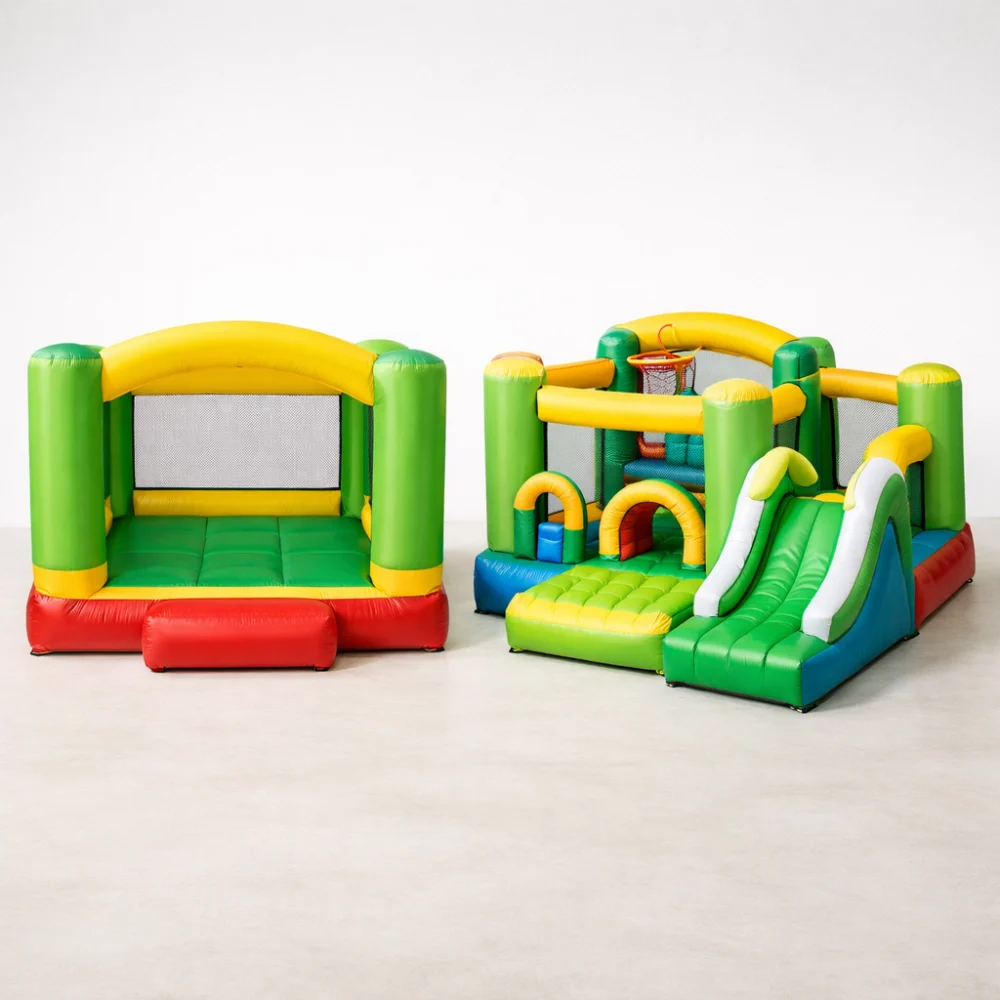
- Simple bounce houses focus on an open jumping area and are often the easiest to understand and use.
- Multi-feature designs add slides, hoops, climbing sections or other play elements, which can make them more varied but also more complex.
- Themed or character-led designs may appeal more to gift buyers, although the theme should not distract from checking fit and usability.
- Water-play hybrids can suit warmer weather use, but they need a closer look at whether the wet features match your garden setup and how you want to manage them.
If you are unsure, a simpler layout is often easier to assess and may be the safer choice for first-time buyers.
Which features suit different buyers?
| Buyer need | Likely priority | What to look for |
|---|---|---|
| Small garden | Compact footprint and straightforward setup | Clear dimensions, simple shape and enough clearance around the edges |
| Family with mixed-age children | Enough room and a layout that does not feel cramped | Capacity guidance, internal space and how the play zones are arranged |
| Gift purchase | Clear appeal and manageable handling | A style the child will enjoy, plus storage and setup that the household can realistically manage |
| Occasional use | Easy inflation and packing away | Setup convenience, storage size and anything included to help with use |
| Frequent summer use | Practical durability and comfort of use | Construction details, space, and whether the feature mix suits regular play |
Common mistakes to avoid
- Choosing on features alone. A long list of extras can be attractive, but it is still the footprint and layout that determine whether the product works well in your garden.
- Ignoring storage space. A bouncy castle that fits the lawn may still be awkward to store between uses.
- Overlooking the likely age mix. A design that suits one child or a small group may feel less comfortable if the users vary widely in age or size.
- Assuming all inflatables are equally easy to set up. Convenience can differ, so it is worth checking what is included and how the product is intended to be used.
Safety and suitability caveats
Bouncy castles are a leisure purchase, but suitability still matters. Check the product page carefully for any guidance on intended use, supervision, location and capacity, and make sure the setup space is appropriate for the model you are considering. If the garden is tight, uneven or shared with other activity areas, a simpler design may be easier to manage.
Do not rely on a title alone to judge suitability. Product wording can sound similar across very different designs, so the individual page is the place to confirm the details that matter.
Maintenance, storage and lifespan considerations
Ownership is usually straightforward, but a bouncy castle still benefits from sensible care. Think about where it will be stored when dry, how it will be packed away after use and whether your household has the space to keep it in decent condition. Cleaning needs are generally about removing dirt after outdoor use rather than treating it like a permanent fixture.
How long it lasts in practice depends on use, care and the product itself, so avoid assuming that a more elaborate design will necessarily be more durable. It is better to buy for the level of use you expect than to overbuy on the basis of appearance.
How to compare options efficiently
- Start with the garden space you can realistically dedicate to the inflatable.
- Decide who will use it most often and how many children it needs to accommodate comfortably.
- Compare the layout: simple bounce area, added slide, extra play zones or wet-play elements.
- Check the practical details on the individual page, including setup, storage and any use guidance.
- Choose the option whose trade-offs feel closest to your real use, not just the one with the most features.
Summary buyer decision checklist
- Does it fit the available garden space with room around it?
- Is the layout suitable for the children who will use it most often?
- Are the extra features genuinely useful, or would a simpler design work better?
- Can you store and handle it conveniently between uses?
- Have you checked the individual product page for the details that vary by model?
Frequently asked questions
Is a bigger bouncy castle always better?
Not necessarily. Bigger can mean more space to play, but it can also be harder to fit, store and handle. The right size is the one that suits your garden and the likely users without making the product awkward to use.
Should I choose a simple bounce house or one with extra features?
Choose the simplest layout that still suits the way you expect it to be used. Extra features can add variety, but they can also reduce the open bounce area and increase the overall footprint.
What matters most for a first-time buyer?
Fit, layout and ease of use are usually the key points. A product that is easy to understand and realistic to store is often a better first purchase than one with lots of extras you may not need.
Do themed designs change how useful a bouncy castle is?
Themed designs mainly affect appearance and appeal. They can be great for gifts, but the practical checks remain the same: space, layout, suitability and storage.
How do I know if a bouncy castle suits mixed-age children?
Look at the layout and the stated guidance on the product page. If the children using it are very different in size or age, you will usually want enough space to avoid the play area feeling crowded.
What should I check if I want one for occasional use?
Focus on straightforward setup, sensible storage and a design that does not take too much effort to manage. If it is easy to put away, you are more likely to use it when the weather and occasion suit.