
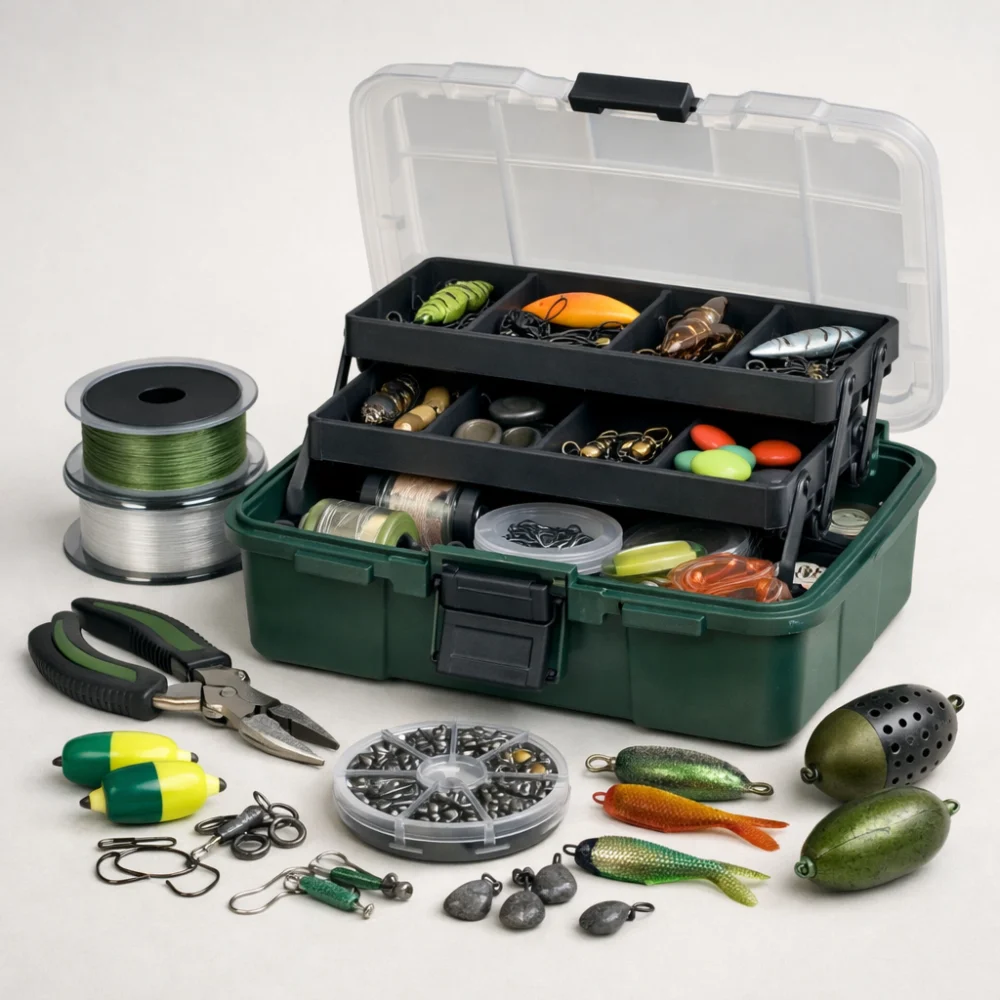
Fishing tackle boxes are about keeping small fishing items organised, protected and easy to find when you need them. The right choice depends less on appearance and more on how much tackle you carry, how often you move spots and how you like to sort hooks, lures, floats and accessories.
If you are replacing an old box or buying your first one, it helps to focus on layout first and size second. A box that looks generous on paper can still feel awkward if the compartments do not suit the tackle you actually use.
This guide covers the practical differences shoppers usually need to compare, so you can narrow down the options without guessing.
What should you look for first in a fishing tackle box?
Start with the items you want to store. Small hooks, swivels and split shot need secure, well-separated storage, while lures and larger accessories usually need more open space or deeper compartments. The best starting point is to match the box layout to the tackle you carry most often, then check the overall size and portability. Specifications vary by model, so always check the individual product page before buying.
| Feature | What it means | Why it matters | What to check |
|---|---|---|---|
| Compartment layout | The number, size and arrangement of sections inside the box | Determines how well you can separate hooks, lures, terminal tackle and tools | Look for dividers, trays or slots that suit the items you carry |
| Size and capacity | How much tackle the box can hold | Affects portability and how much you can keep in one place | Check the internal layout as well as the external dimensions |
| Portability | How easy the box is to carry or store in a bag, boat or vehicle | Important if you fish on the move or travel light | Consider weight, handle style and whether the shape fits your kit |
| Visibility | How easily you can see the contents | Can save time when selecting small items | Clear lids or open-view sections may help, but also consider glare and clutter |
| Closure and security | How the box stays shut | Helps reduce spills and accidental opening in transit | Check the clasp or latch design and whether compartments stay closed when moved |
| Material and finish | The general construction of the box | Influences durability, weight and how easy it is to wipe clean | Confirm the material description and look for a finish suitable for your storage conditions |
Key decision criteria explained
Box size versus internal layout
Size is only useful if the internal layout works for your tackle. A larger box can still be poor value if the compartments are awkward, while a compact box may be ideal if you carry a focused set of items. Think about whether you need one box for everything or several smaller boxes for different kinds of tackle.
Compartment style
Different tackle benefits from different storage styles. Small accessories usually suit divided sections, while lures and bulkier items often need roomier spaces. If you swap between bait fishing, lure fishing or mixed sessions, a flexible layout is often more useful than a highly specialised one.
Access and organisation
Ask how quickly you can get to the right item. Boxes that open flat, stack neatly or have clearly separated trays can make packing and unpacking easier. The trade-off is that more compartments can mean more fiddly sorting, so choose a layout that matches how much organisation you are willing to maintain.
Portability and storage
If you carry your kit to the bank, in a boat or inside a larger fishing bag, shape and handling matter as much as capacity. A box that is easy to store away can be more practical than one that simply holds the most items. Check whether it fits alongside your other fishing gear without wasting space.
Common tackle box types and variants
Within this category, shoppers will usually see boxes that differ by layout rather than by dramatic design changes. Some are simple single-level organisers, while others use multiple sections or double-sided storage to separate small items more efficiently. Others are built with a more general-purpose approach for mixed tackle and accessories.
A compact organiser may suit anglers who like a light, tidy carry, but it can feel restrictive if you keep changing rigs or carrying many lure sizes. A more modular or multi-section box is often better for variety, though it may take longer to sort and repack.
Which box suits which kind of buyer?
| Buyer need | What to prioritise | Likely compromise |
|---|---|---|
| Beginner setting up a first kit | Simple layout, easy access, enough space for basics | May not offer the most advanced organisation |
| Angler carrying lots of small terminal tackle | Many small sections and secure storage | Can be slower to sort if the layout is very compartment-heavy |
| Lure angler with mixed sizes | Deeper or more adaptable sections | Some boxes become less compact |
| Mobile angler who travels light | Compact size and easy transport | Will usually hold fewer items |
| Gift buyer | General-purpose storage and straightforward layout | May not suit a specialist fishing style |
Common mistakes and misunderstandings
- Buying by external size alone. Two boxes of similar size can feel very different inside, so the layout matters more than the headline dimensions.
- Overfilling one box. A box that is too full becomes harder to use and easier to mismanage. Sometimes two smaller boxes are more practical than one large one.
- Choosing a layout that does not match the tackle. Small compartments are not ideal for everything, and large open sections are not great for tiny items.
- Ignoring how the box will travel. If the box will live in a rucksack or larger bag, shape and closure design matter as much as storage capacity.
Safety and suitability caveats
A tackle box is a storage item, not a universal solution for every kind of fishing kit. Make sure the size, compartment depth and closure style suit the items you actually carry, especially if you store sharp hooks or delicate terminal tackle. For any model with special features, check the product page carefully so you understand what is included and how it is intended to be used.
Maintenance, storage and lifespan considerations
Fishing tackle boxes are usually easiest to manage when they are emptied, wiped down and dried before storage. That helps reduce dirt build-up, salt residue and lingering moisture from wet tackle. If you fish regularly, think about whether the box is simple to clean and whether it will fit neatly with the rest of your gear between trips.
How to compare options efficiently
- Decide what you need to store most often: small accessories, mixed tackle or larger lures.
- Choose the general box type or layout that suits that tackle best.
- Compare capacity, compartment style, access and portability side by side.
- Check the closure, material and storage fit against how you travel and fish.
- Review the individual product page to confirm the exact details before buying.
Summary buyer decision checklist
- Does the internal layout suit the tackle you carry most often?
- Is the box the right size for your bag, vehicle or storage space?
- Will the compartment style make sorting and finding items easier?
- Is the closure suitable for carrying the box around safely?
- Will the shape and design fit your fishing style and travel habits?
- Have you checked the individual product page for the exact specification?
Frequently asked questions
What is the main purpose of a fishing tackle box?
The main purpose is to keep fishing tackle organised, protected and easy to access. It helps separate small items so they are less likely to get mixed up or lost. The best box is the one that matches the way you actually fish.
Should I choose a small or large tackle box?
Choose the smallest box that comfortably holds the tackle you use most often. Larger boxes can be useful for mixed kits, but they can also become bulky and harder to carry. If you are unsure, start with a more compact option and check whether the layout meets your needs.
Are clear lids or see-through sections worth having?
They can make it easier to identify contents quickly, especially for small accessories. However, visibility is only one part of the decision, and a clear lid does not guarantee a better layout. It is still worth checking how the compartments are arranged.
What matters more: compartments or overall capacity?
For most buyers, compartments matter more because they determine how usable the space really is. Capacity is useful, but a box with poor organisation can still be frustrating. Try to judge capacity together with the type of tackle you plan to store.
Can one tackle box suit every type of fishing?
Sometimes a general-purpose box is enough, especially for a simple kit. But anglers who switch between different styles often find that a more specialised or flexible layout works better. If your tackle varies a lot, you may prefer more than one storage option.
How do I avoid buying the wrong box?
Start by listing the items you will store, then check whether the compartment style matches them. After that, compare portability, closure and fit with the rest of your kit. That approach usually gives a clearer answer than choosing by appearance alone.

