
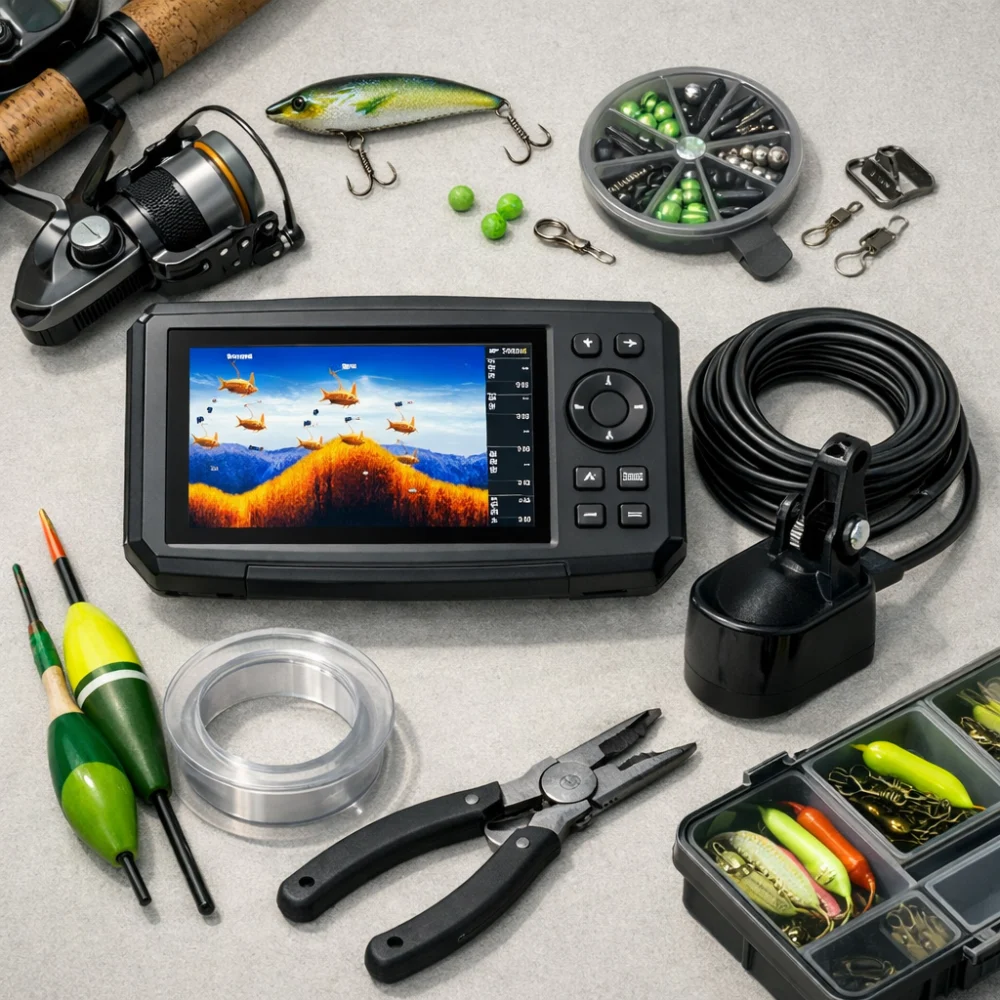
Fish finders and sonar units help anglers understand what is under the water rather than guessing from the surface. They are used for everything from casual bank fishing to boat, kayak and ice fishing, but the right choice depends on how and where you fish.
Because this category covers both portable and mounted styles, the main decision is not just “which is strongest”, but which type fits your setup, your fishing location and how much information you actually need. A compact castable unit may suit one angler, while another may prefer a fixed display with a transducer and more detailed readings.
Specifications vary by model, so always check the individual product page before buying.
What should you look for in a fish finder?
The best starting point is to match the unit to your fishing environment, then compare sonar style, display usability, mounting and power needs. If you fish from different places, portability may matter more than a large screen. If you usually stay on one boat or kayak, a mounted unit with a clearer display may be easier to live with.
The trade-off is usually between convenience and depth of detail. Smaller portable units are simpler to carry and set up, while more feature-rich systems can be easier to read and interpret once installed.
| Feature | What it means | Why it matters | What to check |
|---|---|---|---|
| Sonar type | The way the unit sends and interprets underwater signals | It affects how much detail you see and how the display information is presented | Whether the model suits your style of fishing and the level of detail you want |
| Portability | How easy it is to carry, mount, cast or move between locations | Important for shore anglers, kayaks and anyone fishing in multiple places | Whether it is castable, portable or designed for a fixed mount |
| Display | The screen used to view sonar information | Clearer displays are easier to read quickly, especially in changing light | Screen size, readability and whether the layout feels simple enough for your needs |
| Power source | How the unit is powered in use | It affects runtime, convenience and whether you need charging or separate batteries | Charging method, battery arrangement and how that fits your trips |
| Mounting and transducer setup | How the sensor and display are positioned on the watercraft or near the water | Affects installation effort and how stable the readings are in use | Compatibility with your boat, kayak or fishing method |
| Extra functions | Additional features such as GPS or fish marking on some models | Useful for some anglers, unnecessary for others | Only pay for extras you will actually use |
Key decision criteria explained
Fishing style and location
Start with where you fish most often. Shore anglers often want a unit that is easy to carry, cast or deploy without a fixed installation. Boat and kayak anglers may prefer a model that stays mounted and gives them a constant view while moving around the water. Ice anglers may have different priorities again, so think about the exact setting rather than choosing from the category name alone.
Display clarity and ease of use
A fish finder is only helpful if you can read it quickly and understand what it is telling you. A simple display can suit casual use, while a more detailed screen may suit someone who spends time interpreting sonar returns. The most important question is whether you want straightforward information or more advanced reading and control.
Sonar features and detail level
Different models may present underwater information in different ways. Some are aimed at straightforward depth and fish detection, while others are built for more detailed scanning or mapping-style use. More detail can be useful, but it can also make the unit more complex to learn, so consider how much information you really want to manage on the water.
Power and runtime
Battery choice and charging method affect how easy the unit is to use on longer sessions. If you make short trips, a simple charging routine may be enough. If you spend longer sessions on the bank, kayak or boat, power convenience becomes more important than flashy features.
Mounting, sensor placement and compatibility
Some fish finders are designed to be cast or carried, while others rely on a fixed display and transducer arrangement. The practical question is whether the setup works with your fishing method and craft. Check how the sensor is meant to be used and whether the design suits the way you normally fish.
Common types and how they differ
Portable and castable fish finders
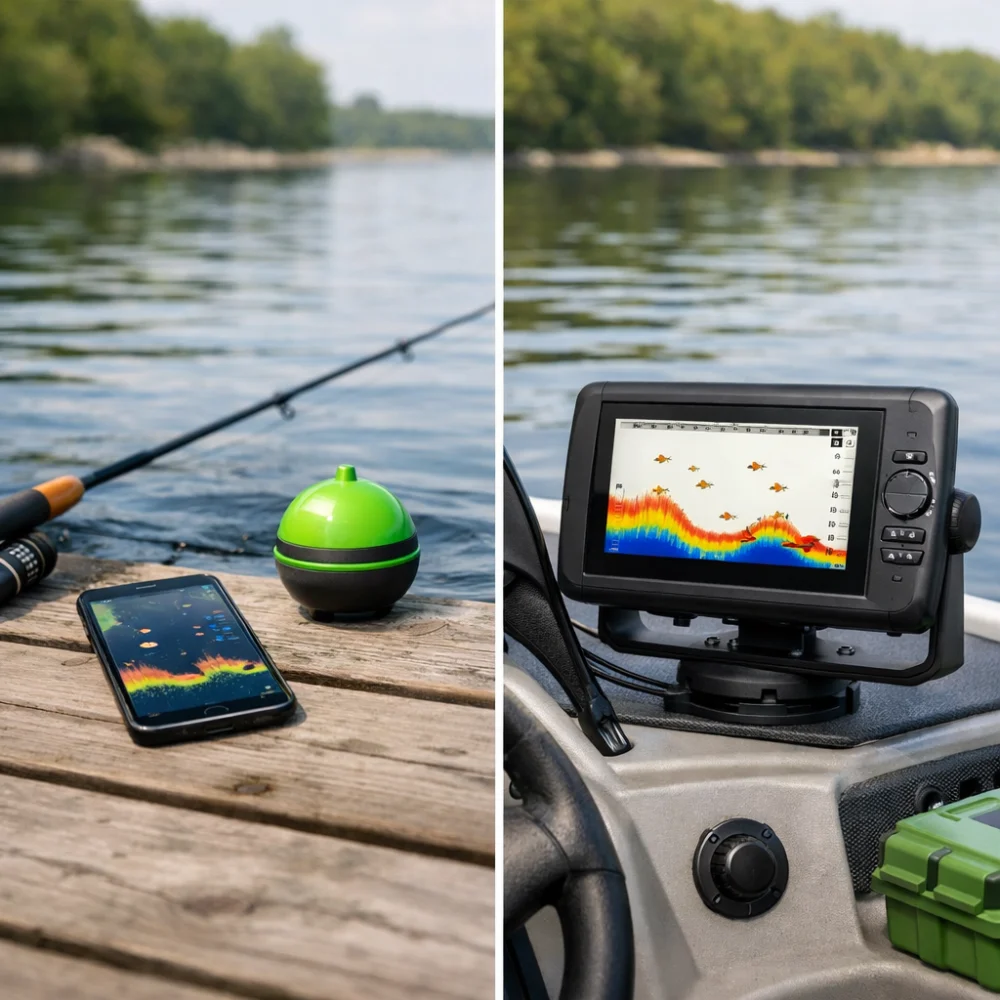
These are useful for anglers who want flexibility and minimal setup. They can suit bank fishing, occasional boat use and fishing from different spots. The main limitation is that convenience may come with a smaller display or fewer on-unit controls.
Boat and kayak fish finders
These are better suited to anglers who want a more fixed setup. They can be easier to use continuously while fishing from a craft and may feel more stable in daily use. The trade-off is that they need more thought around mounting and installation.
More advanced sonar systems
Some models offer more detailed sonar output or additional functions for anglers who want a fuller view of what is below the surface. These can be valuable for experienced users, but they are not always necessary for simple depth checking or casual fishing. A more advanced model is only worth paying for if you will use the extra information.
Which type suits which buyer?
| Buyer need | What to prioritise | Why |
|---|---|---|
| Casual or occasional fishing | Simplicity, easy setup, clear display | You want quick help without spending time learning a complicated interface |
| Shore or bank fishing | Portability and easy deployment | You may need to move spots and carry the unit with other gear |
| Kayak or boat fishing | Mounting method, display visibility and stable sensor use | The unit needs to work reliably while you are already on the water |
| More technical users | Detailed sonar information and any extra functions you will actually use | These buyers often want more reading detail and more control over interpretation |
| Gift buyers | Broad usability and straightforward operation | You may not know the recipient’s exact setup, so versatility matters |
Common mistakes and misunderstandings
- Choosing on features alone: A long list of functions is not useful if the unit is awkward for your fishing style. Match the design to how you actually fish.
- Ignoring portability: A good display does not help much if you will not want to carry or install the unit. Think about transport, setup and storage as well as screen quality.
- Overlooking power needs: If you fish for long sessions, the charging routine or battery arrangement matters more than it first appears. Check how the unit is powered before you buy.
- Assuming all sonar units suit every watercraft: Some are better for shore use, while others are aimed at boats or kayaks. Always confirm the intended use on the product page.
Safety and suitability considerations
Fish finders and sonar units are buying decisions rather than high-risk products, but it is still worth checking practical suitability before purchase. Make sure the unit is appropriate for the watercraft, environment and fishing method you intend to use. If you fish in changing conditions, consider how easy the display is to view and how the unit will be carried or secured.
Maintenance, storage and everyday ownership
These products are generally easiest to keep in good condition when you store them clean, dry and protected between trips. If your model uses rechargeable power or separate batteries, factor that into your routine so it is ready when you need it. Portable units may need more care in transport, while mounted systems may need more attention to setup and removal.
How to compare options efficiently
- Start with where and how you fish most often.
- Choose the broad type first: portable, castable or mounted.
- Compare display readability, power arrangement and sensor setup.
- Decide whether extra functions are genuinely useful or just added complexity.
- Check the individual product page for model-specific details before you buy.
Summary buyer decision checklist
- Does the unit suit your main fishing location and method?
- Is the setup simple enough for the way you actually fish?
- Will the display be easy for you to read quickly?
- Does the power arrangement suit your sessions and routine?
- Are any extra functions useful, or unnecessary for your needs?
- Have you checked the individual product page for model-specific details?
Frequently asked questions
Do I need a fish finder if I already know my fishing spots?
Not necessarily, but it can still help you understand depth changes and what is happening below the surface. Some anglers use one for confirmation rather than discovery. If you already know your waters well, a simpler model may be enough.
What is the difference between a portable fish finder and a mounted one?
A portable unit is designed to be easier to move, carry or deploy in different places. A mounted unit is usually better suited to a fixed installation on a boat or kayak. The right choice depends on how often you change fishing location and how much setup you are willing to do.
Are more expensive fish finders always better?
Not for every buyer. Higher-priced models often offer more detail or extra functions, but that only matters if you will use them. For many anglers, a simpler unit that is easy to read and practical to carry is the better fit.
Can one fish finder suit bank, kayak and boat fishing?
Some can be used across more than one setup, but that does not mean they are ideal in every situation. Versatility is helpful, yet it can come with compromises in mounting, display size or convenience. Check how the model is meant to be used before assuming it will suit all three.
What should I check before buying for the first time?
Focus on your fishing style, the type of setup you want, the display you can comfortably use and the way the unit is powered. Those basics usually matter more than extra functions. Specifications vary by model, so always check the individual product page before buying.
Is sonar the same as fish finding?
Sonar is the technology used to gather underwater information, while fish finding is the practical use of that information for angling. In this category, the terms are often used together because the products help you see depth and underwater features. The exact presentation differs by model.
What if I only want basic depth information?
Then a straightforward model may be more suitable than a feature-heavy one. The simplest units can be easier to learn and quicker to use. There is no need to pay for complex extras if your main aim is basic depth awareness.

