
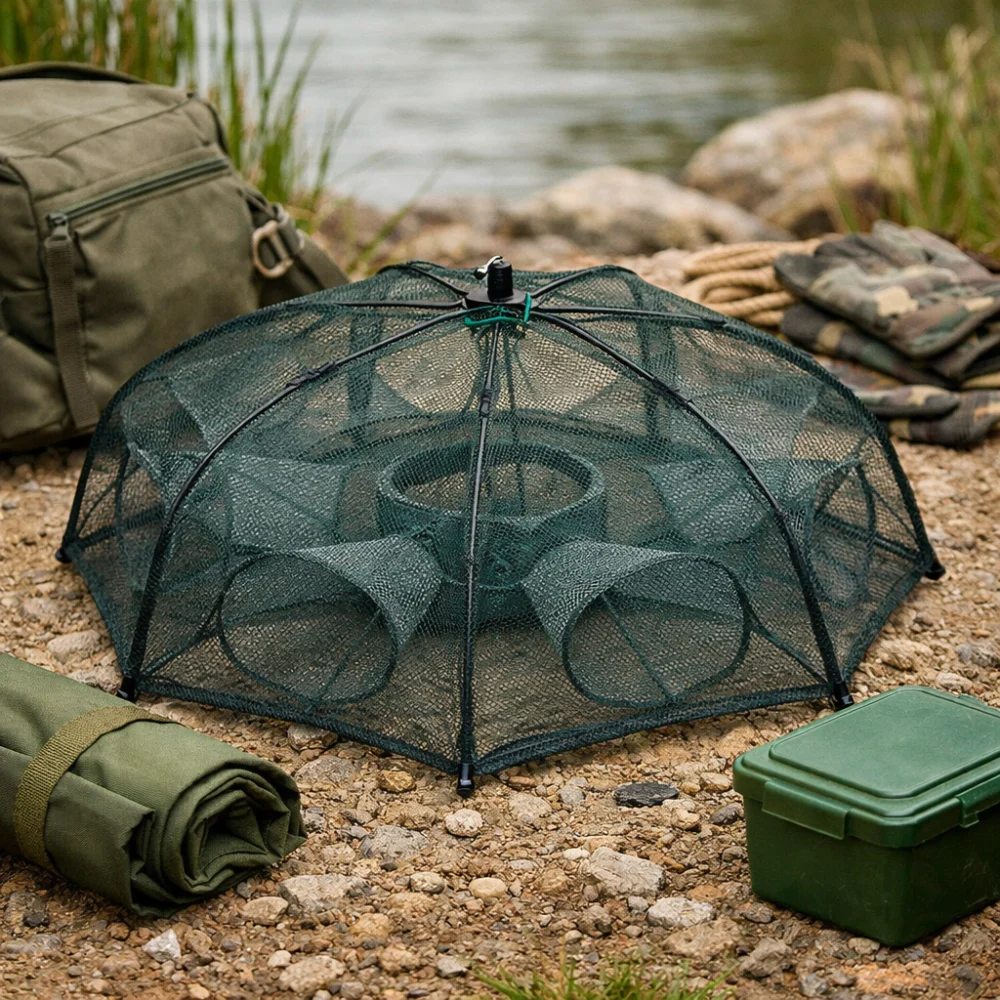
Fishing traps are a practical choice for anglers and outdoor users who want a passive catching method rather than a hand-held net or rod-led approach. The right trap depends on what you plan to target, where you plan to use it and how easy you need it to be to carry, set and clean.
Because products in this category can differ in shape, opening style, mesh, frame and access points, it helps to compare them on function rather than on appearance alone. A small, foldable trap may suit occasional use, while a larger or more rigid design may suit repeated use in the same location.
Specifications vary by model, so always check the individual product page before buying.
What should you look for in a fishing trap?
The best starting point is the species you want to target and the environment you will use the trap in. After that, compare how the trap opens, how it is retrieved, how it is baited and how easy it is to rinse and dry after use. The main trade-off is usually between portability and robustness: lighter collapsible designs are easier to carry, while sturdier builds may feel more stable in use.
| Feature | What it means | Why it matters | What to check |
|---|---|---|---|
| Target species | The type of catch the trap is intended for | Trap shape and entry style need to suit what you want to catch | Look for product wording that matches your intended use |
| Size and profile | How much space the trap occupies when set up or stored | Affects transport, placement and how discreetly it sits in the water or environment | Check overall dimensions and whether it folds or collapses |
| Mesh or opening design | The structure that lets catch enter and stay contained | Influences ease of use and how straightforward retrieval is | Look for the number and position of openings or funnels |
| Frame style | Whether the trap relies on a flexible or rigid support structure | Can affect durability, handling and how the trap holds its shape | Check whether the frame is described as foldable, fixed or reinforced |
| Access and closure | How bait is placed and catch is removed | Good access can make loading and emptying easier | Check for zips, panels, doors or other access points |
| Cleaning and drying | How easy it is to rinse and dry after use | Important for hygiene, odour control and longer-term condition | Look for materials that are easy to wash and store dry |
Key decision criteria
Target use and species
Start with the kind of catch you expect to target. A trap designed for one use may not suit another, even if the product names sound similar. If you are buying for bait collection, crustaceans or other small catches, focus on the trap’s entry design and enclosure rather than on generic size alone.
Portability versus sturdiness
Foldable and collapsible traps are usually easier to transport and store, which is useful if you move between locations or have limited storage space. More rigid designs may be less convenient to carry but can feel simpler to handle once deployed. Decide which matters more to you before comparing finer details.
Access, baiting and retrieval
Some traps are easier to bait and empty than others. Access panels, zips and opening points can make a real difference if you plan to use the trap frequently. If the access point looks awkward or cramped, that may be a sign that day-to-day use will be less convenient than expected.
Material and upkeep
Fishing traps are often used in wet, sandy or muddy conditions, so materials and finish matter. Look for a design that can be rinsed clean and stored dry without becoming difficult to manage. If a trap will be used outdoors often, practical cleaning and drying are more important than decorative features.
Common product types and variants
There are a few broad patterns within the category, although individual products may combine them in different ways:
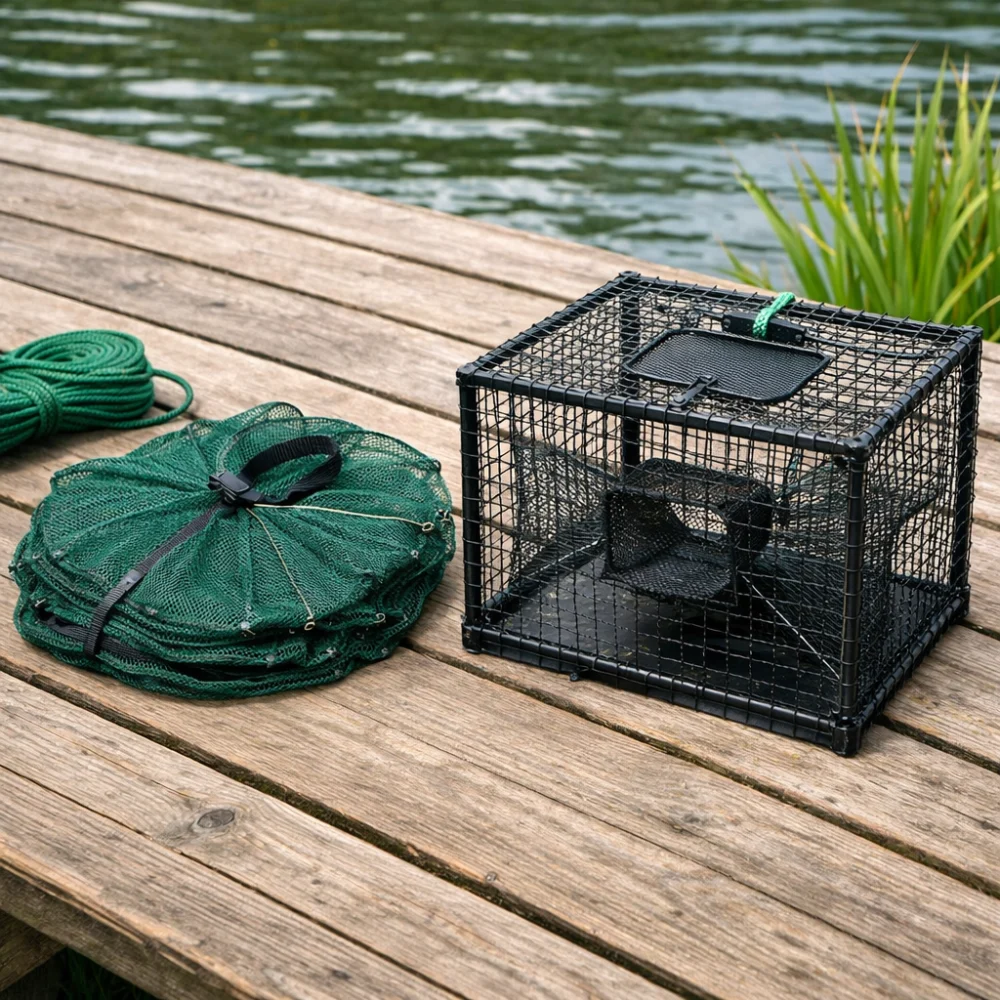
- Foldable or collapsible traps: Good for portability and storage, especially if you need to carry the trap to the water’s edge. Their main limitation is that they may feel less substantial than fixed-frame designs.
- Square or cage-style traps: Often chosen for simple loading and retrieval. Their main limitation is that they can be bulkier to transport if they do not collapse neatly.
- Mesh-based traps with access openings: Useful when lightweight handling is a priority. Their limitation is that the mesh and closure design need to be suitable for the intended use.
Which trap suits different buyers?
| Buyer need | Helpful characteristics | Why this matters |
|---|---|---|
| Occasional use | Simple design, easy storage, straightforward access | Makes the trap easier to keep and reuse without much fuss |
| Frequent use | Robust build, easy cleaning, reliable closure points | Helps the trap cope with repeated handling and rinsing |
| Limited storage space | Collapsible form, compact packed size | Makes transport and home storage much easier |
| Buying for a specific catch | Species-appropriate entry shape and size | Reduces the risk of choosing a trap that is too generalised |
| Simple, low-fuss setup | Clear opening, easy baiting and obvious retrieval point | Reduces frustration when the trap is used outdoors |
Common mistakes to avoid
- Choosing by size alone. A larger trap is not automatically better if it is awkward to carry or does not suit the intended catch.
- Ignoring access design. If baiting and emptying look inconvenient, the trap may be frustrating in regular use.
- Assuming all traps are interchangeable. Small differences in shape, openings and frame style can change how useful a trap is for a particular job.
- Overlooking after-use care. A trap that is difficult to rinse or dry can be less pleasant to store and reuse.
Safety and suitability caveats
Check local rules and any site-specific restrictions before using any fishing trap. Make sure the trap is suitable for the environment and the species you intend to target, and avoid assuming that a product name alone confirms proper use. If you are unsure about a model’s intended application, rely on the individual product page rather than on the wording of the category.
Maintenance, storage and lifespan considerations
Most fishing traps benefit from simple post-use care: rinse off debris, let them dry fully and store them where they will not be crushed or left damp. That helps reduce odour, corrosion risk and general wear. If a trap has moving parts, zips or closures, it is sensible to check that they are easy to clean and remain functional after repeated use.
How to compare options efficiently
- Start with what you want the trap to do and where you expect to use it.
- Choose the broad style that suits that use, such as collapsible or more rigid.
- Compare the opening, access and closure design for day-to-day convenience.
- Check size, packed form and cleaning practicality against your storage needs.
- Read the individual product page carefully before deciding.
Summary buyer decision checklist
- Does the trap suit the species or use you have in mind?
- Is the size practical for carrying, setting and storing?
- Is the access design easy enough for baiting and retrieval?
- Does the frame or mesh style match how often you plan to use it?
- Will it be easy to rinse, dry and store after use?
- Have you checked the individual product page for model-specific details?
Frequently asked questions
What is the main difference between a fishing trap and a net?
A trap is usually designed to stay in place and work passively, whereas a net is generally used more directly and actively. That means the most important buying checks are different: for traps, think about access, closure and suitability for the intended catch.
Are collapsible fishing traps worth considering?
They can be a good choice if portability and storage matter to you. The trade-off is that a collapsible design may feel less rigid than a fixed-frame option, so it is worth checking how the trap is made and how it is meant to be used.
How do I know which size to buy?
Start with the species or use you are targeting and think about where the trap will be placed. A trap that is easy to carry and set up is often more practical than one that is simply large, especially if you have limited space or move around frequently.
What features make a trap easier to use?
Clear access points, straightforward baiting and an obvious retrieval method usually make the biggest difference. If the product page is vague about these details, it is sensible to be cautious and compare it against clearer alternatives.
How important is cleaning and drying?
Very important in practical terms, because a trap that dries well is easier to store and less likely to become unpleasant to handle. For regular use, cleaning convenience is often as important as the initial shape or size.
Can I use one trap for different species?
Sometimes, but only if the trap’s shape and entry design suit the intended uses. Multi-purpose wording can be helpful, but it does not replace checking whether the product is actually appropriate for the kind of catch you want.
Should I rely on the product title alone?
No. Product titles can be useful for quick sorting, but they do not always tell you enough about size, access or practical use. Always read the product page details before deciding.

