
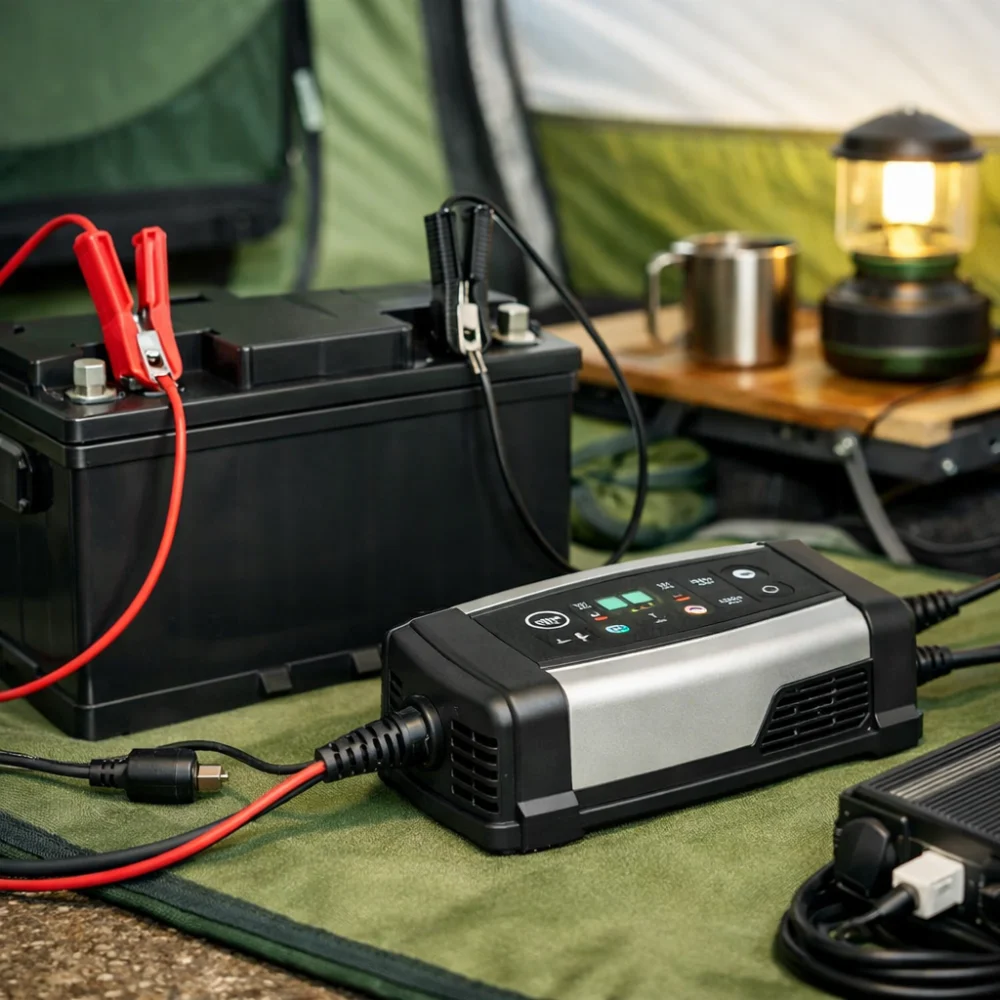
Leisure battery chargers are bought by people who want to keep a battery topped up, recover charge after use or manage charging more carefully during regular off-grid trips. The right choice depends on the battery type, the charging setup you already have and how often you need to recharge.
This guide focuses on the buying decisions that matter most: matching the charger to the battery, understanding charging modes and checking the practical features that make day-to-day use easier. It does not replace the individual product page, because specifications vary by model, so always check the individual product page before buying.
For many buyers, the main challenge is not finding a charger, but avoiding one that is awkward to use with their battery or unnecessary for their needs. A simple charger may be enough for occasional use, while a more capable unit may suit regular charging, maintenance charging or mixed battery types.
What should I look for in a leisure battery charger?
Start by matching the charger to the battery chemistry, voltage and intended use. Then compare how the charger handles charging stages, whether it is suitable for maintenance charging and whether the connections fit the way you actually use the battery. The best starting point is usually compatibility, followed by charging convenience and then any extra features you may genuinely use.
| Feature | What It Means | Why It Matters | What To Check |
|---|---|---|---|
| Battery type | The kind of battery the charger is intended to work with | A charger needs to suit the battery chemistry and use case | Check the product page for supported battery types |
| Voltage | The electrical system the charger is designed for | An unsuitable voltage can make the charger irrelevant to your battery | Confirm the battery voltage before buying |
| Charging mode | How the charger manages the charging process | Different modes suit different levels of hands-on control and maintenance | Look for automatic, maintenance or multi-stage charging if needed |
| Charge current | The rate at which the charger delivers power | This affects how quickly charging may complete, depending on the battery | Compare the charger output against your battery’s requirements |
| Indicators and controls | Displays, lights or buttons that show charging status | These affect ease of use and how clearly you can follow progress | Check whether the charger gives clear status information |
| Connections | The leads, clips or connectors used to attach the charger | Convenient connections make repeated charging easier | Make sure the connection method suits your battery and setup |
Key decision criteria explained
Battery chemistry and system compatibility
Some chargers are intended for particular battery chemistries, while others are broader in use. That matters because the wrong match can mean the charger is unsuitable even if the plug fits. Check the battery type, voltage and any stated compatibility carefully rather than assuming all leisure battery chargers are interchangeable.
Charging style: simple, automatic or maintenance-focused
Some buyers want straightforward charging, while others prefer a charger that can be left connected for maintenance or used as part of regular battery care. Automatic chargers can be more convenient, but the benefit depends on whether you actually need that behaviour. A maintenance-capable charger is often more useful for batteries that are stored between trips or used less frequently.
Output and pace
Charging output affects how long a recharge may take, but higher output is not automatically better. The right level depends on the battery and how quickly you want to recover usable charge. If you are comparing options, look at the charger output alongside the battery size and the manufacturer’s guidance.
Display and ease of use
A clear display or simple status lights can make a charger easier to live with, especially if you only use it occasionally. This is worth considering if you want to know whether charging is underway, complete or paused. A more basic charger may still be fine if you do not need much feedback.
Lead length and connector style
Practical convenience often comes down to how easily the charger connects to the battery. Some buyers prefer clips, while others want a more dedicated connector arrangement. Think about access to the battery, storage space and how often you will unplug and reconnect the charger.
Common product types and variants
Within this category, chargers are often grouped by how they charge and what kind of battery they support. A basic charger may suit occasional top-ups, while a more advanced charger can be better for regular use or batteries that spend time in storage. Some models are designed as maintainers as well as chargers, which may suit buyers who want to keep batteries ready rather than just recharge them after use.
There are also differences in portability, controls and connection methods. A compact unit may suit simple weekend use, while a more feature-rich charger may appeal to buyers who manage batteries more often. The trade-off is usually between simplicity and the extra control or feedback that more advanced units provide.
Which charger suits which buyer?
| Buyer need | What to prioritise | Why | What to avoid |
|---|---|---|---|
| Occasional camper | Simple, compatible charging | Easy use matters more than advanced features | Paying for controls you are unlikely to use |
| Regular off-grid user | Reliable charging and maintenance options | Batteries may need more frequent top-ups | Choosing a charger without the right mode for repeated use |
| Storage or standby use | Maintenance charging behaviour | Useful where batteries are left unused between trips | Assuming a basic charger will suit long periods of storage |
| Buyer with multiple battery types | Clear compatibility information | Different batteries may need different treatment | Relying on a vague description rather than the product page |
Common mistakes and misunderstandings
- Choosing by output alone: a higher charging rate is not the only thing that matters. Compatibility and charging behaviour are just as important.
- Assuming all leisure batteries are the same: battery type and voltage can change what charger is suitable.
- Ignoring storage needs: if the battery is kept for long periods between uses, maintenance capability may matter more than speed.
- Overlooking connection practicality: a charger can be technically suitable but inconvenient if the leads or connectors do not suit your setup.
Safety and suitability caveats
Use charger information as a buying check, not as a substitute for the battery manufacturer’s guidance. If a product page does not clearly state compatibility, treat that as a reason to pause rather than assume it will work. Specifications vary by model, so always check the individual product page before buying.
It is also sensible to think about where and how you will charge the battery. A charger that suits a workshop or garage setup may be less convenient if you need a more portable option, or if access to the battery is awkward.
Maintenance, storage and lifespan considerations
Leisure battery chargers are usually bought to support battery care over time, so convenience and consistency matter. If you plan to store the charger between uses, consider how easy it is to keep the leads tidy and the unit protected from knocks or moisture. If you will move it around often, compactness and simple connections can matter more than extra features.
For buyers managing batteries regularly, the key ownership question is whether the charger makes routine charging easy enough to keep using it properly. A charger that is awkward to connect or unclear to read can become less useful than a simpler one that you are happy to use often.
How to compare options efficiently
- Confirm the battery type and voltage you need to support.
- Decide whether you want simple charging, automatic charging or maintenance charging.
- Compare the output, connection method and status display.
- Check whether the charger suits your storage and usage pattern.
- Read the individual product page carefully before making a final choice.
Summary buyer decision checklist
- Does the charger match the battery type you own?
- Is the voltage appropriate for your setup?
- Do you need maintenance charging or a simpler charger?
- Are the leads or connectors practical for where the battery is fitted or stored?
- Is the information on the product page clear enough for you to compare confidently?
Frequently asked questions
Do I need a special charger for a leisure battery?
Often, yes. A charger intended for this use is more likely to match the battery type, voltage and charging style you need. The important point is to check the product page rather than assuming any charger marketed for batteries will suit your leisure battery.
What is the difference between charging and maintenance charging?
Charging is about restoring battery power, while maintenance charging is aimed at keeping a battery ready over a longer period. That distinction matters if your battery spends time unused between trips. If you only recharge occasionally, a basic charger may be enough.
Is a higher amp charger always better?
Not necessarily. A higher output may be useful in some cases, but only if it suits the battery and your charging needs. Compatibility and intended use are more important than chasing the largest number on the page.
Can I use one charger for different battery types?
Sometimes, but only if the product page clearly says it supports those battery types. Do not assume universal compatibility. If you use more than one battery type, check each requirement separately.
Why does the connection style matter?
Because ease of use affects whether the charger is genuinely practical for you. A technically suitable charger can still be frustrating if the connectors are awkward or the leads do not suit the way you access the battery. Small practical details often make the biggest difference in daily use.
Should I choose the simplest charger available?
That depends on how you use the battery. Simple chargers can be ideal if you only need occasional top-ups and want an uncomplicated setup. If you store batteries for longer periods or charge regularly, a model with more control or maintenance features may be more appropriate.
What should I check if I am replacing an older charger?
Compare the battery type, voltage, charging mode and connection style first. It is easy to replace like for like without noticing that your current charger was only suitable for a particular use case. The product page should make it clear whether the new charger matches your actual battery.

