BUYERS GUIDE
3D Printer Filament Buyers Guide
3D printer filament is the material fed into a fused filament fabrication printer to create a physical object layer by layer. The filament you choose affects print quality, strength, flexibility, heat resistance, appearance and how difficult the material is to print successfully.
Although many filament spools look similar, their behaviour can vary considerably. PLA is commonly used for straightforward models and prototypes, while materials such as PETG, ABS, ASA, TPU, nylon and polycarbonate can suit more specialised applications.
Diameter, spool size, temperature requirements, moisture sensitivity and nozzle compatibility also matter. A filament may have the properties you need but still be unsuitable for your printer.
This guide explains how to compare 3D printer filaments, understand the main material types and avoid common buying mistakes.
Quick Answer
Choose 3D printer filament by first checking the diameter and materials supported by your printer. PLA is commonly suitable for beginners, decorative models and general prototypes. PETG can provide a balance of strength, durability and easier printing, while ABS and ASA can suit tougher or warmer environments when the printer has suitable temperature control and ventilation. TPU is flexible, nylon is tough but moisture sensitive, and reinforced filaments may require a wear resistant nozzle. Always follow the filament and printer manufacturer’s temperature, ventilation, storage and compatibility guidance because settings vary between products.
Quick Product Comparison Framework
| Feature | What It Means | Why It Matters | What To Check |
|---|---|---|---|
| Filament material | The polymer or material blend being printed | Determines strength, flexibility, heat resistance and difficulty | PLA, PETG, ABS, ASA, TPU, nylon or another listed material |
| Diameter | Thickness of the filament | Must match the printer’s feed system and hotend | Commonly 1.75 mm or 2.85 mm, depending on the printer |
| Spool weight | Amount of filament supplied | Affects print quantity and value comparison | Net filament weight rather than total packaged weight |
| Print temperature | Hotend temperature required | Must be within the printer’s supported range | Manufacturer’s recommended temperature range |
| Bed temperature | Heated bed requirement | Affects first layer adhesion and warping | Whether a heated bed is needed |
| Enclosure requirement | Whether controlled ambient temperature is recommended | Important for materials prone to warping | Printer enclosure and ventilation guidance |
| Moisture sensitivity | How readily the filament absorbs water | Moist filament can affect print quality and strength | Storage and drying instructions |
| Nozzle compatibility | Type and size of nozzle required | Abrasive or filled materials can wear ordinary nozzles | Brass, hardened steel or another suitable nozzle |
| Mechanical properties | Strength, stiffness, toughness and flexibility | Determines whether the print suits its intended use | Material data and manufacturer guidance |
| Heat resistance | Ability to retain shape at higher temperatures | Important for parts used near heat or inside vehicles | Listed temperature performance |
| UV and weather resistance | Suitability for exposure outdoors | Affects outdoor lifespan and colour stability | Outdoor suitability where stated |
| Colour and finish | Visual appearance of the finished part | Matters for models, displays and decorative prints | Matte, gloss, translucent, silk or filled finish |
Key Decision Criteria Explained
Printer Compatibility
Before comparing colours or material properties, check which filament diameter and materials your printer supports.
The printer must be able to reach the required nozzle and bed temperatures. Materials that shrink while cooling may also need an enclosed print chamber to reduce drafts and temperature changes.
Check:
- Supported filament diameter
- Maximum hotend temperature
- Maximum bed temperature
- Whether the hotend contains components with temperature limits
- Whether the printer is enclosed
- Extruder type
- Nozzle material and diameter
- Manufacturer approved materials
A filament fitting through the extruder does not automatically mean the printer is suitable for it.
Filament Diameter
The filament diameter must match the printer’s extruder and hotend.
The most common diameter for consumer printers is 1.75 mm, while some machines use 2.85 mm filament. Products described as 3 mm are often intended for systems using approximately 2.85 mm filament, but the exact requirement should be confirmed.
Using the wrong diameter can cause feeding problems, under extrusion or an inability to load the material.
Diameter Consistency
Filament should remain reasonably consistent in diameter along its length.
Large variations can change the amount of plastic pushed through the nozzle, potentially causing uneven extrusion, surface imperfections or jams.
Manufacturers may state a dimensional tolerance. This can help with comparisons, although tolerance claims should not replace correct printer calibration and storage.
Spool Dimensions And Holder Compatibility
Not every spool fits every printer, enclosure or automated material system.
Check:
- Spool outer diameter
- Spool width
- Centre hole dimensions
- Spool weight
- Cardboard or plastic construction
- Compatibility with enclosed spool holders
- Compatibility with automatic filament systems
Large or unusually wide spools may need an external holder.
Net Weight And Filament Length
Filament is commonly sold by weight, but materials have different densities.
A kilogram of one material may provide a different length from a kilogram of another. This matters when estimating how many parts can be produced.
Check whether the stated weight refers to the filament itself rather than the spool and packaging.
Nozzle Temperature
Each filament has a recommended nozzle temperature range.
A temperature that is too low can cause poor layer adhesion, under extrusion and weak parts. Excessive temperature may increase stringing, surface defects, fumes or material degradation.
The correct setting can vary with:
- Filament brand
- Colour and pigment
- Print speed
- Layer height
- Nozzle size
- Printer hotend design
- Cooling level
Begin within the manufacturer’s recommended range and adjust gradually through suitable test prints.
Heated Bed Requirements
Some filament can print on an unheated bed, while other materials normally benefit from or require a heated surface.
Bed temperature affects first layer adhesion, bottom surface quality and warping. Excessive heat can also make some materials difficult to remove or cause lower layers to soften.
The correct build surface and adhesive method vary by material and printer.
Enclosed Printing
Materials such as ABS, ASA, nylon and polycarbonate may benefit from a stable, warm environment.
An enclosure can reduce drafts and sudden cooling, helping to limit warping and layer separation. However, an enclosure must be used in accordance with the printer and filament manufacturer’s safety and ventilation guidance.
Electronics not designed for a heated enclosure may be affected by prolonged exposure to elevated temperatures.
Extruder Design
Flexible filaments can be more difficult to feed because they compress and bend.
A direct drive extruder, where the drive gears are close to the hotend, may make flexible filament easier to control. A Bowden system can still print some flexible materials, but suitability depends on the filament hardness, feed path and printer.
Very soft materials commonly require lower speeds and carefully controlled retraction.
Nozzle Size
The standard nozzle supplied with many printers can work with ordinary unfilled filament.
Composite filaments containing wood, metal, carbon fibre or glass fibre may clog more easily, particularly through a very small nozzle. Some manufacturers recommend a larger nozzle.
Changing nozzle size also changes extrusion width, detail level, print time and slicer settings.
Nozzle Material
Brass nozzles are widely used for standard PLA, PETG, ABS and similar unfilled materials.
Abrasive filaments can wear brass quickly. Carbon fibre, glass fibre, glow in the dark and some mineral or metal filled filaments may require a hardened or wear resistant nozzle.
A worn nozzle can gradually increase in diameter, reducing dimensional accuracy and print quality.
Strength, Stiffness And Toughness
These terms describe different properties.
Strength relates to the load a material can withstand. Stiffness describes resistance to bending. Toughness concerns how much energy the material can absorb before breaking.
A stiff material is not always tough, and a tough material is not necessarily rigid. The printed part’s strength also depends on:
- Layer orientation
- Wall thickness
- Infill
- Print temperature
- Layer bonding
- Moisture
- Part design
- Nozzle size
Material choice cannot compensate for an unsuitable design or poor print settings.
Layer Adhesion
A printed part is built from individual layers, making bonding between them important.
Nozzle temperature, cooling, enclosure temperature, print speed and moisture can all affect layer adhesion.
Parts loaded across layer lines may behave differently from injection moulded products made from the same underlying polymer.
Heat Resistance
PLA can soften in environments that would not affect certain engineering materials.
Parts intended for vehicles, machinery, warm rooms or outdoor sunlight may need a material with greater temperature resistance.
Check the material data rather than assuming a stronger filament is automatically more heat resistant. Some materials also require controlled heat treatment to reach particular properties, which can alter dimensions.
UV And Weather Resistance
Outdoor prints may be exposed to ultraviolet light, moisture and changing temperatures.
ASA is commonly chosen for outdoor applications because of its weathering properties. PETG can also suit selected outdoor uses, depending on the product and environment.
PLA, ABS and other materials may fade, weaken or change over time outdoors. Check the manufacturer’s suitability information for long term exposure.
Water And Chemical Exposure
Water resistance does not necessarily mean waterproof, chemically resistant or food safe.
Layer lines, gaps and microscopic pores can allow liquids to pass through a printed part. Chemical compatibility varies by material and the substance involved.
Check the filament manufacturer’s technical data and test the printed component under appropriate controlled conditions.
Food Contact Considerations
A filament being described as made from a particular polymer does not automatically make a printed object suitable for food contact.
Other considerations include:
- Colourants and additives
- Filament certification
- Nozzle material
- Previous materials used in the printer
- Layer gaps and porosity
- Cleaning difficulty
- Surface coatings
- Temperature of the food
- Repeated use
Only rely on appropriate material certification and recognised guidance for the complete printing process.
Moisture Sensitivity
Many filaments absorb moisture from the air.
Wet filament may produce:
- Popping or crackling sounds
- Bubbles
- Rough surfaces
- Excessive stringing
- Weak layers
- Inconsistent extrusion
- Cloudy or dull finishes
Nylon, TPU, PETG, PVA and some engineering filaments can be particularly sensitive.
Keep filament sealed with a suitable desiccant and follow the manufacturer’s drying instructions when required.
Colour And Pigment Differences
Different colours within the same filament range may not print identically.
Pigments and additives can influence temperature, flow, opacity, strength and surface finish. A setting that works perfectly for one colour may need small adjustments for another.
New spools should be tested before starting a large or time sensitive print.
Surface Finish
Filaments are available with finishes such as:
- Standard
- Matte
- Silk
- Gloss
- Translucent
- Transparent
- Marble
- Wood effect
- Metallic effect
- Glow in the dark
- Colour changing
Decorative additives can change print behaviour and may increase brittleness, stringing, nozzle wear or clogging risk.
Choose the finish according to both appearance and functional requirements.
Print Speed
Some high flow filaments are formulated for faster printing, but printer capability still matters.
High speed printing requires the hotend to melt enough material consistently. The cooling system, extruder and motion system must also maintain control.
A filament described as high speed will not automatically make every printer faster without suitable settings and hardware.
Product Type Differentiation And Variants
PLA Filament
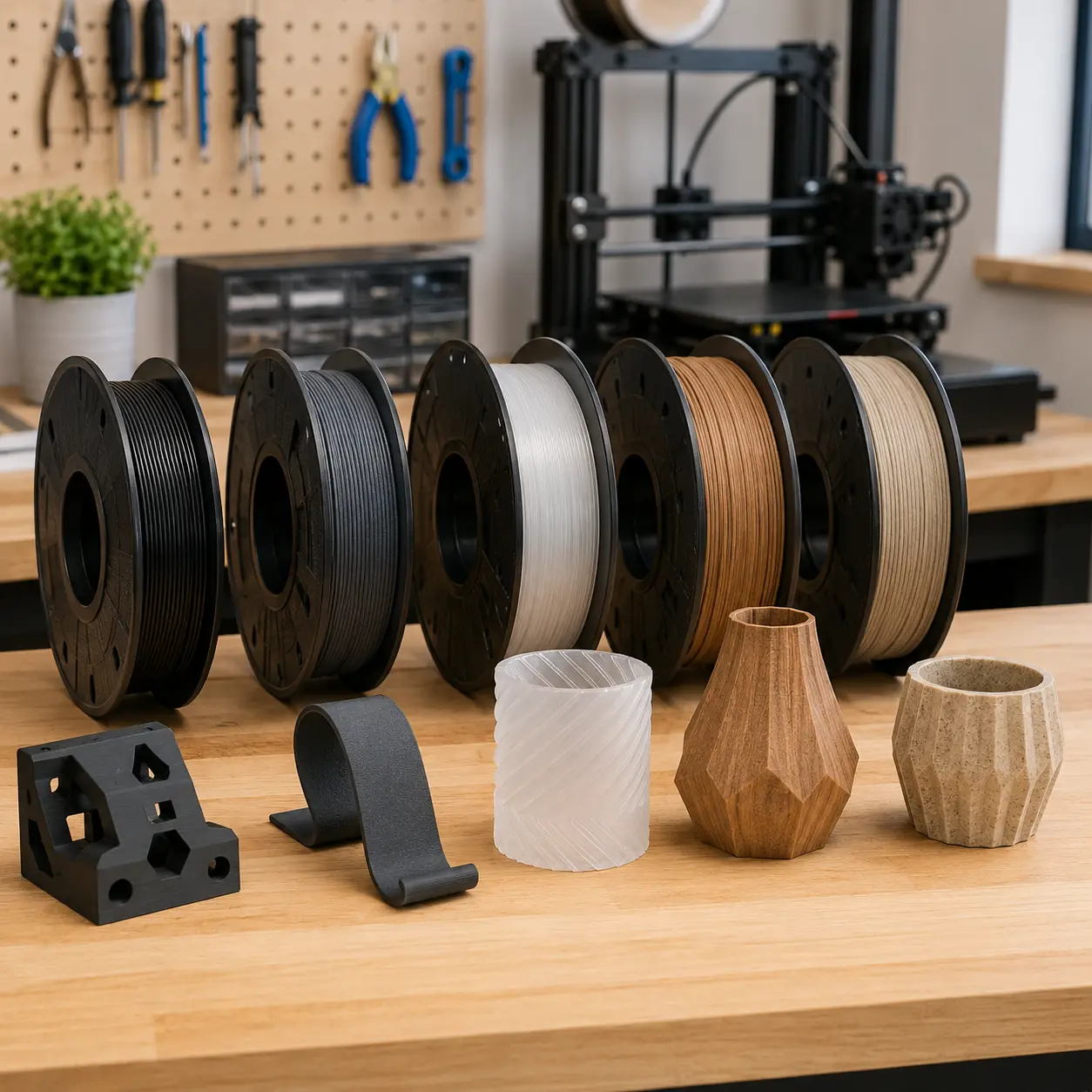
PLA is commonly used for general models, prototypes, ornaments, organisers and straightforward prints.
It is usually easier to print than many engineering materials and can work with modest bed temperatures. It is available in a large range of colours and finishes.
Its limitations can include lower heat resistance and greater brittleness than tougher materials. It may not suit parts left in hot vehicles or exposed to demanding mechanical loads.
PLA Plus And Modified PLA
PLA Plus, PLA Pro and similar names generally describe manufacturer modified PLA blends.
These products may offer improved toughness, layer adhesion or finish, but there is no single universal PLA Plus formulation.
Do not assume two products labelled PLA Plus have the same properties. Check the individual manufacturer’s technical information.
PETG Filament
PETG is commonly chosen when buyers want more toughness and temperature resistance than ordinary PLA while retaining relatively accessible printing behaviour.
It can suit brackets, containers, practical parts and selected outdoor items. It may provide good layer adhesion and reduced brittleness.
PETG can be prone to stringing and may bond very strongly to some build surfaces. Printer and surface guidance should be followed to avoid damage during removal.
ABS Filament
ABS can provide useful toughness, impact resistance and heat performance.
It is commonly used for functional components, housings and workshop parts. However, it can shrink and warp while cooling, making an enclosure and stable temperature helpful.
ABS printing can release fumes and particles. Follow the filament and printer manufacturer’s ventilation and safety guidance.
ASA Filament
ASA offers properties broadly suited to functional and outdoor applications, including improved resistance to ultraviolet exposure compared with many general materials.
It can be used for outdoor housings, brackets and automotive related prototypes where the specific product is suitable.
Like ABS, ASA can warp and normally benefits from an enclosure and appropriate ventilation.
TPU And Flexible Filament
TPU is used for flexible parts such as protective covers, feet, seals, grips and vibration dampers.
Flexibility is often described using Shore hardness. A higher Shore value generally indicates a firmer material within the relevant scale, but products should be compared using manufacturer data.
Softer filament can be more difficult to feed. Print speed, retraction, extruder design and feed path all matter.
Nylon Filament
Nylon can provide strong, tough and wear resistant parts.
It may suit gears, hinges, tools and mechanical components where the specific grade is appropriate. Nylon can absorb moisture quickly and often requires careful drying and storage.
It may also need higher temperatures, a suitable build surface and an enclosed printer.
Polycarbonate Filament
Polycarbonate can provide high strength and heat resistance, depending on the formulation and printing conditions.
It is generally considered a demanding material. High nozzle and bed temperatures, an enclosure and controlled cooling may be necessary.
Not every desktop printer can safely reach or maintain the required conditions.
HIPS Filament
HIPS can be used as a printable material or as a support material with compatible primary filaments.
It may be dissolved using a suitable solvent in certain workflows. Solvent handling requires appropriate precautions and manufacturer guidance.
HIPS printing often has requirements similar to ABS, including temperature control and ventilation.
PVA And Water Soluble Support Filament
PVA can be used to create dissolvable supports in compatible dual material printing systems.
It is highly moisture sensitive and needs careful sealed storage. Printing behaviour and dissolution time vary by formulation.
Confirm that the support filament is compatible with the primary material and the printer’s multi material system.
BVOH Support Filament
BVOH is another water soluble support material.
It may dissolve more readily than some PVA products, depending on the formulation, but it can also cost more and remain highly moisture sensitive.
Follow the manufacturer’s storage and compatibility instructions closely.
Carbon Fibre Filled Filament
Carbon fibre filled filament combines a base polymer with short fibres.
It can provide a stiff, matte finished part and may improve dimensional behaviour in some formulations. The actual properties depend largely on the base polymer.
It is abrasive and commonly requires a wear resistant nozzle. Printed parts containing short fibres are different from continuous fibre reinforced components.
Glass Fibre Filled Filament
Glass fibre filled materials can provide increased stiffness and dimensional stability, depending on the base polymer.
They are abrasive and can require hardened nozzles and careful printer setup.
The fibres may also make the surface rougher and can affect handling, so follow the manufacturer’s safety guidance.
Wood Filled Filament
Wood effect filament commonly contains fine wood particles mixed into a polymer base.
It can produce decorative models with a natural looking surface. It may require a larger nozzle to reduce clogging and can leave residue in the hotend.
It is usually selected for appearance rather than high structural performance.
Metal Filled Filament
Metal effect filament may contain metal powder within a polymer base.
It can produce heavier parts that may be sanded or polished, depending on the product. It is not the same as printing a solid metal component.
The material can be abrasive and may require a suitable nozzle.
Glow In The Dark Filament
Glow in the dark filament contains additives that store and release light.
These additives can be highly abrasive. A wear resistant nozzle may be appropriate even when the base material is PLA or another familiar polymer.
Silk Filament
Silk filament produces a reflective decorative finish.
It can work well for ornaments, models and display pieces. Mechanical strength and layer bonding may differ from ordinary filament, so it should not automatically be chosen for load bearing parts.
Recycled Filament
Recycled filament contains reclaimed material in varying proportions.
It can reduce demand for new raw material, but consistency and performance depend on the manufacturer’s processing and quality control.
Check diameter tolerance, colour consistency and recommended settings.
Conductive And ESD Filament
Conductive or static dissipative filament can suit selected electronics projects, fixtures and enclosures.
Electrical properties vary substantially. These materials should not be treated as suitable for mains electricity, safety critical wiring or high current circuits unless specifically tested and certified for the application.
Suitability By Buyer Type Or Need
| Buyer Type Or Need | What To Prioritise | What To Be Careful About |
|---|---|---|
| Beginner | PLA, clear settings and broad printer compatibility | Avoid demanding engineering materials at first |
| Decorative models | Colour, finish and fine detail | Silk and filled materials may be more brittle |
| Functional household parts | PETG, modified PLA or another suitable tough material | Check heat and load requirements |
| Outdoor parts | ASA or another weather suitable material | Enclosure and ventilation may be required |
| Flexible components | TPU hardness and extruder compatibility | Very soft filament can be difficult to feed |
| Mechanical components | Nylon, polycarbonate or suitable engineering blends | Moisture, temperature and printer capability matter |
| High temperature parts | Material heat performance and printer temperature | PLA may soften in warm environments |
| Dual material supports | PVA, BVOH or compatible support filament | Keep soluble materials extremely dry |
| Fast printing | High flow filament and suitable hotend | Filament alone does not determine print speed |
| Large prints | Warp resistance, spool capacity and consistent diameter | Check whether enough material is available |
| Miniatures | Fine detail, reliable flow and suitable nozzle | Filled filament may clog small nozzles |
| Visual prototypes | PLA, matte or silk finishes | Decorative blends may change strength |
| Food related projects | Certified materials and complete process suitability | Filament type alone does not confirm food safety |
| Outdoor education or workshops | Easy printing and clear safety information | Supervision and ventilation remain important |
Common Mistakes And Misunderstandings
Buying The Wrong Diameter
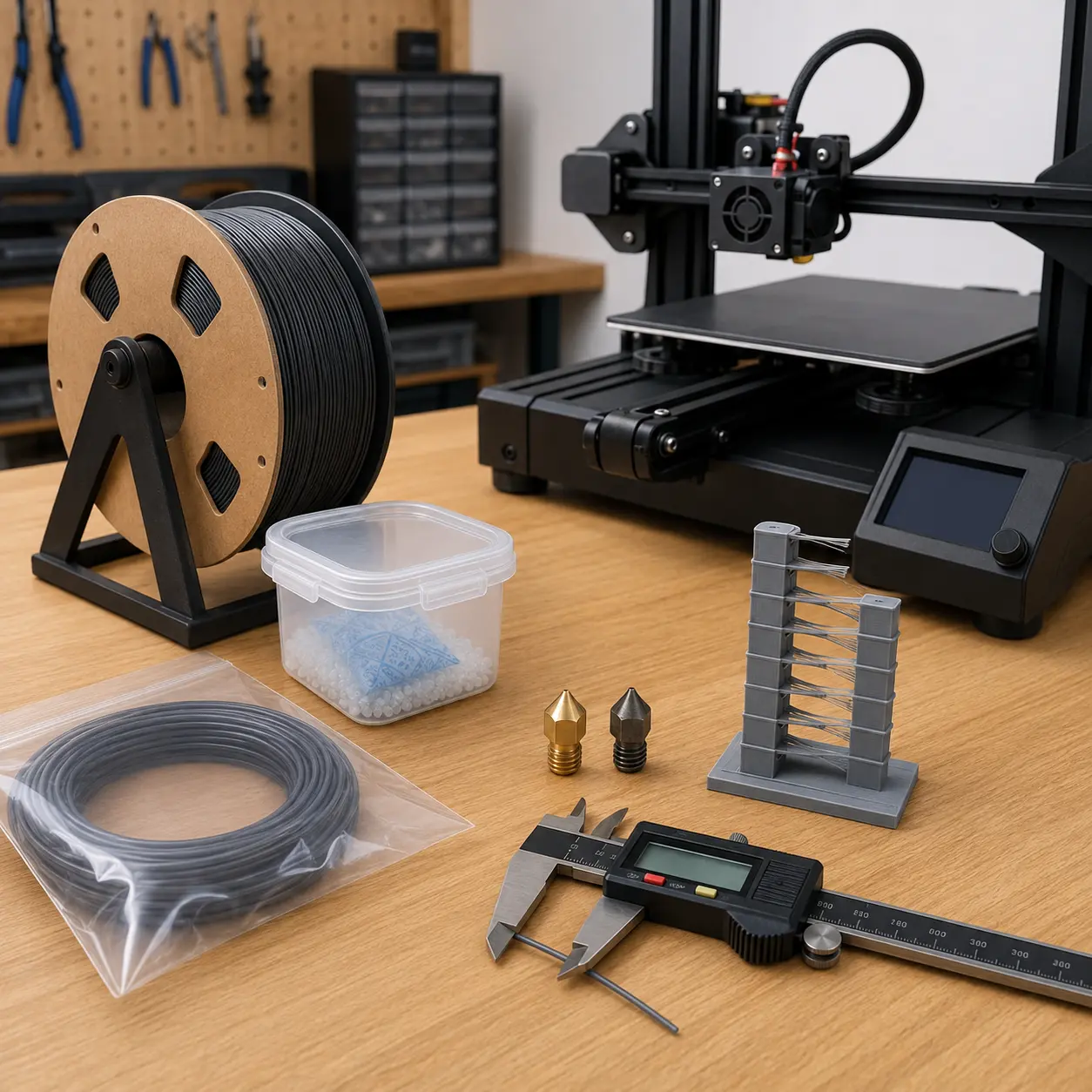
A spool can look suitable while using the wrong filament diameter.
Check the printer specification before ordering. Diameter cannot be corrected through slicer settings.
Assuming Every Printer Can Use Every Material
A printer may lack the nozzle temperature, heated bed, enclosure or compatible hotend required by a filament.
Check the complete material requirements rather than only whether the spool fits.
Choosing By Colour Alone
The most attractive colour may use a material that is unsuitable for the finished part.
Select the polymer first, then choose the colour and finish within that material range.
Assuming PLA Plus Is A Standard Material
PLA Plus is not one single formulation.
Properties and settings vary by manufacturer, so check the individual product rather than relying on the name.
Ignoring Moisture
A freshly opened spool is not guaranteed to remain dry after storage.
Moisture can cause poor surfaces, stringing and weak layers. Keep filament sealed and dry it only according to appropriate guidance.
Using Abrasive Filament With A Brass Nozzle
Filled and glow in the dark materials can wear brass nozzles.
Use a suitable wear resistant nozzle where recommended and inspect it periodically.
Using Too Small A Nozzle For Filled Filament
Particles in wood, metal and fibre filled products can block a narrow nozzle.
Check the manufacturer’s recommended minimum nozzle diameter.
Assuming A Stronger Material Produces A Stronger Part
Material properties are only part of the result.
Layer orientation, walls, infill, temperature and design can have a greater effect than changing filament alone.
Ignoring Heat Resistance
PLA models may look strong at room temperature but soften in a hot car, greenhouse or near equipment.
Choose material according to the expected operating temperature.
Assuming Outdoor Use Means Waterproof
Weather resistance, UV stability and watertightness are separate issues.
Printed layer lines may allow moisture through even when the polymer itself resists water.
Comparing Price By Spool Rather Than Weight
Spool sizes vary.
Compare the net amount of filament and consider density, printing reliability and waste as well as the headline price.
Forgetting Spool Holder Compatibility
Large spools may not fit inside an enclosure or automated material system.
Check spool dimensions as well as material and weight.
Copying Generic Temperature Settings
Temperatures vary by filament, printer, colour and speed.
Use the manufacturer’s starting range and calibrate for the actual machine.
Printing Engineering Materials Without Ventilation
Some materials can release fumes and fine particles.
Follow the material safety documentation, printer instructions and ventilation requirements.
Using Soluble Support Filament After Poor Storage
Moisture damaged soluble filament may print unreliably or become difficult to feed.
Store it in a properly sealed dry environment.
Assuming Composite Filament Is Solid Wood Or Metal
Filled filament remains a polymer composite.
It does not provide the same strength, heat performance or conductivity as a solid material.
Safety And Suitability Caveats
Use filament only with compatible equipment and follow the printer and filament manufacturer’s instructions.
The nozzle, heated bed and printed material can become hot enough to cause burns. Keep hands, loose clothing, children and pets away from moving and heated components.
Use appropriate ventilation. Fumes and ultrafine particles can vary by material, additives, temperature and printer environment. Materials such as ABS, ASA, nylon and polycarbonate may require additional control measures.
Read the product’s safety data where supplied. Do not print unknown materials at excessive temperatures.
Do not leave a printer operating without suitable supervision or fire precautions. Keep combustible materials away from hot components and inspect electrical connections regularly.
Wear suitable protection when sanding, cutting or drilling filled prints. Carbon fibre, glass fibre, resin dust and other particles should not be inhaled.
Food contact, medical, electrical, load bearing and safety critical parts require appropriate materials, testing and professional assessment. A successful print does not confirm that a part is safe for a regulated application.
Maintenance, Storage And Lifespan Considerations
Store filament in a sealed bag, box or dry storage system with suitable desiccant.
Label opened spools with material type and purchase or opening date. This is particularly useful when similar colours are stored together.
Keep the free end secured through the spool holes or with a clip. Allowing the end to pass beneath another loop can create a tangle during printing.
Do not pull tangled filament forcefully through the extruder. Resolve the overlap at the spool.
Dry filament only at a temperature approved for the material and spool. Excessive heat can deform the spool or damage the polymer.
Keep abrasive filament separate from standard nozzle setups where practical. Inspect the nozzle, extruder gears and filament path for wear or debris.
Filament lifespan depends on material, packaging, moisture exposure, heat, ultraviolet light and storage conditions. Properly stored material can remain useful significantly longer than filament left exposed in a humid workshop.
How To Compare Models Efficiently
- Confirm the filament diameter supported by the printer.
- Define the finished part’s purpose.
- Check the expected load, flexibility and temperature.
- Decide whether the part will be used outdoors.
- Compare suitable material families.
- Check required nozzle and bed temperatures.
- Confirm enclosure and ventilation requirements.
- Check whether a wear resistant nozzle is needed.
- Review recommended nozzle diameter.
- Check moisture sensitivity and storage needs.
- Compare spool dimensions with the holder or material system.
- Compare net filament weight.
- Review colour and finish options.
- Check manufacturer printing guidance.
- Print a temperature or calibration test where appropriate.
- Read the individual product page before buying.
Summary Buyer Decision Checklist
| Buying Check | Why It Matters |
|---|---|
| Material type | Determines the main printing and finished properties |
| Intended use | Helps select strength, flexibility and finish |
| Filament diameter | Must match the printer |
| Dimensional consistency | Supports reliable extrusion |
| Nozzle temperature | Must be within the hotend’s capabilities |
| Bed temperature | Influences adhesion and warping |
| Enclosure requirement | Helps control difficult materials |
| Ventilation guidance | Supports safer printing |
| Extruder compatibility | Matters for flexible filament |
| Nozzle material | Abrasive filament can wear brass |
| Nozzle diameter | Filled materials may need a larger opening |
| Heat resistance | Prevents parts softening in warm locations |
| UV resistance | Matters for outdoor use |
| Moisture sensitivity | Affects storage and print quality |
| Spool dimensions | Must fit the holder or material system |
| Net weight | Allows fairer value comparisons |
| Surface finish | Affects decorative appearance |
| Mechanical properties | Must suit the part’s load and movement |
| Manufacturer settings | Provide the correct starting point |
| Product page details | Confirm the exact filament specification |
Frequently Asked Questions
3D printer filament is a continuous strand of thermoplastic or composite material fed into a compatible printer, melted through a nozzle and deposited in layers to create an object.
PLA is commonly recommended for beginners because it generally prints at accessible temperatures with relatively low warping. Exact behaviour still varies by product and printer.
PLA is commonly easier to print and suits models and general prototypes. PETG is often tougher and more temperature resistant but can produce more stringing and may adhere strongly to the build surface.
The answer depends on the type of strength, formulation and printed part. ABS can provide greater impact and heat resistance, while PLA can be stiff and strong under certain loads. Print orientation and settings also matter.
ASA is commonly chosen for outdoor parts because of its ultraviolet and weather resistance. Selected PETG and other specialist filaments may also suit outdoor use where stated by the manufacturer.
TPU and related thermoplastic elastomer filaments are designed for flexible prints. Flexibility varies according to hardness and formulation.
Yes. The filament diameter must match the printer’s extruder and hotend. Common sizes include 1.75 mm and 2.85 mm.
No. Printers vary in diameter support, nozzle temperature, bed temperature, enclosure, extruder and nozzle material.
Many materials absorb moisture from the air. Moist filament can produce bubbles, rough surfaces, stringing, weak layers and inconsistent extrusion.
Keep filament sealed with suitable desiccant in a dry bag, box or filament storage system. Follow the manufacturer’s instructions for particularly moisture sensitive materials.
Many filaments can be dried using suitable equipment and the manufacturer’s recommended temperature and time. Excessive heat can damage the material or deform the spool.
They are normally abrasive and commonly require a hardened or wear resistant nozzle. Check the filament manufacturer’s recommendation.
Some wood filled filaments can print through standard nozzles, but a larger nozzle may be recommended to reduce clogging. The material can also be abrasive.
Soluble filament is used to print removable supports in compatible multi material systems. PVA and BVOH are common examples that can dissolve in water under appropriate conditions.
The base polymer alone does not determine whether a printed object is suitable for food contact. Additives, nozzle contamination, layer gaps, cleaning and certification must all be considered.
Some materials resist water, but layer lines can allow leaks. Waterproofing depends on material, design, print settings and any suitable post processing.
Stringing may be influenced by moisture, nozzle temperature, retraction, travel speed and material type. Drying and calibration may be required.
Check the material, diameter, temperature requirements, enclosure, ventilation, nozzle compatibility, moisture sensitivity, spool dimensions, weight and intended use. Always confirm compatibility with the individual printer.